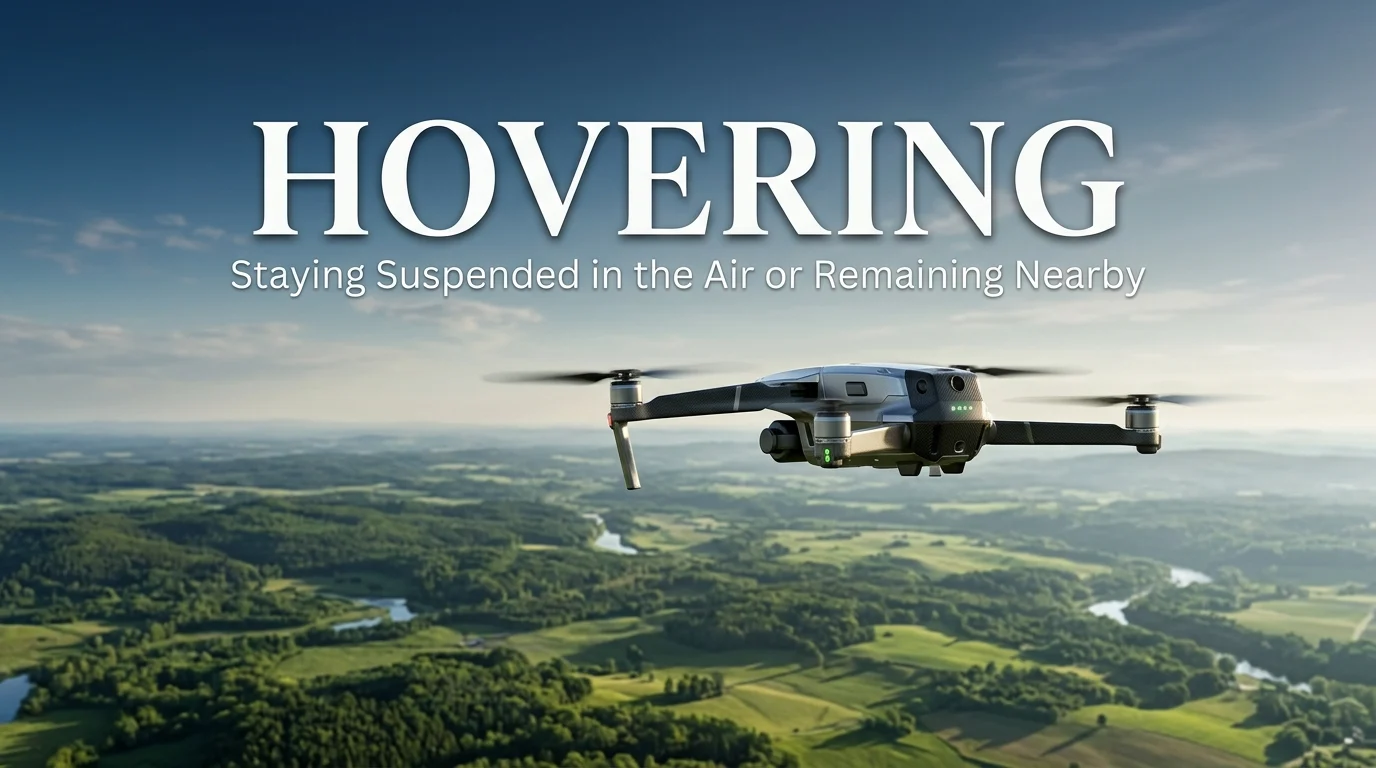
A synonym for hovering is a word or phrase that describes staying suspended in the air, remaining close to someone or something, or lingering nearby. Common alternatives include floating, hanging, lingering, circling, and loitering. The best choice depends on the situation and intended meaning.
Synonym for hovering becomes useful when you want to describe a bird staying in one place in the air or a person standing close by. The right word makes your meaning clearer.
Imagine a helicopter staying above a building. You could describe it as hovering, floating in place, or remaining suspended in the air.
Learning alternatives to hovering helps students improve essays, bloggers create varied content, and writers describe scenes more precisely. Everyday English users also benefit from choosing words that fit each situation.
The word appears in conversations about flight, technology, relationships, and movement. Understanding its different meanings helps you choose natural alternatives without changing your intended message.
What Does “Hovering” Really Mean?
Hovering means staying in one place in the air, remaining close to someone or something, or lingering nearby without moving away. Its exact meaning depends on the context.
For example, a drone can hover above a garden without landing. A worried parent may hover near a child to offer help or keep watch.
Part of Speech
Hovering can function as a verb form, an adjective, or a gerund.
- Verb form: The helicopter is hovering above the field.
- Adjective: She gave him a hovering presence that made him uncomfortable.
- Gerund: Hovering over someone can make them feel watched.
How Native English Speakers Understand It
Native speakers understand hovering through the situation. When describing aircraft or insects, it usually refers to remaining suspended in the air. When describing people, it often suggests staying unusually close or watching someone closely.
In computing, hovering refers to positioning a mouse pointer over an item on a screen without clicking it.
Connotative Meaning
(Connotation means the feeling or association a word creates beyond its basic dictionary meaning.)
- Positive tone: Hovering can suggest care, protection, or helpful attention when someone stays nearby to offer support.
- Negative tone: It can suggest interference, overprotection, or unwanted attention when someone refuses to give others space.
- Neutral tone: It can simply describe an object, aircraft, or insect remaining in the air.
The surrounding words and situation determine whether hovering sounds helpful, intrusive, or purely descriptive.
Etymology
The word hover comes from Middle English hoveren, recorded around the late fourteenth century. It developed from the older form hove, which could mean to remain suspended or linger near a place. Its deeper origin is uncertain.
A Short History of the Word
- Old English (450–1100): There is no firmly established Old English form of hover in the standard etymological accounts. Related meanings were expressed through other words for movement, suspension, and staying.
- Middle English (1100–1500): Hoveren developed as a verb describing wavering movement, lingering, and remaining near a place.
- Modern English (1500–present): The word expanded into figurative uses and later technical contexts. Today, it can describe aircraft, people, numerical values, and computer pointers. Etymology, Origin & Meaning+1
Pronunciation (US and UK – IPA)
- US: /ˈhʌv.ɚ/
- UK: /ˈhɒv.ə/
These are the common pronunciations of hover. The ending -ing produces hovering, pronounced approximately “HUV-er-ing” in American English and “HOV-er-ing” in British English.
Syllables
Hovering: hov-er-ing (3 syllables)
Affixation Pattern of Hovering
- Root: hover
- Prefix: None
- Suffix: -ing, used to form a present participle or gerund
The base verb hover describes the action. Adding -ing creates hovering, which can describe an ongoing action or function as a noun-like form.
Synonyms List :
The best synonym depends on whether you mean remaining in the air, staying nearby, moving around a place, or keeping close watch. These alternatives cover the most useful meanings without treating every word as interchangeable.
1. Floating (Verb) — US /ˈfloʊ.tɪŋ/ | UK /ˈfləʊ.tɪŋ/
Meaning: Floating means remaining on or moving gently through a fluid or air without being firmly supported.
Tone/Register: Neutral; everyday and descriptive.
Examples:
The balloon was floating above the playground.
A few clouds were floating across the morning sky.
2. Suspended (Verb/Adjective) — US /səˈspen.dɪd/ | UK /səˈspen.dɪd/
Meaning: Suspended describes something held in the air or kept from falling.
Tone/Register: Neutral to formal; technical and descriptive.
Examples:
The drone remained suspended above the roof.
A light fixture was suspended from the high ceiling.
3. Lingering (Verb) — US /ˈlɪŋ.ɡɚ.ɪŋ/ | UK /ˈlɪŋ.ɡər.ɪŋ/
Meaning: Lingering means staying somewhere longer than expected or continuing to remain.
Tone/Register: Neutral; conversational and literary.
Examples:
She was lingering near the entrance after the meeting.
The smell of coffee was lingering in the kitchen.
4. Circling (Verb) — US /ˈsɝː.kəl.ɪŋ/ | UK /ˈsɜː.kəl.ɪŋ/
Meaning: Circling means moving around a person, object, or location repeatedly.
Tone/Register: Neutral; common in everyday and descriptive writing.
Examples:
A hawk was circling above the open field.
The rescue helicopter was circling the coastline.
5. Hanging (Verb) — US /ˈhæŋ.ɪŋ/ | UK /ˈhæŋ.ɪŋ/
Meaning: Hanging means remaining suspended from a point or staying in a position without moving much.
Tone/Register: Neutral; informal and everyday.
Examples:
A lantern was hanging above the garden table.
Mist was hanging over the lake at sunrise.
6. Gliding (Verb) — US /ˈɡlaɪ.dɪŋ/ | UK /ˈɡlaɪ.dɪŋ/
Meaning: Gliding means moving smoothly and quietly through the air or across a surface.
Tone/Register: Neutral to elegant; descriptive and literary.
Examples:
The eagle was gliding over the valley.
A paper plane was gliding toward the open window.
7. Hovering Nearby (Verb Phrase) — US /ˈhʌv.ɚ.ɪŋ ˌnɪrˈbaɪ/ | UK /ˈhɒv.ər.ɪŋ ˌnɪəˈbaɪ/
Meaning: Hovering nearby means staying close to a person or place without necessarily approaching directly.
Tone/Register: Neutral; conversational.
Examples:
The waiter was hovering nearby in case we needed anything.
A nervous student was hovering nearby before asking a question.
8. Loitering (Verb) — US /ˈlɔɪ.t̬ɚ.ɪŋ/ | UK /ˈlɔɪ.tər.ɪŋ/
Meaning: Loitering means staying in a place without an obvious purpose or moving on.
Tone/Register: Often negative; everyday, legal, or formal contexts.
Examples:
A few teenagers were loitering outside the closed shop.
Security asked the visitors to stop loitering near the entrance.
9. Circling Around (Verb Phrase) — US /ˈsɝː.kəl.ɪŋ əˈraʊnd/ | UK /ˈsɜː.kəl.ɪŋ əˈraʊnd/
Meaning: Circling means repeatedly moving around a person or place instead of moving directly away.
Tone/Register: Neutral; descriptive.
Examples:
The small aircraft was circling the airport.
A curious dog was circling the picnic blanket.
10. Floating in Place (Verb Phrase) — US /ˈfloʊ.tɪŋ ɪn ˈpleɪs/ | UK /ˈfləʊ.tɪŋ ɪn ˈpleɪs/
Meaning: Floating in place means remaining almost stationary while unsupported by a solid surface.
Tone/Register: Neutral; descriptive and accessible.
Examples:
The balloon was floating in place near the ceiling.
The astronaut appeared to be floating in place inside the spacecraft.
11. Wafting (Verb) — US /ˈwɑːf.tɪŋ/ | UK /ˈwɒf.tɪŋ/
Meaning: Wafting means moving gently through the air, usually referring to smells, smoke, or light materials.
Tone/Register: Descriptive; often gentle or literary.
Examples:
The scent of jasmine was wafting through the window.
Thin smoke was wafting above the campfire.
12. Drifting (Verb) — US /ˈdrɪf.tɪŋ/ | UK /ˈdrɪf.tɪŋ/
Meaning: Drifting means moving slowly without a clear direction, often because of wind or water.
Tone/Register: Neutral; conversational and descriptive.
Examples:
A cloud was drifting above the hills.
The small boat was drifting toward the shore.
13. Soaring (Verb) — US /ˈsɔːr.ɪŋ/ | UK /ˈsɔː.rɪŋ/
Meaning: Soaring means flying or rising high through the air, usually with smooth or expansive movement.
Tone/Register: Positive or dramatic; literary and descriptive.
Examples:
A golden eagle was soaring above the mountains.
The kite was soaring high over the beach.
14. Wheeling (Verb) — US /ˈwiː.lɪŋ/ | UK /ˈwiː.lɪŋ/
Meaning: Wheeling means turning or sweeping around through the air in a broad circular movement.
Tone/Register: Literary or descriptive.
Examples:
Seagulls were wheeling above the fishing boats.
A flock of starlings was wheeling across the evening sky.
15. Buzzing (Verb) — US /ˈbʌz.ɪŋ/ | UK /ˈbʌz.ɪŋ/
Meaning: Buzzing means flying around with a humming sound, particularly when describing insects.
Tone/Register: Informal; vivid and descriptive.
Examples:
A mosquito was buzzing around my head.
Bees were buzzing above the flowers in the garden.
16. Flitting (Verb) — US /ˈflɪt̬.ɪŋ/ | UK /ˈflɪt.ɪŋ/
Meaning: Flitting means moving quickly and lightly from one place to another.
Tone/Register: Descriptive; literary and sometimes playful.
Examples:
A butterfly was flitting between the garden flowers.
Small birds were flitting among the branches.
17. Orbiting (Verb) — US /ˈɔːr.bɪ.t̬ɪŋ/ | UK /ˈɔː.bɪ.tɪŋ/
Meaning: Orbiting means travelling around a planet, star, or other object along a curved path.
Tone/Register: Scientific and technical.
Examples:
The satellite was orbiting Earth during the observation.
Scientists tracked the spacecraft orbiting the distant planet.
18. Loafing (Verb) — US /ˈloʊ.fɪŋ/ | UK /ˈləʊ.fɪŋ/
Meaning: Loafing means spending time idly without doing much useful work.
Tone/Register: Informal; mildly negative or playful.
Examples:
He was loafing around the office instead of finishing his task.
The teenagers were loafing near the basketball court.
19. Lingering Around (Verb Phrase) — US /ˈlɪŋ.ɡɚ.ɪŋ əˈraʊnd/ | UK /ˈlɪŋ.ɡər.ɪŋ əˈraʊnd/
Meaning: Lingering around means remaining in a place without leaving promptly.
Tone/Register: Conversational; neutral or mildly negative.
Examples:
Several guests were lingering around after the event.
A reporter was lingering around the courthouse entrance.
20. Pacing (Verb) — US /ˈpeɪ.sɪŋ/ | UK /ˈpeɪ.sɪŋ/
Meaning: Pacing means walking back and forth repeatedly, often because of worry or impatience.
Tone/Register: Neutral; often suggests nervousness.
Examples:
He was pacing outside the interview room.
She kept pacing across the hallway while waiting for the call.
21. Waiting Nearby (Verb Phrase) — US /ˈweɪ.tɪŋ ˌnɪrˈbaɪ/ | UK /ˈweɪ.tɪŋ ˌnɪəˈbaɪ/
Meaning: Waiting nearby means remaining close to a place or person until something happens.
Tone/Register: Neutral; everyday and polite.
Examples:
The driver was waiting nearby when the conference ended.
I waited nearby while my sister finished her appointment.
22. Standing By (Phrasal Verb) — US /ˌstæn.dɪŋ ˈbaɪ/ | UK /ˌstæn.dɪŋ ˈbaɪ/
Meaning: Standing by means remaining ready to help, respond, or act when needed.
Tone/Register: Neutral to professional; common in workplace and emergency contexts.
Examples:
The technician was standing by in case the system failed.
Our support team is standing by to answer questions.
23. Watching Over (Phrasal Verb) — US /ˌwɑː.tʃɪŋ ˈoʊ.vɚ/ | UK /ˌwɒtʃ.ɪŋ ˈəʊ.və/
Meaning: Watching over means keeping someone or something under protective observation.
Tone/Register: Caring, protective, or formal.
Examples:
Her grandmother was watching over the sleeping baby.
A lifeguard was watching over the children near the pool.
24. Shadowing (Verb) — US /ˈʃæd.oʊ.ɪŋ/ | UK /ˈʃæd.əʊ.ɪŋ/
Meaning: Shadowing means following someone closely, often to observe their actions or learn from them.
Tone/Register: Professional, neutral, or potentially negative.
Examples:
The new employee was shadowing an experienced nurse.
She felt uncomfortable when a stranger kept shadowing her through the store.
25. Crowding (Verb) — US /ˈkraʊ.dɪŋ/ | UK /ˈkraʊ.dɪŋ/
Meaning: Crowding means gathering too closely around a person or occupying their space.
Tone/Register: Neutral to negative; everyday and descriptive.
Examples:
Fans were crowding around the singer after the show.
Please stop crowding the doorway and leave room for others.
26. Poising (Verb) — US /ˈpɔɪ.zɪŋ/ | UK /ˈpɔɪ.zɪŋ/
Meaning: Poising means holding something balanced and ready to move, often just above a surface or in a particular position.
Tone/Register: Descriptive; literary and formal.
Examples:
The hawk was poised above the grass before diving.
She stood poised at the starting line, ready to run.
27. Fluttering (Verb) — US /ˈflʌt̬.ɚ.ɪŋ/ | UK /ˈflʌt.ər.ɪŋ/
Meaning: Fluttering means moving with quick, light movements of wings or other flexible parts.
Tone/Register: Descriptive; everyday and literary.
Examples:
A moth was fluttering near the porch light.
The tiny bird was fluttering above the garden fence.
28. Flapping (Verb) — US /ˈflæp.ɪŋ/ | UK /ˈflæp.ɪŋ/
Meaning: Flapping means moving wings or similar parts up and down repeatedly.
Tone/Register: Neutral; everyday and descriptive.
Examples:
The pigeon was flapping its wings near the rooftop.
A butterfly was flapping rapidly beside the open window.
29. Swooping (Verb) — US /ˈswuː.pɪŋ/ | UK /ˈswuː.pɪŋ/
Meaning: Swooping means moving quickly downward or across an area, usually through the air.
Tone/Register: Vivid; descriptive and dramatic.
Examples:
The falcon was swooping toward its prey.
A seagull swooped over the picnic area to grab a piece of bread.
30. Skimming (Verb) — US /ˈskɪm.ɪŋ/ | UK /ˈskɪm.ɪŋ/
Meaning: Skimming means moving lightly over or just above a surface.
Tone/Register: Neutral; descriptive and technical.
Examples:
The helicopter was skimming low over the coastline.
A stone came skimming across the surface of the lake.
31. Sailing (Verb) — US /ˈseɪ.lɪŋ/ | UK /ˈseɪ.lɪŋ/
Meaning: Sailing means moving smoothly through the air or across a surface with little apparent effort.
Tone/Register: Descriptive; neutral to positive.
Examples:
A kite was sailing above the rooftops.
The paper plane came sailing through the classroom.
32. Hovering Overhead (Verb Phrase) — US /ˈhʌv.ɚ.ɪŋ ˌoʊ.vɚˈhɛd/ | UK /ˈhɒv.ər.ɪŋ ˌəʊ.vəˈhed/
Meaning: Hovering overhead means remaining in the air directly above a person, object, or location.
Tone/Register: Neutral; descriptive.
Examples:
A news helicopter was hovering overhead during the parade.
Dark clouds were hovering overhead as the storm approached.
33. Station-Keeping (Noun/Verb Form) — US /ˈsteɪ.ʃən ˌkiː.pɪŋ/ | UK /ˈsteɪ.ʃən ˌkiː.pɪŋ/
Meaning: Station-keeping refers to maintaining a particular position, especially in space or during coordinated movement.
Tone/Register: Technical; scientific and professional.
Examples:
The satellite used station-keeping to maintain its assigned position.
The spacecraft performed station-keeping during the orbital mission.
34. Remaining Aloft (Verb Phrase) — US /rɪˈmeɪ.nɪŋ əˈlɔːft/ | UK /rɪˈmeɪ.nɪŋ əˈlɒft/
Meaning: Remaining aloft means continuing to stay in the air without landing.
Tone/Register: Formal; aviation and descriptive writing.
Examples:
The aircraft remained aloft while the crew assessed the weather.
The glider was capable of remaining aloft for several hours.
35. Maintaining Altitude (Verb Phrase) — US /meɪnˈteɪ.nɪŋ ˈæl.tə.tuːd/ | UK /meɪnˈteɪ.nɪŋ ˈæl.tɪ.tjuːd/
Meaning: Maintaining altitude means keeping an aircraft or airborne object at a consistent height.
Tone/Register: Technical; aviation and scientific contexts.
Examples:
The pilot was maintaining altitude above the mountain range.
The drone maintained altitude while recording the landscape.
36. Hanging in Midair (Verb Phrase) — US /ˈhæŋ.ɪŋ ɪn ˌmɪdˈer/ | UK /ˈhæŋ.ɪŋ ɪn ˌmɪdˈeə/
Meaning: Hanging in midair means appearing to remain suspended between the ground and a higher point.
Tone/Register: Descriptive; conversational and literary.
Examples:
The balloon looked as though it were hanging in midair.
A stunt performer appeared to be hanging in midair above the stage.
37. Remaining Stationary (Verb Phrase) — US /rɪˈmeɪ.nɪŋ ˈsteɪ.ʃəˌner.i/ | UK /rɪˈmeɪ.nɪŋ ˈsteɪ.ʃən.ər.i/
Meaning: Remaining stationary means staying in one position without moving from that spot.
Tone/Register: Formal; technical and neutral.
Examples:
The drone remained stationary above the inspection site.
The vehicle stayed stationary while the team checked the equipment.
38. Poised in the Air (Adjective Phrase) — US /pɔɪzd ɪn ði ˈer/ | UK /pɔɪzd ɪn ði ˈeə/
Meaning: Poised in the air describes something balanced or positioned as if ready to move while airborne.
Tone/Register: Literary; vivid and descriptive.
Examples:
The hummingbird appeared poised in the air beside the flower.
The acrobat looked poised in the air before reaching for the bar.
39. Fluttering About (Verb Phrase) — US /ˈflʌt̬.ɚ.ɪŋ əˈbaʊt/ | UK /ˈflʌt.ər.ɪŋ əˈbaʊt/
Meaning: Fluttering about means moving lightly and irregularly from one nearby spot to another.
Tone/Register: Informal; playful and descriptive.
Examples:
Small butterflies were fluttering about the flower beds.
A moth was fluttering about the room after sunset.
40. Milling Around (Verb Phrase) — US /ˈmɪl.ɪŋ əˈraʊnd/ | UK /ˈmɪl.ɪŋ əˈraʊnd/
Meaning: Milling around means moving about a place in a group without a clear direction or organized activity.
Tone/Register: Neutral to informal; everyday and descriptive.
Examples:
Guests were milling around the lobby before the ceremony.
Students were milling around the courtyard after class.
41. Hanging Back (Phrasal Verb) — US /ˌhæŋ.ɪŋ ˈbæk/ | UK /ˌhæŋ.ɪŋ ˈbæk/
Meaning: Hanging back means staying behind or keeping some distance instead of joining others immediately.
Tone/Register: Informal; conversational.
Examples:
He was hanging back near the doorway, unsure whether to join the group.
She hung back while her friends entered the crowded room.
42. Trailing (Verb) — US /ˈtreɪ.lɪŋ/ | UK /ˈtreɪ.lɪŋ/
Meaning: Trailing means following behind someone or something at a short distance.
Tone/Register: Neutral; everyday and descriptive.
Examples:
The little boy was trailing behind his older sister.
A second car was trailing the lead vehicle along the road.
43. Tailgating (Verb) — US /ˈteɪlˌɡeɪ.tɪŋ/ | UK /ˈteɪlˌɡeɪ.tɪŋ/
Meaning: Tailgating means following a vehicle too closely or staying very close behind someone in a queue.
Tone/Register: Informal; often negative.
Examples:
The driver was tailgating the car in front of him.
Please stop tailgating other customers while they wait in line.
44. Keeping Close (Verb Phrase) — US /ˈkiː.pɪŋ ˈkloʊs/ | UK /ˈkiː.pɪŋ ˈkləʊs/
Meaning: Keeping close means remaining near a person or object, often for safety, support, or attention.
Tone/Register: Neutral; conversational.
Examples:
The guide told everyone to keep close during the night hike.
The puppy kept close to its owner in the unfamiliar park.
45. Clustering (Verb) — US /ˈklʌs.tɚ.ɪŋ/ | UK /ˈklʌs.tər.ɪŋ/
Meaning: Clustering means gathering closely together around a point or within a small area.
Tone/Register: Neutral; academic, technical, and everyday.
Examples:
Visitors were clustering around the information desk.
Several birds were clustering on the power line above the road.
46. Gathering Around (Verb Phrase) — US /ˈɡæð.ɚ.ɪŋ əˈraʊnd/ | UK /ˈɡæð.ər.ɪŋ əˈraʊnd/
Meaning: Gathering around means coming together near a person, object, or event.
Tone/Register: Neutral; everyday and conversational.
Examples:
Children were gathering around the magician in the park.
Reporters began gathering around the speaker after the announcement.
47. Surrounding (Verb) — US /səˈraʊn.dɪŋ/ | UK /səˈraʊn.dɪŋ/
Meaning: Surrounding means being positioned around someone or something on several sides.
Tone/Register: Neutral; descriptive and formal.
Examples:
Tall trees were surrounding the small cabin.
Security staff were surrounding the entrance during the event.
48. Enveloping (Verb) — US /ɪnˈvel.ə.pɪŋ/ | UK /ɪnˈvel.ə.pɪŋ/
Meaning: Enveloping means covering or surrounding something completely, often with mist, darkness, or another surrounding presence.
Tone/Register: Literary; descriptive and sometimes dramatic.
Examples:
Thick fog was enveloping the hillside at dawn.
Silence was enveloping the room after the final announcement.
49. Looming (Verb) — US /ˈluː.mɪŋ/ | UK /ˈluː.mɪŋ/
Meaning: Looming means appearing large, close, or threatening, often in a way that creates unease.
Tone/Register: Often negative; descriptive and dramatic.
Examples:
A large aircraft was looming above the runway as it approached.
The dark building was looming over the narrow street.
50. Bearing Down (Phrasal Verb) — US /ˌber.ɪŋ ˈdaʊn/ | UK /ˌbeə.rɪŋ ˈdaʊn/
Meaning: Bearing down means moving toward someone or something with force, pressure, or determination.
Tone/Register: Dramatic; often conveys urgency or threat.
Examples:
The storm was bearing down on the coastal town.
The cyclist was bearing down on the final turn at full speed.
51. Hovering in Suspense (Verb Phrase) — US /ˈhʌv.ɚ.ɪŋ ɪn səˈspens/ | UK /ˈhɒv.ər.ɪŋ ɪn səˈspens/
Meaning: Hovering in suspense describes remaining in an uncertain or tense state while waiting for an outcome.
Tone/Register: Literary; dramatic.
Examples:
The final decision was hovering in suspense until the judges returned.
A feeling of uncertainty hovered over the team before the results arrived.
52. Lurking (Verb) — US /ˈlɝː.kɪŋ/ | UK /ˈlɜː.kɪŋ/
Meaning: Lurking means staying hidden or partly concealed, often while waiting or watching in a suspicious way.
Tone/Register: Negative; informal and literary.
Examples:
A stranger was lurking near the closed warehouse.
The threat of another delay was lurking in the background.
53. Peering (Verb) — US /ˈpɪr.ɪŋ/ | UK /ˈpɪə.rɪŋ/
Meaning: Peering means looking closely or with difficulty at something, often from a short distance.
Tone/Register: Neutral; descriptive.
Examples:
She was peering through the window to see who had arrived.
The child was peering over the fence at the puppies.
54. Looming Nearby (Verb Phrase) — US /ˈluː.mɪŋ ˌnɪrˈbaɪ/ | UK /ˈluː.mɪŋ ˌnɪəˈbaɪ/
Meaning: Looming nearby describes something appearing close and imposing, often creating a sense of pressure or unease.
Tone/Register: Negative or dramatic; descriptive writing.
Examples:
The enormous ship was looming nearby through the morning fog.
A difficult deadline was looming nearby as the team reviewed its unfinished work.
55. Keeping Watch (Verb Phrase) — US /ˌkiː.pɪŋ ˈwɑːtʃ/ | UK /ˌkiː.pɪŋ ˈwɒtʃ/
Meaning: Keeping watch means observing a person, place, or situation carefully to notice danger or important changes.
Tone/Register: Neutral to formal; security and everyday contexts.
Examples:
A guard was keeping watch outside the museum overnight.
The volunteers took turns keeping watch over the campsite.
Note: These alternatives cover several meanings associated with hovering, including staying airborne, remaining nearby, following closely, and watching. Some are context-specific rather than direct replacements, so choose the word that preserves your intended meaning.
Synonyms for Hovering by Tone
The emotional tone of a synonym can change how readers understand a sentence. Choose a word that matches both the action and the feeling you want to communicate.
Positive Synonyms
- Gliding: Suggests smooth, graceful movement.
- Soaring: Creates a sense of freedom, height, or grandeur.
- Watching over: Communicates care and protection.
- Standing by: Suggests readiness and support.
- Floating: Often creates a calm, peaceful image.
Neutral Synonyms
- Suspended: Focuses on something held in the air.
- Circling: Describes repeated movement around an area.
- Drifting: Suggests slow movement without a fixed direction.
- Hanging: Describes a position maintained in the air.
- Waiting nearby: Emphasizes location and patience.
- Orbiting: Describes movement along a curved path around an object.
Negative Synonyms
- Loitering: Can imply that someone has no clear reason to remain.
- Crowding: Suggests a lack of personal space.
- Shadowing: May suggest unwanted following.
- Pacing: Can imply nervousness or impatience.
- Lingering around: May suggest reluctance to leave.
Playful or Informal Synonyms
- Buzzing: Creates a lively image, especially for insects.
- Flitting: Suggests quick, light movement.
- Loafing: Describes idle or lazy behavior.
- Hanging around: An informal expression for staying somewhere without a specific purpose.
- Floating in place: An easy-to-understand description of remaining almost stationary.
Why Tone Matters in Word Choice
Consider two sentences: “The nurse was watching over the patient” and “The nurse was crowding the patient.”
Both describe someone close to another person, but they communicate different attitudes. One suggests care, while the other suggests discomfort.
“Hovering” vs. Close Alternatives
These three alternatives are particularly useful when describing movement through the air.
| Word | Main difference | Best use |
|---|---|---|
| Hovering | Staying in one place in the air or remaining close by | Drones, helicopters, people, and computer pointers |
| Floating | Remaining buoyant or moving gently without firm support | Balloons, clouds, and objects on water |
| Circling | Moving repeatedly around a point or area | Birds, aircraft, and people moving around a location |
| Lingering | Staying longer than expected | People, smells, sounds, and memories |
Quick tip: Use hovering when stillness or close presence matters. Choose floating for gentle buoyancy, circling for repeated movement, and lingering for an extended stay.
How “Hovering” Changes by Context
Daily Conversation
In everyday speech, hovering often describes a person who stays too close or waits nearby. It can also describe an insect or object that remains in the air.
For example, “My brother kept hovering while I cooked” suggests that he stayed nearby, perhaps watching or trying to help.
Writing and Blogging
Writers use hovering to create a clear visual image. However, repeating the same word can make descriptions feel limited.
A travel blogger might choose soaring for an eagle, drifting for clouds, or circling for birds around a cliff. Each word adds a different movement to the scene.
Professional and Academic Writing
In professional writing, hovering can describe aircraft, sensors, or values that remain near a particular level.
For example, “The temperature remained near freezing” may sound clearer than “The temperature hovered near freezing” in a technical report where direct wording is preferred.
The verb also appears in digital design. A mouse pointer can hover over a link without activating it.
Creative and Informal Use
In fiction, hovering can create suspense or communicate emotion. A character hovering outside a closed door may feel anxious, hesitant, or afraid.
Words such as lingering, shadowing, and pacing help authors make the character’s behavior more specific. Choose the one that best describes what the character actually does.
Common Mistakes Learners Make
1. Treating Every Synonym as Interchangeable
A bird can hover above a tree, but loiter usually sounds unnatural for this situation. Loitering normally describes a person remaining somewhere without a clear purpose.
2. Confusing Floating With Hovering
Floating can describe movement on water or gentle movement in the air. Hovering usually emphasizes remaining at a particular position or close to something.
A leaf floating on a pond is natural English. A helicopter hovering above a field is also natural, but the two verbs describe different physical situations.
3. Using “Shadowing” When You Mean “Watching Over”
Shadowing emphasizes following someone closely. Watching over emphasizes protection or supervision.
A trainee can shadow a doctor to learn professional skills. A parent watches over a young child to keep them safe.
4. Using “Loitering” in a Positive Situation
Loitering often carries a negative implication. It may suggest that a person is staying somewhere without permission or purpose.
If you mean that a friend is waiting for you, waiting nearby is usually more appropriate.
5. Using “Hovering” Too Often
Repeated use can make writing monotonous. Replace it with a precise alternative when the context supports one.
Do not change the word simply to avoid repetition if the alternative alters the meaning. Accuracy matters more than variety.
Register Notes: Formal vs. Informal English
- Formal: Suspended, orbiting, and remaining stationary suit technical or scientific descriptions.
- Neutral: Floating, circling, lingering, and waiting nearby work in most general contexts.
- Informal: Hanging around and loafing suit casual conversation.
- Potentially negative: Loitering, crowding, and shadowing can suggest unwanted behavior.
For additional vocabulary practice, you can also explore related synonym guides on words describing movement, waiting, and close observation.
Real-Life Mini Scenarios
Workplace
A delivery drone remains above a garden while its navigation system checks the landing area. Here, hovering or remaining suspended describes its position accurately.
Social situations
Someone waits outside an office, unsure whether to knock. Lingering near the door conveys hesitation more clearly than a general description of hovering.
Media and nature
A wildlife documentary shows an eagle moving in wide circles above a valley. Circling or wheeling captures its motion more precisely than hovering if it keeps moving.
Writing and storytelling
A character stays outside a house after everyone else has left. Lingering builds suspense, while loitering may make the character seem suspicious.
Conclusion
Learning a synonym for hovering helps you describe movement, location, and human behavior more precisely. Each alternative adds a different shade of meaning to your English.
Whether you are writing an essay, creating a blog post, or chatting with friends, choosing accurate words makes your message clearer and more engaging.
Strong vocabulary grows through practice. Try using floating, lingering, and circling in sentences that describe real situations you encounter every day.
Start practicing today by writing three original sentences with different synonyms for hovering. Use them in an email, an essay, or a daily conversation to build confidence naturally.
Interactive Practice Quiz:
Choose the word or phrase that best fits each situation. The questions test meaning, tone, and everyday usage.
1. A helicopter stays almost motionless above a building. Which word fits best?
A. Loitering
B. Hovering
C. Pacing
2. A leaf moves gently across a pond. Which word is most suitable?
A. Floating
B. Shadowing
C. Crowding
3. An eagle moves repeatedly around a mountain peak. Which word fits?
A. Suspended
B. Circling
C. Loafing
4. A person stays outside a shop without a clear purpose. Which word may sound negative?
A. Soaring
B. Gliding
C. Loitering
5. A trainee follows an experienced nurse to learn the job. Which word fits?
A. Shadowing
B. Wafting
C. Orbiting
6. A parent stays close to protect a young child. Which phrase is most appropriate?
A. Loafing around
B. Watching over
C. Circling around
7. The scent of fresh bread moves gently through a room. Which verb fits?
A. Crowding
B. Pacing
C. Wafting
8. A spacecraft travels around a planet. Which word is most accurate?
A. Orbiting
B. Lingering
C. Hanging
9. Someone walks back and forth nervously before an interview. Which word fits?
A. Floating
B. Pacing
C. Soaring
10. A bird moves smoothly through the sky with little effort. Which word fits?
A. Gliding
B. Loitering
C. Crowding
11. A support team remains ready to help if a problem occurs. Which phrase fits?
A. Standing by
B. Flitting away
C. Hanging around
12. A person stays too close and blocks someone else’s personal space. Which word is most suitable?
A. Soaring
B. Crowding
C. Drifting
Quiz answer key: 1-B, 2-A, 3-B, 4-C, 5-A, 6-B, 7-C, 8-A, 9-B, 10-A, 11-A, 12-B
Reflection Task
Write one original sentence using lingering, floating, or watching over. Describe a real situation and explain why your chosen word fits better than hovering.
FAQs
1. What is the closest synonym for hovering in academic writing?
Suspended is often a close alternative when describing an object held in the air. For example, a scientific report might describe a device as suspended above a surface. However, hovering may be more accurate for an aircraft or drone that actively maintains its position. Always choose the word that matches the physical process.
2. What is another word for hovering over someone?
Lingering nearby, standing close, and shadowing may fit, depending on the situation. Lingering nearby emphasizes staying in the area. Standing close describes physical distance. Shadowing suggests following someone closely, sometimes to observe their actions. If the person is offering protection, watching over is usually more appropriate.
3. What does hovering mean in computer terminology?
In computing, hovering means placing a mouse pointer over an item on a screen without clicking it. A website may display a tooltip, change a button’s color, or reveal additional information when a user hovers over an element. The word describes pointer position, not necessarily a physical object suspended in the air.
4. Can hovering describe emotions or uncertainty?
Yes. Hovering can be used figuratively to describe a feeling, expression, or thought that seems to remain present without fully developing. For example, a smile may hover on someone’s lips, or doubt may hover in the background. In these expressions, the word creates an image of something lingering rather than describing literal flight.
5. What is the difference between hovering and hanging around?
Hovering often suggests staying close to a person or remaining in one place in the air. Hanging around is an informal expression for spending time in a place without a specific activity or reason. A drone can hover above a field, while friends might hang around a café after lunch.
6. Is hovering a positive or negative word?
Hovering is generally neutral when it describes aircraft, insects, or objects in the air. When applied to people, it can sound positive if someone is nearby to help or protect another person. It may sound negative when someone watches too closely or interferes with another person’s independence. The surrounding context determines the tone.
7. How can I avoid repeating hovering in an essay?
Identify the exact action before replacing the word. Use floating for gentle buoyancy, circling for movement around an area, lingering for staying longer than expected, and suspended for something held in the air. Avoid changing every occurrence automatically; repeating a precise word can be better than using an inaccurate synonym.
External Source
For reliable definitions, pronunciation, and examples of hover, consult the Cambridge Dictionary.
Cambridge Dictionary: Hover — Meaning, Pronunciation, and Examples

I’m Hezel, a passionate English language enthusiast and the creator of Synworda.com. I love exploring synonyms, vocabulary, grammar, and the many ways words can make communication clearer and more effective. Through Synworda.com, I create simple, practical, and easy-to-understand content for students, writers, professionals, and anyone who wants to improve their English. I enjoy breaking down confusing words and grammar concepts into helpful explanations with clear examples. I aim to make learning English feel less complicated and more enjoyable. I believe that understanding the right words can help everyone communicate with confidence in everyday life.