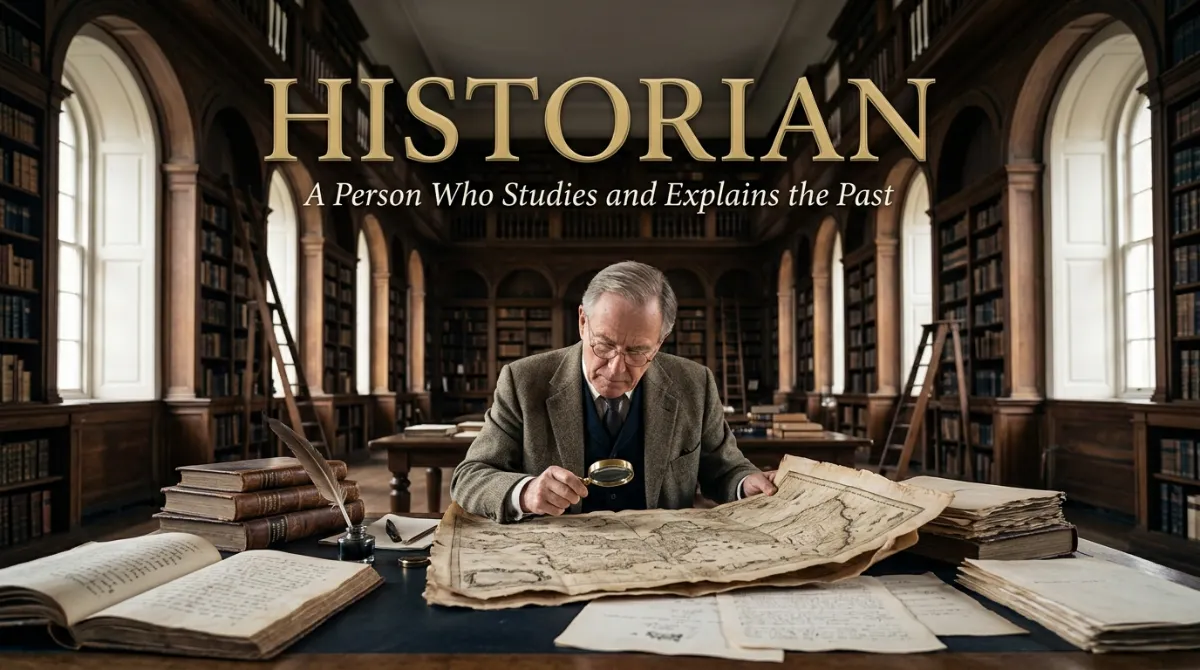
A synonym for historian is a word or phrase that describes someone who studies, researches, interprets, or writes about the past. Common alternatives include historical researcher, history scholar, chronicler, and history writer. The best choice depends on the person’s role, expertise, and the context in which the word appears.
Imagine reading an article about an ancient civilization. One writer studies old documents, another investigates archaeological records, and a third explains how historical events shaped modern society. Although their work overlaps, different words can describe their roles more precisely.
Learning synonyms for historian helps you explain historical work without repeating the same word. Students can improve essays, bloggers can create engaging articles, and content writers can make educational material more precise.
The word historian appears in books, documentaries, classrooms, news articles, and academic discussions. Understanding its alternatives helps everyday English users discuss the past with greater confidence.
Whether you are writing a school assignment or creating a history blog, the right synonym makes your message clearer. It also helps you distinguish between someone who researches history and someone who simply tells stories about past events.
What Does “Historian” Really Mean?
A historian is a person who studies, researches, analyzes, or writes about past events. Historians examine evidence such as letters, official records, diaries, photographs, and historical documents to understand what happened and why it mattered.
Part of speech: Noun
Simple definition: A person who studies and explains history using evidence and research.
Historians may specialize in different periods, places, or subjects. Some study ancient civilizations, while others research modern wars, political movements, social changes, or family histories.
Native English speakers generally understand a historian as a person who studies the past seriously, often through research and evidence. The word does not automatically mean that someone is a university professor or holds a particular academic qualification.
For example, a historian might investigate why a kingdom collapsed, compare different accounts of a major event, or explain how an earlier law influenced society today.
Connotative Meaning
Connotation (the emotional or cultural associations connected to a word beyond its basic definition) helps explain how a historian sounds in different situations.
- Positive tone: Suggests knowledge, careful research, expertise, and respect for evidence.
- Negative tone: May sound critical when used sarcastically about someone who focuses too much on the past, although this is not the word’s usual meaning.
- Neutral tone: Simply identifies a person who studies or writes about history.
In most academic, educational, and professional contexts, historian is a neutral and respectful term.
Etymology of Historian
The word historian developed from words associated with history, inquiry, and knowledge.
Its deeper roots can be traced to the Ancient Greek word histōr, meaning a knowledgeable person, witness, or judge. Greek historia referred to inquiry or investigation. The word later passed through Latin and French before developing into its modern English form.
Historical Development
Old English (450–1100)
The modern word historian was not established in Old English. English speakers used other words and expressions to describe accounts of past events, chronicles, and people who recorded important happenings.
Middle English (1100–1500)
Following the Norman Conquest, French and Latin vocabulary strongly influenced English. Words related to history became more established, especially in religious writing, chronicles, and accounts of rulers or major events.
Modern English (1500–Present)
The word historian became established as a term for someone who studies or records history. Today, historians often use research methods to assess sources, interpret evidence, and explain the significance of past events.
Pronunciation of Historian
- US: /hɪˈstɔːriən/
- UK: /hɪˈstɔːriən/
Pronunciation can vary slightly by accent.
Syllables: his-tor-i-an
Affixation pattern: The word is built around history and the occupational or personal noun-forming ending -ian.
- Root/base: histor- (related to history)
- Prefix: None
- Suffix: -ian, used in words referring to people associated with a subject or activity.
Examples of the same suffix pattern include librarian, musician, and politician.
Synonyms List :
The following alternatives describe people who research, study, record, or explain the past. Some are direct alternatives, while others fit particular historical roles. Always choose a word that matches the person’s actual work.
Historical Researcher (Noun) — US /hɪˈstɔːrɪkəl ˈriːsɜːrtʃər/ | UK /hɪˈstɒrɪkəl rɪˈsɜːtʃə/
Meaning: A person who investigates past events by examining historical evidence and records.
Tone/Register: Neutral, professional, and academic.
Examples:
The historical researcher examined letters from the early twentieth century.
She works as a historical researcher for a museum.
History Scholar (Noun) — US /ˈhɪstəri ˈskɑːlər/ | UK /ˈhɪstəri ˈskɒlə/
Meaning: A person with substantial knowledge of history who studies historical subjects in depth.
Tone/Register: Formal, academic, and respectful.
Examples:
The history scholar explained the causes of the revolution.
We invited a history scholar to discuss the ancient empire.
Chronicler (Noun) — US /ˈkrɑːnɪklər/ | UK /ˈkrɒnɪklə/
Meaning: A person who records events in the order in which they happen or are believed to have happened.
Tone/Register: Literary, historical, and sometimes formal.
Examples:
The medieval chronicler recorded the king’s military campaigns.
Her book portrays her as a careful chronicler of village life.
History Writer (Noun) — US /ˈhɪstəri ˈraɪtər/ | UK /ˈhɪstəri ˈraɪtə/
Meaning: A person who writes about historical events, people, or periods.
Tone/Register: Neutral and accessible.
Examples:
The history writer published a book about ancient Egypt.
He hopes to become a history writer after graduation.
Historical Author (Noun) — US /hɪˈstɔːrɪkəl ˈɔːθər/ | UK /hɪˈstɒrɪkəl ˈɔːθə/
Meaning: An author whose work focuses on historical subjects or past events.
Tone/Register: Neutral to formal.
Examples:
The historical author spent years researching the royal family.
Readers praised the author’s account of the civil war.
History Professor (Noun) — US /ˈhɪstəri prəˈfesər/ | UK /ˈhɪstəri prəˈfesə/
Meaning: A university-level teacher or academic whose subject is history.
Tone/Register: Professional and academic.
Examples:
The history professor discussed the origins of democracy.
A history professor helped the students evaluate the documents.
History Lecturer (Noun) — US /ˈhɪstəri ˈlektʃərər/ | UK /ˈhɪstəri ˈlektʃərə/
Meaning: A person who teaches history through lectures, often at a college or university.
Tone/Register: Formal and educational.
Examples:
The history lecturer explained the causes of the First World War.
We asked our history lecturer for advice on the essay.
Historical Analyst (Noun) — US /hɪˈstɔːrɪkəl ˈænəlɪst/ | UK /hɪˈstɒrɪkəl ˈænəlɪst/
Meaning: A person who interprets historical evidence to identify patterns, causes, and consequences.
Tone/Register: Professional, analytical, and academic.
Examples:
The historical analyst compared political decisions across two centuries.
Her report explains how earlier conflicts shaped current borders.
Historical Commentator (Noun) — US /hɪˈstɔːrɪkəl ˈkɑːmənteɪtər/ | UK /hɪˈstɒrɪkəl ˈkɒmənteɪtə/
Meaning: A person who provides explanations or opinions about historical events and their significance.
Tone/Register: Neutral, journalistic, and analytical.
Examples:
The historical commentator discussed the anniversary on television.
His comments helped viewers understand the event’s wider impact.
Historical Biographer (Noun) — US /hɪˈstɔːrɪkəl baɪˈɑːɡrəfər/ | UK /hɪˈstɒrɪkəl baɪˈɒɡrəfə/
Meaning: A writer who researches and documents the lives of people from the past.
Tone/Register: Formal, literary, and academic.
Examples:
The historical biographer uncovered new details about the activist.
She is writing a biography of a nineteenth-century scientist.
Archivist (Noun) — US /ˈɑːrkɪvɪst/ | UK /ˈɑːkaɪvɪst/
Meaning: A professional who preserves, organizes, and manages historical records and documents.
Tone/Register: Professional and specialized.
Examples:
The archivist found an old letter in the museum collection.
An archivist helped the researcher access government records.
Usage note: An archivist supports historical research but is not necessarily a historian.
Antiquarian (Noun) — US /ˌæntɪˈkweriən/ | UK /ˌæntɪˈkweəriən/
Meaning: A person who studies or collects objects, documents, and traditions from the past, especially those of historical interest.
Tone/Register: Formal, traditional, and specialized.
Examples:
The antiquarian collected rare books about medieval England.
An antiquarian helped identify the age of the old manuscript.
Usage note: The word often emphasizes old objects, artifacts, and documents rather than broad historical analysis.
Archaeologist (Noun) — US /ˌɑːrkiˈɑːlədʒɪst/ | UK /ˌɑːkiˈɒlədʒɪst/
Meaning: A specialist who studies past human societies through material remains such as tools, buildings, and artifacts.
Tone/Register: Academic and scientific.
Examples:
The archaeologist discovered pottery near the ancient settlement.
An archaeologist explained what the ruins revealed about daily life.
Usage note: Archaeologists and historians may study the same period, but archaeology focuses particularly on material evidence.
Genealogist (Noun) — US /ˌdʒiːniˈɑːlədʒɪst/ | UK /ˌdʒiːniˈɒlədʒɪst/
Meaning: A person who researches family ancestry, relationships, and historical family records.
Tone/Register: Professional and specialized.
Examples:
The genealogist traced the family back five generations.
We hired a genealogist to understand our family’s history.
Usage note: A genealogist is a useful alternative only when the historical work concerns family history or ancestry.
Biographer (Noun) — US /baɪˈɑːɡrəfər/ | UK /baɪˈɒɡrəfə/
Meaning: A person who researches and writes the life story of another person.
Tone/Register: Literary, professional, and neutral.
Examples:
The biographer studied the politician’s private letters.
Her latest book describes the life of a famous inventor.
Usage note: A biographer may be a historian, but the word describes the person’s focus on an individual’s life.
Record Keeper (Noun) — US /ˈrekərd ˌkiːpər/ | UK /ˈrekɔːd ˌkiːpə/
Meaning: A person responsible for maintaining records of events, decisions, or activities.
Tone/Register: Neutral and practical.
Examples:
The record keeper preserved the town’s meeting notes.
She served as the official record keeper for the organization.
Usage note: This is broader than historian. Record keeping does not necessarily involve interpreting the past.
Annalist (Noun) — US /ˈænəlɪst/ | UK /ˈænəlɪst/
Meaning: A person who records events year by year, often in a historical account.
Tone/Register: Formal, literary, and specialized.
Examples:
The annalist documented major events during the ruler’s reign.
Researchers consulted the annalist’s account of the famine.
Documentary Researcher (Noun) — US /ˌdɑːkjəˈmentəri rɪˈsɜːrtʃər/ | UK /ˌdɒkjʊˈmentəri rɪˈsɜːtʃə/
Meaning: A person who investigates information from documents to support historical writing, films, or other factual projects.
Tone/Register: Professional and media-related.
Examples:
The documentary researcher checked the dates before filming began.
A documentary researcher located photographs for the history series.
Historical Consultant (Noun) — US /hɪˈstɔːrɪkəl kənˈsʌltənt/ | UK /hɪˈstɒrɪkəl kənˈsʌltənt/
Meaning: An expert who advises writers, filmmakers, museums, or organizations on historical accuracy.
Tone/Register: Professional and specialized.
Examples:
The historical consultant corrected the film’s costumes and dialogue.
A historical consultant reviewed the museum’s new exhibition.
Public Historian (Noun) — US /ˈpʌblɪk hɪˈstɔːriən/ | UK /ˈpʌblɪk hɪˈstɔːriən/
Meaning: A historian who shares historical knowledge with the public through museums, exhibitions, community projects, or media.
Tone/Register: Professional, educational, and accessible.
Examples:
The public historian organized a local history exhibition.
She helps communities preserve stories about their neighborhoods.
Social Historian (Noun) — US /ˈsoʊʃəl hɪˈstɔːriən/ | UK /ˈsəʊʃəl hɪˈstɔːriən/
Meaning: A historian who studies the lives, customs, relationships, and experiences of ordinary people in the past.
Tone/Register: Academic and analytical.
Examples:
The social historian studied working conditions in nineteenth-century factories.
Her research explores how families lived during the industrial era.
Political Historian (Noun) — US /pəˈlɪtɪkəl hɪˈstɔːriən/ | UK /pəˈlɪtɪkəl hɪˈstɔːriən/
Meaning: A historian who specializes in governments, political movements, leaders, and institutions of the past.
Tone/Register: Academic, formal, and analytical.
Examples:
The political historian explained the rise of the reform movement.
A political historian examined the leader’s influence on public policy.
Military Historian (Noun) — US /ˈmɪləˌteri hɪˈstɔːriən/ | UK /ˈmɪlɪtəri hɪˈstɔːriən/
Meaning: A historian who researches wars, military strategies, armed forces, and related events.
Tone/Register: Professional, academic, and specialized.
Examples:
The military historian explained the strategy behind the campaign.
We watched a military historian discuss the battle’s consequences.
Cultural Historian (Noun) — US /ˈkʌltʃərəl hɪˈstɔːriən/ | UK /ˈkʌltʃərəl hɪˈstɔːriən/
Meaning: A historian who examines how beliefs, art, customs, traditions, and everyday practices change over time.
Tone/Register: Academic and interpretive.
Examples:
The cultural historian studied how fashion reflected social change.
Her research explores the history of music and popular culture.
Local Historian (Noun) — US /ˈloʊkəl hɪˈstɔːriən/ | UK /ˈləʊkəl hɪˈstɔːriən/
Meaning: A person who researches the history of a particular town, city, region, or community.
Tone/Register: Neutral, educational, and community-focused.
Examples:
The local historian shared stories about the town’s first school.
A local historian helped us understand the area’s old buildings.
Historian of Record (Noun Phrase) — US /hɪˈstɔːriən əv ˈrekərd/ | UK /hɪˈstɒriən əv ˈrekɔːd/
Meaning: A person formally recognized as documenting or interpreting the history of a particular organization, institution, or event.
Tone/Register: Formal and institutional.
Examples:
The university appointed a historian of record to document its development.
The project relies on its historian of record for an accurate timeline.
Usage note: This is a context-specific phrase, not a universal substitute for historian.
Historical Investigator (Noun) — US /hɪˈstɔːrɪkəl ɪnˈvestɪɡeɪtər/ | UK /hɪˈstɒrɪkəl ɪnˈvestɪɡeɪtə/
Meaning: A person who investigates past events by examining evidence, documents, and historical claims.
Tone/Register: Formal, investigative, and professional.
Examples:
The historical investigator examined records from the royal court.
She uncovered new details about the forgotten incident.
History Researcher (Noun) — US /ˈhɪstəri rɪˈsɜːrtʃər/ | UK /ˈhɪstəri rɪˈsɜːtʃə/
Meaning: A person who conducts research to understand historical people, events, or periods.
Tone/Register: Neutral, academic, and professional.
Examples:
The history researcher compared several accounts of the battle.
He found useful evidence in the university archives.
Historical Educator (Noun) — US /hɪˈstɔːrɪkəl ˈedʒəkeɪtər/ | UK /hɪˈstɒrɪkəl ˈedjʊkeɪtə/
Meaning: A person who teaches others about historical events, people, and ideas.
Tone/Register: Educational, professional, and accessible.
Examples:
The historical educator created lessons about ancient civilizations.
She helps young learners understand the past.
History Instructor (Noun) — US /ˈhɪstəri ɪnˈstrʌktər/ | UK /ˈhɪstəri ɪnˈstrʌktə/
Meaning: A person who teaches history in a school, college, or educational program.
Tone/Register: Neutral, educational, and professional.
Examples:
Our history instructor explained the causes of the conflict.
The instructor encouraged students to question historical sources.
Historical Interpreter (Noun) — US /hɪˈstɔːrɪkəl ɪnˈtɜːrprɪtər/ | UK /hɪˈstɒrɪkəl ɪnˈtɜːprɪtə/
Meaning: A person who explains the meaning and significance of historical evidence or events.
Tone/Register: Formal, analytical, and educational.
Examples:
The historical interpreter explained the meaning of the ancient symbols.
Her presentation connected traditions with modern life.
Heritage Researcher (Noun) — US /ˈherɪtɪdʒ rɪˈsɜːrtʃər/ | UK /ˈherɪtɪdʒ rɪˈsɜːtʃə/
Meaning: A person who investigates the history of cultural traditions, places, objects, or communities.
Tone/Register: Professional, cultural, and academic.
Examples:
The heritage researcher documented the village’s traditional buildings.
His findings helped protect an important historic site.
Heritage Specialist (Noun) — US /ˈherɪtɪdʒ ˈspeʃəlɪst/ | UK /ˈherɪtɪdʒ ˈspeʃəlɪst/
Meaning: An expert who works with historical or cultural heritage and its preservation.
Tone/Register: Professional, formal, and specialized.
Examples:
The heritage specialist assessed the condition of the old monument.
She advised the council on preserving local traditions.
Historical Document Specialist (Noun) — US /hɪˈstɔːrɪkəl ˈdɑːkjəmənt ˈspeʃəlɪst/ | UK /hɪˈstɒrɪkəl ˈdɒkjʊmənt ˈspeʃəlɪst/
Meaning: A specialist who examines, identifies, or interprets documents that provide evidence about the past.
Tone/Register: Technical, professional, and formal.
Examples:
The historical document specialist examined the handwritten contract.
Her expertise helped establish the document’s significance.
Manuscript Scholar (Noun) — US /ˈmænjəskrɪpt ˈskɑːlər/ | UK /ˈmænjʊskrɪpt ˈskɒlə/
Meaning: A scholar who studies handwritten historical texts and manuscripts.
Tone/Register: Academic, specialized, and formal.
Examples:
The manuscript scholar translated a centuries-old text.
He identified corrections made by an earlier copyist.
Historical Textual Scholar (Noun) — US /hɪˈstɔːrɪkəl ˈtekstʃuəl ˈskɑːlər/ | UK /hɪˈstɒrɪkəl ˈtekstʃuəl ˈskɒlə/
Meaning: A scholar who examines historical texts to understand their wording, development, and historical significance.
Tone/Register: Highly academic and specialized.
Examples:
The historical textual scholar compared different versions of the document.
Her analysis revealed changes introduced over several generations.
Diplomatic Historian (Noun) — US /ˌdɪpləˈmætɪk hɪˈstɔːriən/ | UK /ˌdɪpləˈmætɪk hɪˈstɔːriən/
Meaning: A historian who specializes in international relations, diplomacy, treaties, and negotiations of the past.
Tone/Register: Academic, formal, and political.
Examples:
The diplomatic historian studied negotiations between neighboring states.
His book explains how the treaty changed regional relations.
Economic Historian (Noun) — US /ˌiːkəˈnɑːmɪk hɪˈstɔːriən/ | UK /ˌiːkəˈnɒmɪk hɪˈstɔːriən/
Meaning: A historian who studies economic systems, trade, labor, and financial changes over time.
Tone/Register: Academic, analytical, and professional.
Examples:
The economic historian examined the effects of the Industrial Revolution.
Her research explores how trade transformed the region.
Religious Historian (Noun) — US /rɪˈlɪdʒəs hɪˈstɔːriən/ | UK /rɪˈlɪdʒəs hɪˈstɔːriən/
Meaning: A historian who studies the development of religious beliefs, institutions, and practices over time.
Tone/Register: Academic, formal, and descriptive.
Examples:
The religious historian investigated the origins of the ancient institution.
His lecture traced changes in religious practices across centuries.
Intellectual Historian (Noun) — US /ˌɪntəˈlektʃuəl hɪˈstɔːriən/ | UK /ˌɪntəˈlektʃuəl hɪˈstɔːriən/
Meaning: A historian who studies the development of ideas, philosophies, and intellectual movements.
Tone/Register: Academic, analytical, and specialized.
Examples:
The intellectual historian explored the spread of Enlightenment ideas.
Her research examined how philosophers influenced political debates.
Environmental Historian (Noun) — US /ɪnˌvaɪrənˈmentəl hɪˈstɔːriən/ | UK /ɪnˌvaɪrənˈmentəl hɪˈstɔːriən/
Meaning: A historian who studies how people and the natural environment have influenced each other over time.
Tone/Register: Academic, scientific, and analytical.
Examples:
The environmental historian investigated the history of forest use.
His research showed how farming changed the local landscape.
Legal Historian (Noun) — US /ˈliːɡəl hɪˈstɔːriən/ | UK /ˈliːɡəl hɪˈstɔːriən/
Meaning: A historian who studies the development of laws, courts, and legal institutions.
Tone/Register: Formal, academic, and professional.
Examples:
The legal historian traced the origins of the country’s court system.
Her article explains how earlier laws shaped modern rights.
Urban Historian (Noun) — US /ˈɜːrbən hɪˈstɔːriən/ | UK /ˈɜːbən hɪˈstɔːriən/
Meaning: A historian who studies the development of cities, urban communities, and city life.
Tone/Register: Academic, professional, and analytical.
Examples:
The urban historian researched the growth of the old industrial city.
His findings explain why certain neighborhoods developed differently.
Medical Historian (Noun) — US /ˈmedɪkəl hɪˈstɔːriən/ | UK /ˈmedɪkəl hɪˈstɔːriən/
Meaning: A historian who studies medicine, healthcare, diseases, and medical practices in the past.
Tone/Register: Academic, scientific, and professional.
Examples:
The medical historian examined treatments used during the epidemic.
Her book describes the evolution of public hospitals.
Art Historian (Noun) — US /ˈɑːrt hɪˈstɔːriən/ | UK /ˈɑːt hɪˈstɔːriən/
Meaning: A specialist who studies the history, development, and cultural meaning of visual art.
Tone/Register: Academic, cultural, and professional.
Examples:
The art historian identified the painting’s artistic influences.
He explained how the artist’s style changed over time.
Literary Historian (Noun) — US /ˈlɪtəˌreri hɪˈstɔːriən/ | UK /ˈlɪtərəri hɪˈstɔːriən/
Meaning: A historian who studies the development of literature, literary movements, and writing traditions.
Tone/Register: Academic, literary, and formal.
Examples:
The literary historian studied the rise of the modern novel.
Her lecture explored how social change influenced poetry.
Science Historian (Noun) — US /ˈsaɪəns hɪˈstɔːriən/ | UK /ˈsaɪəns hɪˈstɔːriən/
Meaning: A historian who investigates the development of scientific knowledge, discoveries, and institutions.
Tone/Register: Academic, analytical, and professional.
Examples:
The science historian examined the development of early astronomy.
His research explains how scientific theories changed over time.
Technology Historian (Noun) — US /tekˈnɑːlədʒi hɪˈstɔːriən/ | UK /tekˈnɒlədʒi hɪˈstɔːriən/
Meaning: A historian who studies the evolution of technologies and their effects on society.
Tone/Register: Academic, technical, and professional.
Examples:
The technology historian traced the development of personal computers.
Her article explores how communication changed after the internet emerged.
Educational Historian (Noun) — US /ˌedʒəˈkeɪʃənəl hɪˈstɔːriən/ | UK /ˌedjʊˈkeɪʃənəl hɪˈstɔːriən/
Meaning: A historian who researches the development of schools, teaching methods, and educational systems.
Tone/Register: Academic, educational, and formal.
Examples:
The educational historian studied the origins of public schooling.
His research compares classroom practices across different eras.
Gender Historian (Noun) — US /ˈdʒendər hɪˈstɔːriən/ | UK /ˈdʒendə hɪˈstɔːriən/
Meaning: A historian who examines how gender roles and relationships have changed throughout history.
Tone/Register: Academic, analytical, and specialized.
Examples:
The gender historian researched women’s access to higher education.
Her work explores changing expectations of family life.
Labor Historian (Noun) — US /ˈleɪbər hɪˈstɔːriən/ | UK /ˈleɪbə hɪˈstɔːriən/
Meaning: A historian who studies workers, labor movements, employment conditions, and workplace changes over time.
Tone/Register: Academic, professional, and social.
Examples:
The labor historian investigated the origins of the workers’ union.
His research describes changing factory conditions.
Maritime Historian (Noun) — US /ˈmærɪˌtaɪm hɪˈstɔːriən/ | UK /ˈmærɪtaɪm hɪˈstɔːriən/
Meaning: A historian who specializes in the history of ships, seafaring, naval activity, and maritime trade.
Tone/Register: Academic, professional, and specialized.
Examples:
The maritime historian studied trade routes across the Indian Ocean.
Her book explains how sailing technology changed sea travel.
Military Campaign Researcher (Noun) — US /ˈmɪləˌteri kæmˈpeɪn rɪˈsɜːrtʃər/ | UK /ˈmɪlɪtəri kæmˈpeɪn rɪˈsɜːtʃə/
Meaning: A researcher who investigates the events, strategies, and records associated with military campaigns.
Tone/Register: Professional, analytical, and specialized.
Examples:
The military campaign researcher mapped the army’s movements.
His report compared eyewitness accounts of the operation.
Oral Historian (Noun) — US /ˈɔːrəl hɪˈstɔːriən/ | UK /ˈɔːrəl hɪˈstɔːriən/
Meaning: A historian who collects and interprets recorded interviews and personal memories to document the past.
Tone/Register: Academic, community-focused, and professional.
Examples:
The oral historian interviewed residents who remembered the flood.
She preserved their experiences for the community archive.
Historical Preservation Specialist (Noun) — US /hɪˈstɔːrɪkəl ˌprezərˈveɪʃən ˈspeʃəlɪst/ | UK /hɪˈstɒrɪkəl ˌprezəˈveɪʃən ˈspeʃəlɪst/
Meaning: A specialist who works to protect historic buildings, sites, and objects from damage or loss.
Tone/Register: Professional, technical, and heritage-focused.
Examples:
The historical preservation specialist assessed the damaged monument.
Her recommendations helped protect the building’s original features.
Historical Evidence Analyst (Noun) — US /hɪˈstɔːrɪkəl ˈevɪdəns ˈænəlɪst/ | UK /hɪˈstɒrɪkəl ˈevɪdəns ˈænəlɪst/
Meaning: A person who evaluates historical evidence to assess its reliability and relevance to a particular claim.
Tone/Register: Analytical, formal, and research-focused.
Examples:
The historical evidence analyst compared conflicting eyewitness accounts.
His review identified gaps in the available records.
Historical Narrative Specialist (Noun) — US /hɪˈstɔːrɪkəl ˈnærətɪv ˈspeʃəlɪst/ | UK /hɪˈstɒrɪkəl ˈnærətɪv ˈspeʃəlɪst/
Meaning: A person who specializes in developing or evaluating narratives about historical events.
Tone/Register: Professional, literary, and analytical.
Examples:
The historical narrative specialist helped organize the exhibition’s storyline.
Her work connected individual experiences with wider historical changes.
Note: Some of these are specialized role descriptions rather than exact dictionary synonyms for historian. Use them only when they accurately reflect the person’s expertise or responsibilities.
Synonyms for “Historian” by Tone
The right alternative depends on what you want to communicate. Some words emphasize academic expertise, while others focus on recording events or sharing historical information.
Positive Synonyms
These alternatives can highlight knowledge, research, and professional credibility.
- History scholar — emphasizes deep knowledge and academic study.
- Historical researcher — highlights investigation and evidence.
- Public historian — suggests a commitment to sharing history with communities.
- Cultural historian — emphasizes understanding of traditions and social change.
- Historical biographer — highlights detailed research into people’s lives.
Neutral Synonyms
These words describe a role or activity without expressing a strong opinion.
- History writer — someone who writes about the past.
- Chronicler — someone who records events.
- Archivist — someone who preserves historical records.
- Local historian — someone who studies a particular community’s past.
- Documentary researcher — someone who gathers information for factual projects.
Negative Synonyms
There is no standard negative synonym for historian. However, some words can suggest a critical attitude when the context supports it.
- Armchair historian — a person who discusses history without necessarily having professional research experience.
- Amateur historian — someone who studies history outside a professional role; the term is not inherently negative.
- Revisionist — someone who reinterprets an established historical account. This can be neutral or negative depending on the evidence and context.
Use these expressions carefully. Being an amateur does not mean someone lacks knowledge, and revising a historical interpretation is not automatically misleading.
Playful or Informal Alternatives
- History buff — someone who is very interested in history.
- History enthusiast — someone who enjoys learning about the past.
- History nerd — an informal expression for someone deeply interested in historical subjects.
- History lover — a simple, friendly expression for someone who enjoys history.
These expressions describe interest in history rather than necessarily identifying someone as a professional historian.
Why does tone matter? A university essay usually benefits from a historical researcher or history scholar. A casual conversation may sound more natural with a history buff. Choosing the right register makes your meaning clearer.
“Historian” vs. Close Alternatives
Several words appear interchangeable at first but have important differences.
| Word | Main difference | Best context |
|---|---|---|
| Historian | Studies and interprets the past using evidence | General, academic, and educational writing |
| Chronicler | Records events, often in chronological order | Historical narratives and literary writing |
| Historical researcher | Emphasizes investigation and gathering evidence | Research projects, museums, and publications |
| History scholar | Emphasizes deep subject knowledge and academic study | Universities and scholarly discussions |
For example, a historian might investigate why a war began. A chronicler might record the sequence of events during that war. A historical researcher might locate original documents, while a history scholar might contribute specialized academic analysis.
The distinction is not absolute. One person can perform all these roles, depending on the project.
How “Historian” Changes by Context
Daily Conversation
In everyday conversation, simple expressions often sound more natural than academic terms.
You might say, “My uncle is a history buff,” when describing someone who enjoys reading about historical events. If your uncle researches the past professionally, historian may be more accurate.
For example, “We asked a local historian about the old railway station” sounds natural when discussing a community’s heritage.
Writing and Blogging
Writers can use historian, historical researcher, chronicler, or history writer to avoid repetition. However, each word should describe the person’s actual role.
A blog post might introduce a historian and then refer to the person as a researcher when discussing their investigation. This adds variety without changing the facts.
Professional and Academic Writing
Academic writing benefits from precise terminology. Use social historian for someone specializing in society and everyday life, or political historian for someone studying political institutions and movements.
Avoid calling every history teacher a historian. Teaching history and conducting historical research are related but distinct activities.
Creative and Informal Writing
In storytelling, a chronicler can create a literary tone. It may describe a narrator who records the rise and fall of a fictional kingdom.
In casual writing, a history enthusiast or history buff creates a friendlier tone. These expressions work well when professional qualifications are not relevant.
Common Mistakes Learners Make
Using Related Professions as Exact Synonyms
An archaeologist is not automatically a historian. Archaeologists focus on material remains, while historians may rely on documents, oral accounts, and other forms of evidence.
Likewise, an archivist preserves records but does not necessarily analyze historical events.
Confusing Interest With Professional Work
A history buff enjoys learning about the past. A historian generally studies or interprets the past through research. Both can have extensive knowledge, but the expressions emphasize different things.
Assuming “Chronicler” Means Any Historian
A chronicler typically emphasizes recording events. The term may not fully describe someone whose main work involves comparing sources, testing claims, and developing historical interpretations.
Choosing an Overly Formal Word
Words such as annalist and antiquarian may be suitable in specialized writing, but they can sound unnatural in ordinary conversation.
Use familiar alternatives when your audience may not recognize specialized vocabulary.
Repeating “Historian” Too Often
Repeated wording can make an article feel monotonous. However, replacing every instance with a different term can create inaccuracies.
Use the original word when it is the clearest option. Introduce a synonym only when it adds useful meaning.
Register Notes: Formal vs. Informal
Formal and academic
Historical researcher, history scholar, political historian, social historian, historical analyst.
Professional and practical
Archivist, documentary researcher, historical consultant, history writer.
Everyday and informal
History buff, history enthusiast, history lover, history nerd.
Formal expressions tend to work better in academic papers, professional biographies, and museum descriptions. Informal alternatives suit conversations, personal blogs, and friendly introductions.
Real-Life Mini Scenarios
Workplace
A museum needs someone to verify dates and check historical documents. The team hires a historical researcher to examine the evidence before publishing its exhibition notes.
Social Situations
Someone at a family gathering knows fascinating details about the Roman Empire. A relative might say, “You’re such a history buff!” This is a friendly description, not a professional title.
Media and Documentaries
A film producer wants to portray an eighteenth-century city accurately. The production team hires a historical consultant to review clothing, customs, and dialogue.
Writing and Storytelling
An author creates a story about a forgotten kingdom. The narrator describes the kingdom’s rise and collapse as its chronicler, giving the narrative a historical and literary feel.
Suggested External Source
For additional background on the meaning and study of history, explore the Encyclopaedia Britannica introduction to history. It provides useful context for understanding historical research and interpretation.
Interactive Practice Quiz:
Test your understanding by choosing the word that best fits each situation. Think about the person’s actual role and the tone of the sentence before checking the answer key.
Multiple-Choice Questions
1. Maria studies old letters and government documents to understand a historical event. What best describes her role?
- a) Historical researcher
- b) History buff
- c) History lover
2. A person records events in chronological order in an account of a medieval kingdom. Which word fits best?
- a) Archivist
- b) Chronicler
- c) Archaeologist
3. A university academic specializes in the history of political movements. Which term is most suitable?
- a) Political historian
- b) History nerd
- c) Record keeper
4. Someone preserves, organizes, and manages old documents in a museum. What is this person’s role?
- a) Biographer
- b) Archivist
- c) Historical commentator
5. A person loves reading about ancient Greece but does not work in the field professionally. Which expression sounds natural?
- a) History buff
- b) Historian of record
- c) Historical consultant
6. A filmmaker needs expert advice to make a historical drama accurate. Whom should the production team consult?
- a) Local historian
- b) Historical consultant
- c) Annalist
7. A writer researches and publishes the life story of a famous historical leader. What is the writer called?
- a) Biographer
- b) Archivist
- c) History lecturer
8. A specialist investigates ancient buildings, tools, and pottery to learn about past societies. Which profession fits best?
- a) Chronicler
- b) Archaeologist
- c) Political historian
9. A researcher studies how ordinary families lived during the Industrial Revolution. Which term is most appropriate?
- a) Social historian
- b) Military historian
- c) History writer
10. A person teaches history to university students through lectures. Which expression best describes the role?
- a) History lecturer
- b) Antiquarian
- c) Record keeper
Reflection and Writing Practice
Write two short sentences about a historical figure or event you find interesting.
- Use historian in the first sentence.
- Replace it with a suitable synonym in the second sentence.
Check whether your alternative describes the person’s role accurately.
Answer Key: 1-a, 2-b, 3-a, 4-b, 5-a, 6-b, 7-a, 8-b, 9-a, 10-a
FAQs
What is the most accurate synonym for historian in academic writing?
Historical researcher is a strong alternative when the emphasis is on investigating evidence and examining sources. History scholar works well when the person has substantial academic expertise. However, historian remains the clearest general term for someone who studies and interprets the past. Choose the alternative that accurately describes the person’s work rather than changing words to avoid repetition.
What is another word for a historian who studies ancient civilizations?
The best term depends on the person’s research methods. An ancient historian specializes in ancient societies. An archaeologist studies material remains, such as buildings and artifacts. These roles can overlap, but they are not identical. Someone researching ancient written records may be a historian, while someone excavating an ancient settlement is generally an archaeologist.
What do you call someone who records history but does not analyze it?
A chronicler is a suitable term for someone who records events, often in chronological order. An annalist is a more specialized word for someone who documents events year by year. Both terms emphasize recording rather than broad historical interpretation. The appropriate choice depends on the type of record and the style of writing.
Is a history buff the same as a historian?
No. A history buff is someone who has a strong interest in history, while a historian studies, researches, or interprets the past. A history buff may possess extensive knowledge without conducting formal research. A historian may also be a history buff, but the two expressions emphasize different things. Use history buff for casual conversation and historian for historical study or professional work.
What is a good synonym for historian in a history blog?
History writer works well when discussing someone who creates articles or books about the past. Historical researcher is more appropriate when the person investigates sources, while historical commentator suits someone who explains the significance of events. Choose the expression that reflects the writer’s actual contribution. This approach improves readability without making inaccurate claims about expertise.
What is the difference between a historian and an antiquarian?
A historian studies and interprets the past, often examining causes, consequences, and changes over time. An antiquarian traditionally focuses on old objects, documents, artifacts, and customs. An antiquarian may contribute valuable historical knowledge, but the term often emphasizes collecting and studying antiquities. The words overlap, although they do not describe the same focus.
Can an amateur historian be knowledgeable?
Yes. An amateur historian studies history outside a professional role, often because of personal interest. Amateur researchers can develop strong expertise through careful reading, source evaluation, and sustained investigation. However, the label does not automatically establish the quality of someone’s research. When assessing historical claims, focus on the evidence, methods, and reliability of the sources rather than the person’s professional title.
Which synonym for historian sounds best in everyday English?
History enthusiast and history buff are natural choices when describing someone who enjoys learning about the past. If the person conducts historical research, historian or historical researcher is more precise. In casual conversation, simple expressions usually sound more natural than specialized words such as annalist or antiquarian. Always consider the audience and the purpose of your sentence.
Conclusion
Choosing the right synonym for historian helps you express ideas clearly and accurately. Words such as chronicler, historical researcher, and history scholar describe different aspects of studying the past.
Learning these alternatives can improve your essays, blog posts, professional writing, and everyday conversations. Each word adds a slightly different meaning, helping you communicate with greater confidence.
Practice using these synonyms in sentences, emails, and short paragraphs. Notice how the meaning changes with the context, and choose words that reflect the person’s real role.
Keep building your vocabulary one word at a time. Try the practice quiz again, create your own examples, and use your favorite alternatives in your next piece of writing.

I’m Hezel, a passionate English language enthusiast and the creator of Synworda.com. I love exploring synonyms, vocabulary, grammar, and the many ways words can make communication clearer and more effective. Through Synworda.com, I create simple, practical, and easy-to-understand content for students, writers, professionals, and anyone who wants to improve their English. I enjoy breaking down confusing words and grammar concepts into helpful explanations with clear examples. I aim to make learning English feel less complicated and more enjoyable. I believe that understanding the right words can help everyone communicate with confidence in everyday life.