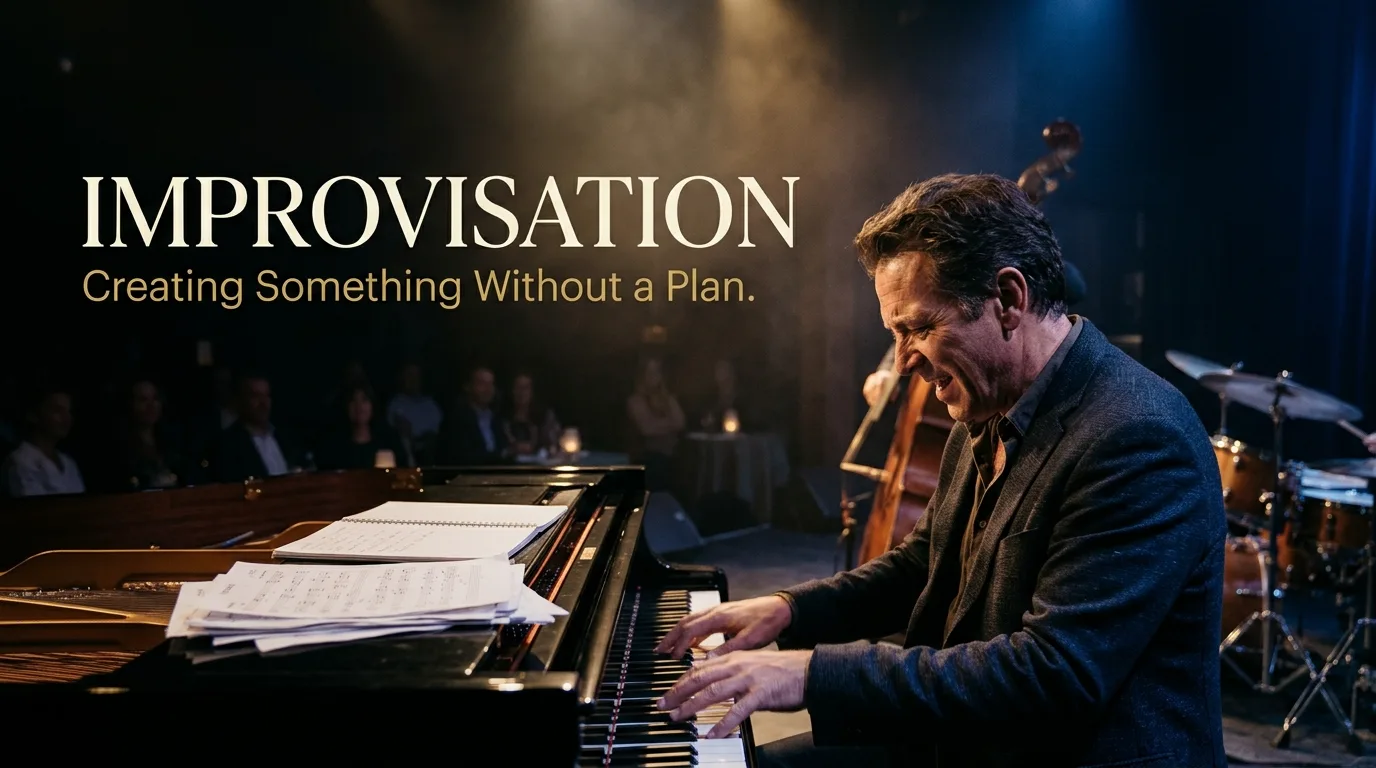
A synonym for improvisation is a word or phrase that describes creating, performing, or responding without a fixed plan. Common alternatives include spontaneity, ad-libbing, extemporization, and thinking on your feet. The best choice depends on the situation, tone, and intended meaning.
Imagine a speaker whose presentation suddenly loses its slides. Instead of stopping, the speaker explains the topic naturally and keeps the audience engaged. That quick response is improvisation in action.
The word improvisation appears in music, acting, writing, business, and everyday conversations. It describes the ability to create something or respond effectively without preparing every detail beforehand.
Learning a synonym for improvisation helps students write stronger essays, bloggers describe creative processes, and content writers avoid repetitive language. Everyday English users can also express ideas more clearly.
Different alternatives highlight different skills. Spontaneity emphasizes natural, unplanned action, while ad-libbing often describes speaking without a prepared script. Choosing the right word makes your message more precise.
What Does “Improvisation” Really Mean?
Improvisation means creating, performing, or responding in the moment without following a fully prepared plan. It involves using available information, creativity, and judgment to handle a situation as it develops.
The word is a noun. Its related verb is improvise, which means to create or perform something without complete preparation.
Native English speakers commonly use this word when discussing music, theater, comedy, public speaking, problem-solving, and unexpected situations. It can describe both artistic creativity and practical thinking.
For example, a jazz musician may change a melody during a performance. Similarly, a teacher may explain a difficult concept in a new way when students seem confused. Both situations involve improvisation.
Connotative Meaning
(Connotation is the emotional or cultural association that a word carries beyond its basic dictionary meaning.)
- Positive tone: Improvisation can suggest creativity, flexibility, confidence, and resourcefulness.
- Negative tone: In certain situations, it may suggest poor planning, uncertainty, or a last-minute solution.
- Neutral tone: It can simply describe creating or responding without preparation.
The word itself is usually neutral or positive. Its meaning depends on the situation. A musician improvising a melody may demonstrate expertise, while a team improvising an emergency procedure may need to compensate for missing resources.
Etymology
The word improvisation entered English through French improvisation, which is associated with the verb improviser. These forms connect to Italian improvvisare and Latin improvisus, meaning “unforeseen” or “not foreseen.”
The word’s history reflects its central idea: doing something without knowing exactly what will happen beforehand.
Historical Development
- Old English (450–1100): The modern word improvisation did not exist in Old English. People expressed related ideas through words and phrases describing unexpected events, invention, and unplanned action.
- Middle English (1100–1500): English vocabulary developed through French and Latin influences. The linguistic foundations of the modern word came through these later European traditions.
- Modern English (1500–present): Improvisation became established as a term for spontaneous composition and performance. Its use expanded across theater, music, education, communication, and practical problem-solving.
Pronunciation (US and UK – IPA)
- US: /ˌɪm.prə.vəˈzeɪ.ʃən/
- UK: /ˌɪm.prə.vaɪˈzeɪ.ʃən/
Syllables
im-pro-vi-sa-tion
Affixation Pattern of Improvisation
- Root: provis relates historically to foreseeing or providing for something.
- Prefix: im- appears in the word’s historical formation and reflects the idea of something not foreseen.
- Suffix: -ation forms a noun that describes an action, process, or result.
The word developed through several languages, so its structure is best understood historically rather than as a simple modern English prefix-and-root combination.
Synonyms List:
The following words offer different ways to describe improvisation. Some work best in creative settings, while others suit conversation, professional writing, or problem-solving.
Extemporization (Noun) — US: /ɪkˌstem.pɚ.əˈzeɪ.ʃən/ | UK: /ɪkˌstem.prəˈzeɪ.ʃən/
Meaning: The act of speaking, composing, or performing without any preparation or written notes.
Tone/Register: Formal, Academic, Rhetorical
Example 1: His extemporization during the keynote address stunned the university audience.
Example 2: She delivered an unexpected extemporization when her teleprompter malfunctioned mid-speech.
Ad-lib (Noun) — US: /ˈæd.lɪb/ | UK: /ˈæd.lɪb/
Meaning: Spoken words, jokes, or stage actions created spontaneously during a live performance.
Tone/Register: Informal, Casual, Entertainment
Example 1: The comedian threw in a clever ad-lib that had the entire crowd roaring with laughter.
Example 2: That unexpected line was a pure ad-lib that made the scene far more authentic.
Spontaneity (Noun) — US: /ˌspɑːn.təˈneɪ.ə.ṭi/ | UK: /ˌspɒn.təˈneɪ.ə.ti/
Meaning: The condition or quality of acting on impulse without premeditation or external force.
Tone/Register: Neutral to Positive, General, Literary
Example 1: Her natural spontaneity makes her travel vlogs remarkably engaging to watch.
Example 2: We loved the utter spontaneity of our weekend road trip across the coast.
Inventiveness (Noun) — US: /ɪnˈven.tɪv.nəs/ | UK: /ɪnˈven.tɪv.nəs/
Meaning: The creative ability to design, adapt, or originate new things on the spot.
Tone/Register: Positive, Professional, Academic
Example 1: The team showed incredible inventiveness when building a prototype from spare components.
Example 2: Cooking without a written recipe demands a high degree of culinary inventiveness.
Ingenuity (Noun) — US: /ˌɪn.dʒəˈnuː.ə.ṭi/ | UK: /ˌɪn.dʒəˈnjuː.ə.ti/
Meaning: The quality of being remarkably clever, original, and inventive when solving unexpected problems.
Tone/Register: Positive, Formal, Business
Example 1: Fixing the rover engine required the sheer ingenuity of the engineering team.
Example 2: She handled the severe budget cut with impressive administrative ingenuity.
Resourcefulness (Noun) — US: /rɪˈsɔːrs.fəl.nəs/ | UK: /rɪˈzɔːs.fəl.nəs/
Meaning: The capacity to find quick, clever, and effective ways to overcome difficult obstacles.
Tone/Register: Positive, Professional, Daily English
Example 1: His resourcefulness allowed the group to survive in the wilderness without basic supplies.
Example 2: Hiring managers always value practical resourcefulness over rigid adherence to rules.
Contrivance (Noun) — US: /kənˈtraɪ.vəns/ | UK: /kənˈtraɪ.vəns/
Meaning: A quick, clever, or artificial arrangement created to serve a temporary purpose.
Tone/Register: Neutral to Slightly Negative, Literary
Example 1: The makeshift shelter was a clever contrivance made of bamboo and tarps.
Example 2: Critics disliked the ending, calling it a forced narrative contrivance.
Expedient (Noun) — US: /ɪkˈspiː.di.ənt/ | UK: /ɪkˈspiː.di.ənt/
Meaning: An action or means employed to achieve a quick result, often out of urgent necessity.
Tone/Register: Formal, Political, Business
Example 1: Setting up temporary shelters was a necessary expedient after the storm hit.
Example 2: Using duct tape on the hose was merely a short-term expedient.
Make-do (Noun) — US: /ˈmeɪk.duː/ | UK: /ˈmeɪk.duː/
Meaning: A temporary, imperfect substitute created from whatever materials are currently accessible.
Tone/Register: Informal, Conversational
Example 1: This old wooden crate will serve as a fine make-do until the new desk arrives.
Example 2: We accepted the basic arrangement as a functional make-do for the evening.
Compromise (Noun) — US: /ˈkɑːm.prə.maɪz/ | UK: /ˈkɒm.prə.maɪz/
Meaning: An adjustment or temporary solution reached by modifying original plans or expectations.
Tone/Register: Neutral, Professional, Daily English
Example 1: The updated project schedule was a reasonable compromise for both dynamic teams.
Example 2: Accepting an alternate venue was a practical compromise after the weather turned bad.
Invention (Noun) — US: /ɪnˈven.ʃən/ | UK: /ɪnˈven.ʃən/
Meaning: Something created through original thought or spontaneous imagination on the spot.
Tone/Register: Neutral to Positive, General
Example 1: His sudden explanation was a brilliant invention that saved the delicate negotiation.
Example 2: The jazz pianist filled the interlude with fresh musical invention.
Adaptation (Noun) — US: /ˌæd.æpˈteɪ.ʃən/ | UK: /ˌæd.əpˈteɪ.ʃən/
Meaning: The process or result of changing behavior or tools to suit new or unexpected conditions.
Tone/Register: Neutral, Academic, Professional
Example 1: Rapid adaptation is essential when taking over an unfamiliar business project.
Example 2: The play was a clever modern adaptation created during live rehearsal sessions.
Unscriptedness (Noun) — US: /ʌnˈskrɪp.tɪd.nəs/ | UK: /ʌnˈskrɪp.tɪd.nəs/
Meaning: The state or quality of occurring naturally without a pre-written text, guidelines, or rehearsal.
Tone/Register: Neutral, Media, Modern English
Example 1: Audiences love the raw unscriptedness of live podcasting channels.
Example 2: The show retained its charm due to the total unscriptedness of its main hosts.
Jamming (Noun) — US: /ˈdʒæm.ɪŋ/ | UK: /ˈdʒæm.ɪŋ/
Meaning: Informal, collective musical or creative improvisation among a group of artists without fixed music.
Tone/Register: Informal, Musical, Casual
Example 1: Late-night jamming in the garage produced their best album single.
Example 2: The interactive workshop started with a quick creative brainstorming and jamming session.
Vamp (Noun) — US: /væmp/ | UK: /væmp/
Meaning: A simple, repeated musical introductory phrase or accompaniment played spontaneously while waiting for a cue.
Tone/Register: Technical, Musical, Professional
Example 1: The pianist played a brief vamp until the lead singer walked onto the stage.
Example 2: Keep playing that rhythmic vamp until the speaker signals they are ready.
Play-it-by-ear (Noun) — US: /pleɪ.ɪt.baɪ.ɪr/ | UK: /pleɪ.ɪt.baɪ.ɪər/
Meaning: The practice of dealing with dynamic matters as they unfold rather than following a fixed plan.
Tone/Register: Idiomatic, Informal, Conversational
Example 1: Having no set agenda, our travel strategy was pure play-it-by-ear.
Example 2: We decided on a flexible play-it-by-ear approach for the weekend schedule.
Hack (Noun) — US: /hæk/ | UK: /hæk/
Meaning: A quick, clever, or unorthodox solution devised on the spot to solve a tricky problem.
Tone/Register: Informal, Digital, Modern English
Example 1: Using a paperclip to clear the clogged nozzle was a brilliant practical hack.
Example 2: She shared an ingenious life hack for setting up quick studio lighting.
Stopgap (Noun) — US: /ˈstɑːp.ɡæp/ | UK: /ˈstɒp.ɡæp/
Meaning: A temporary measure or substitute designed to address an immediate crisis or gap.
Tone/Register: Neutral, Business, Political
Example 1: Passing the emergency funding bill served as an essential financial stopgap.
Example 2: The wooden patch was just a temporary stopgap until full repairs began.
Quick-fix (Noun) — US: /ˈkwɪk.fɪks/ | UK: /ˈkwɪk.fɪks/
Meaning: An immediate, often superficial or temporary solution implemented rapidly to resolve an emergency.
Tone/Register: Informal, Neutral to Slightly Negative
Example 1: Applying electrical tape was merely a temporary quick-fix for the frayed cord.
Example 2: Do not rely on a simple quick-fix when dealing with complex software bugs.
Rigging (Noun) — US: /ˈrɪɡ.ɪŋ/ | UK: /ˈrɪɡ.ɪŋ/
Meaning: The act of assembling or constructing something quickly using makeshift or unconventional materials.
Tone/Register: Neutral, Technical, Informal
Example 1: The emergency jury-rigging of the boat’s sail kept the crew safe at sea.
Example 2: Simple stage rigging allowed us to hang lights without heavy structural frames.
Impromptu (Noun) — US: /ɪmˈprɑːmp.tuː/ | UK: /ɪmˈprɒmp.tjuː/
Meaning: A performance, speech, or action done without any previous preparation or planning.
Tone/Register: Neutral to Positive, General, Literary
Example 1: Her piano performance turned into a brilliant impromptu that delighted the guests.
Example 2: We held a brief impromptu in the office to celebrate the successful launch.
Off-the-cuff (Noun) — US: /ˌɑːf.ðəˈkʌf/ | UK: /ˌɒf.ðəˈkʌf/
Meaning: A remark, speech, or action made spontaneously without thinking or preparing beforehand.
Tone/Register: Informal, Casual, Conversational
Example 1: His hilarious off-the-cuff remark added a lighthearted mood to the entire conference.
Example 2: She delivered a sharp off-the-cuff remark during the open panel debate.
Instability (Noun) — US: /ˌɪn.stəˈbɪl.ə.ṭi/ | UK: /ˌɪn.stəˈbɪl.ə.ti/
Meaning: The dynamic quality of changing unpredictably, requiring quick mid-course adjustments.
Tone/Register: Neutral, Technical, Strategic
Example 1: Navigating market instability requires constant dynamic decision-making.
Example 2: The instability of the live setup demanded rapid troubleshooting on stage.
Workaround (Noun) — US: /ˈwɝːk.ə.raʊnd/ | UK: /ˈwɜːk.ə.raʊnd/
Meaning: A temporary bypass or method for overcoming a system limitation or unexpected fault.
Tone/Register: Professional, Technical, Business
Example 1: The IT team developed a clever workaround to keep the servers online overnight.
Example 2: Using an external microphone was an effective workaround for the audio glitch.
Invention-on-the-fly (Noun) — US: /ɪnˈven.ʃən ɑːn ðə flaɪ/ | UK: /ɪnˈven.ʃən ɒn ðə flaɪ/
Meaning: The act of inventing a solution or plan instantly as an activity progresses.
Tone/Register: Informal, Modern English
Example 1: Successful live broadcasts often depend on sheer invention-on-the-fly.
Example 2: Cooking dinner with random pantry items turned into a fun invention-on-the-fly.
Jury-rig (Noun) — US: /ˈdʒʊr.i.rɪɡ/ | UK: /ˈdʒʊə.ri.rɪɡ/
Meaning: A temporary assembly or makeshift solution built hastily out of whatever is available.
Tone/Register: Informal, Technical
Example 1: The mechanic used a wire jury-rig to keep the engine exhaust pipe secured.
Example 2: Our outdoor stage setup was a basic jury-rig against the sudden wind.
Extemporaneity (Noun) — US: /ɪkˌstem.pɚ.əˈneɪ.ə.ṭi/ | UK: /ɪkˌstem.prəˈneɪ.ə.ti/
Meaning: The quality or state of being spoken, performed, or produced without premeditation.
Tone/Register: Formal, Academic, Rhetorical
Example 1: The speaker’s extemporaneity gave the lecture a fresh, authentic feel.
Example 2: Critics praised the theater company for maintaining raw extemporaneity in every show.
Adaptability (Noun) — US: /əˌdæp.təˈbɪl.ə.ṭi/ | UK: /əˌdæp.təˈbɪl.ə.ti/
Meaning: The capacity to adjust quickly to new, unexpected, or changing environmental conditions.
Tone/Register: Positive, Professional, Corporate
Example 1: Her remarkable adaptability helped the startup survive dramatic industry changes.
Example 2: Demonstrating spatial adaptability is key when designing compact living rooms.
Flexibility (Noun) — US: /ˌflek.səˈbɪl.ə.ṭi/ | UK: /ˌflek.səˈbɪl.ə.ti/
Meaning: The willingness and ability to modify plans, actions, or ideas on the spot.
Tone/Register: Positive, General, Workplace
Example 1: Schedule flexibility allowed us to handle the sudden delay without extra stress.
Example 2: He showed impressive tactical flexibility during the final game strategy.
Versatility (Noun) — US: /ˌvɝː.səˈtɪl.ə.ṭi/ | UK: /ˌvɜː.səˈtɪl.ə.ti/
Meaning: The ability to turn one’s hand to many different tasks or adapt rapidly to diverse roles.
Tone/Register: Positive, Professional, Artistic
Example 1: The actor’s incredible versatility allowed him to jump between comedy and drama.
Example 2: Her career success stems from her professional versatility across multiple sectors.
Patch-up (Noun) — US: /ˈpætʃ.ʌp/ | UK: /ˈpætʃ.ʌp/
Meaning: A hasty, temporary repair designed to fix a problem for a short time.
Tone/Register: Informal, Slightly Negative
Example 1: The quick roof patch-up held until the roofers arrived the next week.
Example 2: Applying a simple patch-up won’t solve the underlying structural issue.
Shift (Noun) — US: /ʃɪft/ | UK: /ʃɪft/
Meaning: A sudden, spontaneous change in direction, strategy, or focus during an ongoing event.
Tone/Register: Neutral, Business, Tactical
Example 1: A sudden strategic shift helped the team capture the competitor’s market share.
Example 2: We noticed a clear shift in tone during the unscripted portion of the interview.
Adjustment (Noun) — US: /əˈdʒʌst.mənt/ | UK: /əˈdʒʌst.mənt/
Meaning: A minor, quick modification made to adapt to unexpected feedback or changes.
Tone/Register: Neutral, Professional, Technical
Example 1: Making a fast tactical adjustment saved the team from a costly error.
Example 2: She made a seamless audio adjustment while continuing to host the live show.
Deviation (Noun) — US: /ˌdiː.viˈeɪ.ʃən/ | UK: /ˌdiː.viˈeɪ.ʃən/
Meaning: A spontaneous departure from an established plan, script, or standard procedure.
Tone/Register: Neutral, Formal, Analytical
Example 1: The director welcomed a slight creative deviation from the original movie script.
Example 2: Any minor deviation from the flight path required immediate pilot input.
Maneuver (Noun) — US: /məˈnuː.vɚ/ | UK: /məˈnuː.vər/
Meaning: A clever, dynamic movement or action designed to guide a situation past obstacles.
Tone/Register: Neutral to Positive, Tactical, Business
Example 1: Her sudden legal maneuver completely caught the opposing defense team off guard.
Example 2: Steering the ship through the narrow channel required an expert spatial maneuver.
Promptitude (Noun) — US: /ˈprɑːmp.tə.tuːd/ | UK: /ˈprɒmp.tɪ.tjuːd/
Meaning: The quality of acting quickly, decisively, and without hesitation in unexpected moments.
Tone/Register: Formal, Literary
Example 1: His promptitude during the sudden building emergency averted a serious crisis.
Example 2: She handled customer complaints with reassuring speed and impressive promptitude.
Quickness (Noun) — US: /ˈkwɪk.nəs/ | UK: /ˈkwɪk.nəs/
Meaning: The ability to think, react, or invent solutions at a rapid pace under pressure.
Tone/Register: Positive, General, Daily English
Example 1: Mental quickness is essential when answering fast-paced interview questions.
Example 2: Her physical quickness allowed her to catch the falling display stand in time.
Agility (Noun) — US: /əˈdʒɪl.ə.ṭi/ | UK: /əˈdʒɪl.ə.ti/
Meaning: The capacity to think, understand, and adapt rapidly in dynamic or complex scenarios.
Tone/Register: Positive, Corporate, Strategic
Example 1: Cognitive agility helps software leaders pivot rapidly when client goals change.
Example 2: The firm demonstrated market agility by launching an emergency delivery service.
Spurt (Noun) — US: /spɝːt/ | UK: /spɜːt/
Meaning: A sudden, short burst of spontaneous activity, effort, or creative expression.
Tone/Register: Neutral to Informal, General
Example 1: An unexpected spurt of creative genius allowed her to finish the painting.
Example 2: He wrote three key chapters during a late-night spurt of inspiration.
Fluke (Noun) — US: /fluːk/ | UK: /fluːk/
Meaning: An accidental or unscripted stroke of good luck that produces a successful result on the spot.
Tone/Register: Informal, Casual
Example 1: Winning the local tournament felt like an unscripted fluke to the young team.
Example 2: Hitting that incredible target was a total fluke born out of a wild guess.
Gambit (Noun) — US: /ˈɡæm.bɪt/ | UK: /ˈɡæm.bɪt/
Meaning: A calculated, spontaneous move or remark made to gain an immediate advantage.
Tone/Register: Neutral to Formal, Strategic, Political
Example 1: Opening the discussion with an unscripted joke was a clever ice-breaking gambit.
Example 2: Her bold negotiating gambit caught the corporate buyers completely unprepared.
Free-styling (Noun) — US: /ˈfriː.staɪ.lɪŋ/ | UK: /ˈfriː.staɪ.lɪŋ/
Meaning: The act of improvising lyrics, music, or dance moves without pre-set choreography or script.
Tone/Register: Informal, Artistic, Modern English
Example 1: His energetic free-styling captivated the street audience for over an hour.
Example 2: The dance battle concluded with an impressive round of solo free-styling.
Improvisator (Noun) — US: /ɪmˈprɑː.və.zeɪ.t̬ɚ/ | UK: /ɪmˈprɒv.ɪ.zeɪ.tər/
Meaning: The active state or identity of working as an inventive, spontaneous performer.
Tone/Register: Formal, Artistic, Archaic
Example 1: The musician acted as a true improviser, creating melodies directly from audience cues.
Example 2: Historical accounts praise the orator as a master improviser of political speeches.
Unpremeditation (Noun) — US: /ˌʌn.priː.med.əˈteɪ.ʃən/ | UK: /ˌʌn.priː.med.ɪˈteɪ.ʃən/
Meaning: The condition of acting or speaking without prior thought, design, or planning.
Tone/Register: Formal, Legal, Academic
Example 1: The total lack of premeditation in her sudden speech made it exceptionally heartfelt.
Example 2: Legal teams argued over the clear unpremeditation behind his unexpected actions.
Emergency-measure (Noun) — US: /ɪˈmɝː.dʒən.si ˈmeʒ.ɚ/ | UK: /ɪˈmɜː.dʒən.si ˈmeʒ.ər/
Meaning: An action taken quickly and spontaneously to cope with a crisis or failure.
Tone/Register: Formal, Business, Public Safety
Example 1: Rerouting the traffic grid was a necessary emergency measure during the storm.
Example 2: Closing the office early served as a practical emergency measure after the power outage.
Patchwork (Noun) — US: /ˈpætʃ.wɝːk/ | UK: /ˈpætʃ.wɜːk/
Meaning: A solution compiled spontaneously from a mixed variety of available parts or ideas.
Tone/Register: Neutral, General, Descriptive
Example 1: The final proposal was a creative patchwork of ideas from several departments.
Example 2: They built a functional shelter using a patchwork of recycled canvas sheets.
Brainstorm (Noun) — US: /ˈbreɪn.stɔːrm/ | UK: /ˈbreɪn.stɔːm/
Meaning: A sudden, spontaneous outburst of creative ideas or unscripted problem-solving.
Tone/Register: Informal to Professional, Business
Example 1: An unexpected late-afternoon brainstorm yielded our best marketing campaign idea.
Example 2: Sit down with the design team for a quick unscripted brainstorm session.
Fast-talk (Noun) — US: /ˈfæst.tɑːk/ | UK: /ˈfɑːst.tɔːk/
Meaning: Spontaneous, persuasive speech intended to handle a situation or convince someone on the spot.
Tone/Register: Informal, Slightly Negative
Example 1: He used a bit of clever fast-talk to get past the venue security guard.
Example 2: Relying on pure fast-talk won’t substitute for well-researched project facts.
Shift-of-gears (Noun) — US: /ʃɪft ʌv ɡɪrz/ | UK: /ʃɪft ɒv ɡɪəz/
Meaning: A spontaneous, abrupt change in approach, pace, or strategy during an ongoing task.
Tone/Register: Informal, Workplace, Conversational
Example 1: Her sudden shift-of-gears saved the awkward interview from spiraling out of control.
Example 2: Moving from technical details to broad vision required a quick shift-of-gears.
Live-wire (Noun) — US: /ˈlaɪv.waɪɚ/ | UK: /ˈlaɪv.waɪər/
Meaning: A dynamic, highly spontaneous state of creative activity or energetic problem-solving.
Tone/Register: Informal, Energetic, Idiomatic
Example 1: The interactive workshop became a live wire of spontaneous ideas and collaboration.
Example 2: Her unscripted hosting brought a live-wire energy to the evening broadcast.
Synonyms for Improvisation by Tone
The tone of a synonym affects how readers understand your message. A word that sounds natural in conversation may feel too casual in an academic essay.
Positive Synonyms
These words emphasize creativity, flexibility, and effective responses.
- Spontaneity: Natural, unplanned action.
- Resourcefulness: Finding useful solutions with what is available.
- Adaptability: Adjusting effectively to changing circumstances.
- Quick thinking: Responding intelligently under pressure.
- Improvisational creativity: Developing original ideas in the moment.
Use these terms when describing someone’s strengths or creative achievements.
Neutral Synonyms
These alternatives describe unplanned creation without strongly praising or criticizing it.
- Extemporization: Speaking or performing with limited preparation.
- Spontaneous response: An immediate reaction.
- Spontaneous composition: Creating a work in the moment.
- Unscripted expression: Communicating without a prepared script.
- Impromptu performance: Performing without a planned presentation.
These choices work well in informative articles, reports, and general explanations.
Negative or Cautionary Alternatives
Improvisation is not inherently negative. However, certain expressions emphasize a lack of preparation or a potentially unreliable approach.
- Last-minute improvisation: A solution developed because time is running out.
- Ad hoc solution: An approach created for a particular situation rather than as part of a general plan.
- Makeshift arrangement: A temporary solution assembled from available resources.
- Unplanned response: A reaction that was not prepared beforehand.
Examples:
The team relied on last-minute improvisation after missing the deadline for preparation.
They created a makeshift arrangement until the proper equipment arrived.
These expressions are not exact synonyms in every context. Choose them when the situation involves urgency, temporary fixes, or insufficient planning.
Playful and Informal Synonyms
These expressions work especially well in casual conversations and entertainment.
- Ad-libbing: Inventing words or actions while performing.
- Riffing: Freely developing jokes, ideas, or musical phrases.
- Off-the-cuff speaking: Talking without rehearsed wording.
- Thinking on your feet: Handling an unexpected situation quickly.
- On-the-spot thinking: Developing an immediate answer or solution.
For example, you might say, “The host kept riffing on the audience’s comments.” In a formal report, “The host responded spontaneously to audience comments” would usually sound more appropriate.
Improvisation vs. Close Alternatives
Several words overlap with improvisation, but each highlights a different part of the process.
| Word | Main difference | Best use |
|---|---|---|
| Improvisation | Creating or responding without a complete prior plan | Music, theater, problem-solving |
| Spontaneity | Acting naturally without planning | Social interactions and personal behavior |
| Ad-libbing | Adding unprepared words or actions | Comedy, acting, broadcasting |
| Extemporization | Performing or speaking with limited preparation | Speeches, debates, presentations |
| Resourcefulness | Finding practical solutions with available resources | Work, emergencies, everyday challenges |
Which Word Should You Choose?
Choose improvisation when you want to describe the overall process of creating or adapting in the moment.
Choose spontaneity when the main idea is natural, unplanned behavior. Use ad-libbing when someone invents lines during a performance.
Choose extemporization for a more formal discussion of speaking or performing with limited preparation. Use resourcefulness when you want to emphasize the ability to solve a problem successfully.
How Improvisation Changes by Context
Daily Conversation
In everyday English, people often prefer simple expressions such as thinking on your feet, quick thinking, or making it up as you go.
For example, “I had to think on my feet when my friends changed our plans.” This sounds natural and clearly describes an unexpected situation.
Writing and Blogging
Writers can use spontaneity, unscripted expression, or spontaneous creation to describe creative processes. These choices also help avoid repeating the same keyword throughout an article.
For example, a blogger might write, “Spontaneity gave the story a more authentic voice.” This sentence emphasizes natural creativity rather than a specific performance technique.
Professional and Academic English
In professional writing, extemporization, adaptability, and on-the-fly problem-solving may suit particular situations.
A report might state, “The team demonstrated adaptability when the original schedule changed.” This sounds more precise than saying the team simply improvised.
For academic presentations, extemporaneous speaking is useful when discussing speeches delivered with limited preparation.
Creative and Informal English
Artists, musicians, actors, and comedians often use riffing, ad-libbing, and free improvisation.
A musician may riff on a melody, while an actor may ad-lib a line. These expressions communicate the specific creative action more clearly than a general term.
Workplace Scenario
A meeting presenter loses access to their notes and continues explaining the project using their knowledge of the subject. You could describe this as improvisation or thinking on their feet.
Social Scenario
Friends arrive at a restaurant without a reservation and decide to explore nearby cafés. Their spontaneity makes the unexpected change enjoyable.
Media and Pop Culture Scenario
A comedian adds a joke that was not included in the script. This is an example of ad-libbing, particularly when the joke responds to something happening on stage.
Writing and Storytelling Scenario
A novelist changes a scene while drafting because a character’s actions suggest a more interesting direction. The writer is using spontaneous creation, although the broader writing process may still involve planning.
Common Mistakes Learners Make
1. Treating Every Alternative as an Exact Synonym
Resourcefulness and adaptability are related to improvisation, but they describe abilities rather than the act itself.
Use improvisation when discussing the process. Use resourcefulness when highlighting someone’s ability to find a solution.
2. Confusing Spontaneity With Poor Planning
Spontaneity does not automatically mean carelessness. A skilled performer may improvise deliberately because the situation calls for flexibility.
If you want to criticize insufficient preparation, expressions such as last-minute improvisation may communicate that meaning more accurately.
3. Using Informal Words in Formal Writing
Words such as riffing and ad-libbing suit conversational or creative contexts. They may sound too casual in a research paper or formal business report.
Choose extemporization or a precise phrase such as unscripted response when the context requires a more formal register.
4. Assuming Improvisation Always Means Speaking
Improvisation also occurs in music, dance, visual art, teaching, cooking, and problem-solving. The word applies whenever someone creates or adapts without following a fully predetermined plan.
5. Repeating the Same Word Too Often
Using improvisation in every sentence can make an article sound repetitive. However, replacing it with a loosely related word can reduce accuracy.
Use a synonym only when it preserves your intended meaning. Clarity matters more than variety.
Register Notes: Formal vs. Informal
| Register | Suitable choices |
|---|---|
| Formal | Extemporization, extemporaneous speaking |
| Academic | Free improvisation, improvisational creativity |
| Professional | Adaptability, on-the-fly problem-solving |
| Everyday | Quick thinking, thinking on your feet |
| Informal | Ad-libbing, riffing, off-the-cuff speaking |
| Artistic | Spontaneous composition, improvised performance |
These categories can overlap. For instance, quick thinking works in both everyday conversation and a professional performance review.
For related vocabulary, you can also explore an internal article on synonyms for spontaneity to understand how natural, unplanned action differs from creative improvisation.
Interactive Practice Quiz:
Choose the most suitable word or phrase for each situation. Consider the meaning, tone, and context before selecting your answer.
Multiple-Choice Questions
1. A jazz musician creates a melody during a live performance. Which word fits best?
- A. Rehearsal
- B. Improvisation
- C. Memorization
2. A comedian invents a funny line that is not in the script. What is this called?
- A. Ad-libbing
- B. Formal speaking
- C. Repetition
3. A speaker delivers a speech with limited preparation and relies on their knowledge. Which term is most suitable?
- A. Spontaneity
- B. Extemporization
- C. Memorization
4. A person quickly finds a solution using the few materials available. Which quality does this demonstrate?
- A. Resourcefulness
- B. Hesitation
- C. Rigidity
5. Someone naturally suggests an unplanned activity during a friendly gathering. Which word best describes their behavior?
- A. Extemporization
- B. Spontaneity
- C. Formality
6. A presenter answers an unexpected question confidently. Which phrase best describes this ability?
- A. Thinking on your feet
- B. Following a script
- C. Delaying a response
7. Musicians freely develop new musical ideas without following a fixed composition. Which term fits best?
- A. Free improvisation
- B. Rehearsed composition
- C. Written instruction
8. A writer creates a scene naturally without deciding every detail beforehand. Which expression is most suitable?
- A. Strict planning
- B. Spontaneous creation
- C. Careful memorization
9. Which term best describes speaking without rehearsing the exact words?
- A. Off-the-cuff speaking
- B. Scripted delivery
- C. Written composition
10. A project manager changes plans quickly when an unexpected problem occurs. Which quality is most relevant?
- A. Adaptability
- B. Inflexibility
- C. Predictability
11. Which word is most suitable for a formal discussion of delivering a speech with limited preparation?
- A. Riffing
- B. Extemporization
- C. Fooling around
12. A team creates a temporary fix because the proper equipment is unavailable. Which expression best describes the solution?
- A. Makeshift arrangement
- B. Spontaneity
- C. Artistic expression
Reflection Task
Write two original sentences using different synonyms for improvisation. Use one in a professional situation and the other in an everyday conversation.
Then explain how the meaning or tone changes between your chosen words.
Answer Key
1. B 2. A 3. B 4. A 5. B 6. A 7. A 8. B 9. A 10. A 11. B 12. A
FAQs
1. What is the best synonym for improvisation in an essay?
Spontaneous creation, extemporization, or adaptability may work well, depending on your meaning. Use extemporization when discussing a speech or performance with limited preparation. Choose spontaneous creation for an unplanned creative process. If you are discussing how someone handles unexpected changes, adaptability may be more precise.
2. What is a synonym for improvisation in music?
Common alternatives include musical improvisation, free improvisation, and spontaneous composition. Musicians may also use riffing when developing musical ideas from an existing melody or phrase. The best choice depends on the technique. Free improvisation usually allows greater freedom from predetermined musical structures, while riffing often builds on an existing idea.
3. What is a professional word for improvisation?
Extemporization is a formal alternative for speaking or performing with limited preparation. In business contexts, on-the-fly problem-solving describes developing solutions while work is underway. Adaptability is suitable when you want to highlight the ability to adjust to change rather than the specific act of improvising.
4. What is the difference between improvisation and spontaneity?
Improvisation involves creating, performing, or responding without a complete prior plan. Spontaneity describes the quality of acting naturally without planning. A musician who invents a melody during a performance demonstrates improvisation. A friend who unexpectedly suggests a fun outing demonstrates spontaneity. The two concepts overlap, but they emphasize different aspects of unplanned action.
5. Is improvisation a positive or negative word?
Improvisation is generally neutral and often positive. It can suggest creativity, flexibility, and the ability to handle unexpected situations. However, it may sound negative when it describes a rushed response caused by poor preparation. Expressions such as last-minute improvisation can emphasize the problem, while creative improvisation highlights skill and originality.
6. What is the verb form of improvisation?
The verb form is improvise. It means to create or perform something without preparing every detail in advance, or to find a solution using available resources. For example, “We had to improvise when the projector stopped working.” The related adjective improvisational describes something involving improvisation, such as improvisational theater.
7. How can I avoid repeating improvisation in an article?
Choose alternatives that match each sentence’s intended meaning. You might use ad-libbing for spontaneous dialogue, spontaneous composition for music, and on-the-fly problem-solving for workplace challenges. Do not replace the word mechanically. A precise repeated word is better than an inaccurate synonym, especially in educational and SEO content.
Conclusion
Learning a synonym for improvisation helps you describe creativity, spontaneous action, and quick problem-solving with greater accuracy. Each alternative adds a slightly different shade of meaning.
Students can strengthen essays with precise vocabulary, while bloggers and content writers can make articles more engaging. Everyday English users can also communicate ideas naturally and confidently.
The key is to understand context before choosing a word. Practice using these synonyms in emails, essays, presentations, and everyday conversations to make them part of your active vocabulary.
Start today by choosing three new synonyms and writing one original sentence for each. Small, regular practice can make your English clearer, more expressive, and more natural.
Suggested External Source
For a reliable dictionary definition, pronunciation, and usage examples, consult the Cambridge Dictionary entry for improvisation: Cambridge Dictionary — Improvisation

I’m Hezel, a passionate English language enthusiast and the creator of Synworda.com. I love exploring synonyms, vocabulary, grammar, and the many ways words can make communication clearer and more effective. Through Synworda.com, I create simple, practical, and easy-to-understand content for students, writers, professionals, and anyone who wants to improve their English. I enjoy breaking down confusing words and grammar concepts into helpful explanations with clear examples. I aim to make learning English feel less complicated and more enjoyable. I believe that understanding the right words can help everyone communicate with confidence in everyday life.