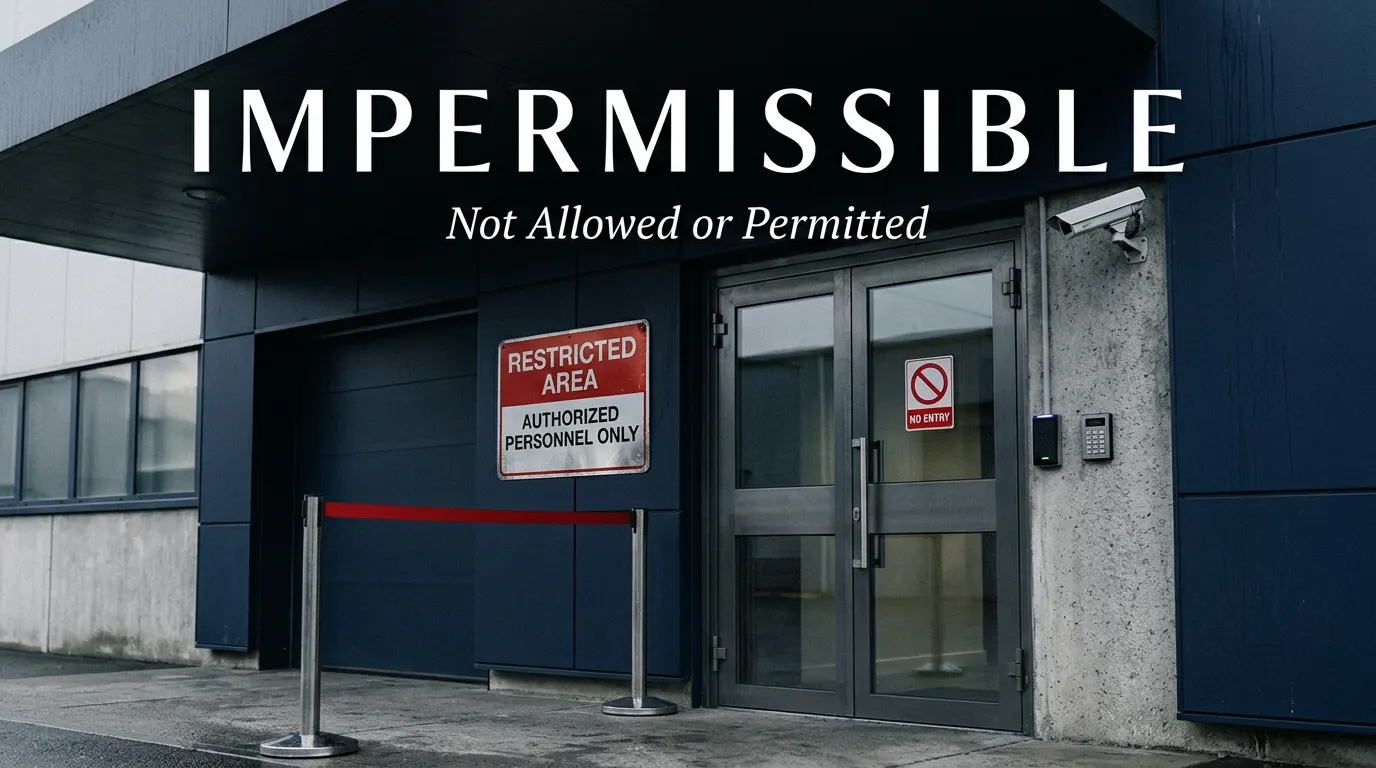
A synonym for impermissible is a word or phrase that means not allowed, forbidden, or prohibited by a rule, law, policy, or authority. Common alternatives include prohibited, forbidden, unlawful, inadmissible, and unacceptable. The best choice depends on the situation.
Imagine a student bringing a prohibited item into an examination hall. The school may describe the item as impermissible under its examination rules. Choosing the right synonym makes this situation easier to explain.
The word impermissible often appears in legal documents, workplace policies, academic writing, and discussions about acceptable behavior. It helps people communicate boundaries clearly and precisely.
Learning a synonym for impermissible can strengthen your vocabulary. Students can use alternatives in essays, bloggers can avoid repetition, and content writers can make explanations more precise.
In everyday English, choosing between forbidden, unacceptable, and unlawful matters. Each word expresses a different degree or type of restriction, so context should guide your choice.
What Does “Impermissible” Really Mean?
Impermissible is an adjective that describes something that is not permitted, allowed, or acceptable under a particular rule, law, agreement, or standard.
In simple English, if something is impermissible, you are not allowed to do it or use it in the given circumstances.
For example, using a mobile phone during a closed-book examination may be impermissible under school rules. The same action might be perfectly acceptable outside the examination hall.
How Native English Speakers Understand the Word
Native speakers generally understand impermissible as a formal word associated with rules, restrictions, and boundaries. It often suggests that an established standard determines what is allowed.
The word does not always mean that an action is illegal. Something can be impermissible under a company policy without breaking any law.
Part of Speech and Simple Definition
- Part of speech: Adjective
- Simple definition: Not allowed or permitted by a rule, law, policy, or standard.
- Common contexts: Law, education, business, research, ethics, and formal communication.
- Example: Sharing confidential customer information without authorization is impermissible under company policy.
Connotative Meaning of Impermissible
(Connotation means the feelings, associations, or attitudes a word suggests beyond its basic dictionary meaning.)
Positive tone: The word can support positive values when it describes restrictions that protect privacy, safety, fairness, or professional standards.
Negative tone: It can sound strict or disapproving because it identifies an action that crosses an established boundary.
Neutral tone: In policies, regulations, and academic discussions, it may simply describe what a particular rule does not allow.
The emotional effect depends on the context. A restriction designed to protect students may seem reasonable, while an unnecessary restriction may feel unfair.
Etymology of Impermissible
The word impermissible developed from elements of Latin origin through the history of English word formation.
- Prefix: im- means “not” or “opposite of.”
- Root: permit, meaning to allow or authorize.
- Suffix: -ible means “able to be” or “capable of being.”
Together, these elements form a word meaning “not able to be permitted” or, more naturally, “not allowed.”
A Short History of the Word
Old English (450–1100): The modern word impermissible was not established in Old English. Speakers expressed restrictions using words related to forbidding, preventing, and prohibiting.
Middle English (1100–1500): English vocabulary continued to develop through contact with French and Latin. Words connected with permission and prohibition became increasingly important in formal communication.
Modern English (1500–present): The growth of legal, administrative, scientific, and academic writing helped establish impermissible as a formal adjective for something that cannot be permitted under a given standard.
Pronunciation of Impermissible
- US: /ˌɪm.pɚˈmɪs.ə.bəl/
- UK: /ˌɪm.pəˈmɪs.ə.bəl/
Syllables: im-per-mis-si-ble
Affixation pattern: Prefix + root + suffix
- Prefix: im- — expresses negation.
- Root: permit — expresses allowance or authorization.
- Suffix: -ible — forms an adjective expressing possibility or suitability.
The word is usually pronounced with stress on the third syllable: mis.
Synonyms List:
Unallowable (Adjective) — US: /ˌʌn.əˈlaʊ.ə.bəl/ / UK: /ˌʌn.əˈlaʊ.ə.bəl/
Meaning: Not capable or permitted of being allowed under established standards.
Tone / Register: Formal / Policy
Examples:
- Claiming personal travel expenses on a corporate expense report is unallowable.
- The grant committee identified several unallowable line items in the proposed budget.
Proscribed (Adjective) — US: /proʊˈskraɪbd/ / UK: /prəˈskraɪbd/
Meaning: Denounced, condemned, or forbidden by official decree or law.
Tone / Register: High Formal / Legal
Examples:
- The treaty listed all proscribed weapons and military equipment.
- Certain aggressive trading tactics are strictly proscribed in financial markets.
Interdicted (Adjective) — US: /ˌɪn.t̬ɚˈdɪk.tɪd/ / UK: /ˌɪn.təˈdɪk.tɪd/
Meaning: Officially prohibited or intercepted by authoritative order.
Tone / Register: Formal / Military / Legal
Examples:
- Coast guard vessels patrolled the waters to stop interdicted shipments.
- The government declared interdicted zones along the border during the crisis.
Out of Bounds (Adjective) — US: /aʊt əv baʊndz/ / UK: /aʊt əv baʊndz/
Meaning: Outside designated geographic, social, or thematic limits.
Tone / Register: General / Idiomatic
Examples:
- The construction zone is strictly out of bounds for unauthorized visitors.
- Personal questions about the candidate’s family were ruled out of bounds during the interview.
Off-Limits (Adjective) — US: /ˌɑːfˈlɪm.ɪts/ / UK: /ˌɒfˈlɪm.ɪts/
Meaning: Forbidden to be accessed, used, or discussed by specified persons.
Tone / Register: Informal / Everyday
Examples:
- The staff kitchen remains off-limits to restaurant customers.
- Certain sensitive server files are off-limits without administrative credentials.
Non-permissible (Adjective) — US: /nɑːn.pɚˈmɪs.ə.bəl/ / UK: /nɒn.pəˈmɪs.ə.bəl/
Meaning: Falling explicitly outside acceptable limits or permissions.
Tone / Register: Technical / Regulatory
Examples:
- The safety technician identified non-permissible voltage levels in the circuit.
- Non-permissible emissions levels will result in immediate factory shutdowns.
Contrary to Regulations (Adjective) — US: /ˈkɑːn.trer.i tuː ˌreɡ.jəˈleɪ.ʃənz/ / UK: /ˈkɒn.trə.ri tuː ˌreɡ.jəˈleɪ.ʃənz/
Meaning: Conflicting directly with written rules or regulatory frameworks.
Tone / Register: Formal / Bureaucratic
Examples:
- Operating machinery without eye protection is contrary to regulations.
- The inspector noted three electrical installations that were contrary to regulations.
Unconstitutional (Adjective) — US: /ˌʌn.kɑːn.stəˈtuː.ʃən.əl/ / UK: /ˌʌn.kɒn.stɪˈtjuː.ʃən.əl/
Meaning: Violating the basic laws or rights established in a constitution.
Tone / Register: Legal / Political
Examples:
- The Supreme Court declared the restrictive voting law unconstitutional.
- Enforcing arbitrary search procedures was deemed unconstitutional by the judge.
Felonious (Adjective) — US: /fəˈloʊ.ni.əs/ / UK: /fəˈləʊ.ni.əs/
Meaning: Constituting or involving a major criminal offense.
Tone / Register: Legal / Criminological
Examples:
- The suspect was arrested on charges of felonious assault.
- Breaking into the secured vault constitutes a felonious act.
Criminal (Adjective) — US: /ˈkrɪm.ə.nəl/ / UK: /ˈkrɪm.ɪ.nəl/
Meaning: Involving or illegal under public law.
Tone / Register: Direct / Legal
Examples:
- The company faced criminal charges for dumping toxic waste.
- Falsifying state records is a severe criminal act.
Contraband (Adjective) — US: /ˈkɑːn.trə.bænd/ / UK: /ˈkɒn.trə.bænd/
Meaning: Illegal to import, export, produce, or possess.
Tone / Register: Official / Legal
Examples:
- Guards confiscated contraband items during the routine security sweep.
- Smugglers attempted to transport contraband goods across the shipping lanes.
Illegitimate (Adjective) — US: /ˌɪl.ɪˈdʒɪt̬.ə.mət/ / UK: /ˌɪl.ɪˈdʒɪt.ə.mət/
Meaning: Not recognized by law, logic, or valid principles.
Tone / Register: Academic / Formal
Examples:
- The opposition party rejected the election results as illegitimate.
- Using company funds for private purchases is an illegitimate use of capital.
Unwarranted (Adjective) — US: /ʌnˈwɔːr.ən.t̬ɪd/ / UK: /ʌnˈwɒr.ən.tɪd/
Meaning: Lacking official justification, necessity, or permission.
Tone / Register: Formal / Critical
Examples:
- The supervisor delivered an unwarranted penalty to the employee.
- The audit revealed unwarranted delays in processing customer refunds.
Unjustifiable (Adjective) — US: /ʌnˈdʒʌs.tə.faɪ.ə.bəl/ / UK: /ˌʌn.dʒʌs.tɪˈfaɪ.ə.bəl/
Meaning: Impossible to defend or excuse under ethical or practical standards.
Tone / Register: Evaluative / Formal
Examples:
- Raising price margins during a natural disaster is unjustifiable.
- Leaving critical emergency equipment unmaintained is completely unjustifiable.
Inexcusable (Adjective) — US: /ˌɪn.ɪkˈskjuː.zə.bəl/ / UK: /ˌɪn.ɪkˈskjuː.zə.bəl/
Meaning: Too bad or offensive to be forgiven or overlooked.
Tone / Register: Strong / Evaluative
Examples:
- Missing a mandatory client deadline without notice is inexcusable.
- His rude behavior toward the medical staff was inexcusable.
Unpardonable (Adjective) — US: /ʌnˈpɑːr.dən.ə.bəl/ / UK: /ʌnˈpɑː.dən.ə.bəl/
Meaning: So serious or wrong that it cannot be forgiven.
Tone / Register: Formal / Severe
Examples:
- Betraying client confidentiality is an unpardonable breach of trust.
- The editor considered factual errors in headline news unpardonable.
Unforgivable (Adjective) — US: /ˌʌn.fɚˈɡɪv.ə.bəl/ / UK: /ˌʌn.fəˈɡɪv.ə.bəl/
Meaning: Completely incapable of receiving forgiveness due to severity.
Tone / Register: General / Emotional
Examples:
- Leaking confidential design blueprints to competitors was unforgivable.
- Abandoning a partner during a crisis is seen as unforgivable behavior.
Unseemly (Adjective) — US: /ʌnˈsiːm.li/ / UK: /ʌnˈsiːm.li/
Meaning: Not suitable, proper, or polite for a given social setting.
Tone / Register: Formal / Social
Examples:
- Arguing loudly about money at a memorial service is unseemly.
- The executive faced criticism for making unseemly remarks during the meeting.
Indecent (Adjective) — US: /ɪnˈdiː.sənt/ / UK: /ɪnˈdiː.sənt/
Meaning: Conflicting with accepted moral standards of decency or propriety.
Tone / Register: Moral / Legal
Examples:
- The television network was fined for broadcasting indecent content.
- Showing up to a professional job interview in beachwear is indecent.
Improper (Adjective) — US: /ɪmˈprɑː.pɚ/ / UK: /ɪmˈprɒp.ər/
Meaning: Dishonest, morally wrong, or not conforming to standards.
Tone / Register: Professional / Ethical
Examples:
- The board launched an inquiry into improper accounting practices.
- Sharing password access with outside contractors is highly improper.
Unbecoming (Adjective) — US: /ˌʌn.bɪˈkʌm.ɪŋ/ / UK: /ˌʌn.bɪˈkʌm.ɪŋ/
Meaning: Not fitting or appropriate for a person of a particular status.
Tone / Register: High Formal / Professional
Examples:
- Spreading rumors about colleagues is unbecoming of a senior manager.
- The officer was reprimanded for conduct unbecoming of the service.
Out of Order (Adjective) — US: /aʊt əv ˈɔːr.dɚ/ / UK: /aʊt əv ˈɔː.də/
Meaning: Violating parliamentary procedure, rules of debate, or social norms.
Tone / Register: Formal / Conversational
Examples:
- The chairperson ruled the delegate’s personal insult out of order.
- Interrupting the speaker during the moment of silence was completely out of order.
Non-compliant (Adjective) — US: /nɑːn.kəmˈplaɪ.ənt/ / UK: /nɒn.kəmˈplaɪ.ənt/
Meaning: Failing or refusing to conform to established rules or laws.
Tone / Register: Business / Regulatory
Examples:
- The facility was fined for using non-compliant safety gear.
- Non-compliant software programs will be removed from the network automatically.
Inappropriate (Adjective) — US: /ˌɪn.əˈproʊ.pri.ət/ / UK: /ˌɪn.əˈprəʊ.pri.ət/
Meaning: Not suitable or proper for a specific situation or context.
Tone / Register: General / Workplace
Examples:
- Using slang in a formal legal document is inappropriate.
- The HR manager addressed inappropriate jokes made during lunch hours.
Unethical (Adjective) — US: /ʌnˈeθ.ɪ.kəl/ / UK: /ʌnˈeθ.ɪ.kəl/
Meaning: Contrary to moral principles or rules governing a profession.
Tone / Register: Professional / Academic
Examples:
- Falsifying research findings to get published is unethical.
- Accepting undisclosed gifts from prospective suppliers is unethical.
Unprincipled (Adjective) — US: /ʌnˈprɪn.sə.pəld/ / UK: /ʌnˈprɪn.sɪ.pəld/
Meaning: Lacking moral principles or ethical standards of behavior.
Tone / Register: Formal / Critical
Examples:
- The unprincipled trader manipulated market prices for personal gain.
- Leaving a contract without honoring terms is unprincipled conduct.
Dishonorable (Adjective) — US: /dɪsˈɑː.nɚ.ə.bəl/ / UK: /dɪsˈɒn.ər.ə.bəl/
Meaning: Bringing shame, disgrace, or loss of reputation.
Tone / Register: High Formal / Moral
Examples:
- The soldier received a dishonorable discharge from the military.
- Stealing credit for a junior colleague’s project is dishonorable.
Outlawed (Adjective) — US: /ˈaʊt.lɑːd/ / UK: /ˈaʊt.lɔːd/
Meaning: Deprived of the protection of the law or officially prohibited.
Tone / Register: Historical / Legal
Examples:
- The council outlawed street parking along the main boulevard.
- Certain dangerous industrial chemicals were outlawed globally.
Unstatutory (Adjective) — US: /ʌnˈstætʃ.ə.tɔːr.i/ / UK: /ʌnˈstætʃ.ʊ.tr.i/
Meaning: Not governed by, created by, or conforming to statutory law.
Tone / Register: Technical / Legal
Examples:
- The agreement contained unstatutory conditions that could not be enforced.
- The judge dismissed the claim because it relied on unstatutory rules.
Extralegal (Adjective) — US: /ˌek.strəˈliː.ɡəl/ / UK: /ˌek.strəˈliː.ɡəl/
Meaning: Beyond or outside the authority, scope, or control of the law.
Tone / Register: Political / Legal
Examples:
- The international community condemned the government’s extralegal detentions.
- Organizing extralegal enforcement measures creates public disorder.
Extrajudicial (Adjective) — US: /ˌek.strə.dʒuːˈdɪʃ.əl/ / UK: /ˌek.strə.dʒuːˈdɪʃ.əl/
Meaning: Occurring outside the regular course of legal proceedings.
Tone / Register: Legal / Human Rights
Examples:
- Human rights groups monitored reports of extrajudicial actions in the region.
- The prisoner was released after proving his punishment was extrajudicial.
Non-canonical (Adjective) — US: /nɑːn.kəˈnɑː.nɪ.kəl/ / UK: /nɒn.kəˈnɒn.ɪ.kəl/
Meaning: Not conforming to accepted rules, doctrines, or standard texts.
Tone / Register: Academic / Literary / Religious
Examples:
- The scholar analyzed non-canonical manuscripts from the ancient library.
- Including those non-canonical characters alters the official storyline.
Unorthodox (Adjective) — US: /ʌnˈɔːr.θə.dɑːks/ / UK: /ʌnˈɔː.θə.dɒks/
Meaning: Contrary to what is usual, traditional, or accepted.
Tone / Register: Neutral / Style
Examples:
- The scientist used unorthodox testing methods to solve the equation.
- Her unorthodox leadership style surprised the board members.
Out of Line (Adjective) — US: /aʊt əv laɪn/ / UK: /aʊt əv laɪn/
Meaning: Beyond what is acceptable, reasonable, or appropriate behavior.
Tone / Register: Informal / Direct
Examples:
- His comments during the team briefing were completely out of line.
- If a student gets out of line, the instructor pauses the session.
Off-base (Adjective) — US: /ˌɑːfˈbeɪs/ / UK: /ˌɒfˈbeɪs/
Meaning: Not conforming to facts, policy, or accepted boundaries.
Tone / Register: Informal / Conversational
Examples:
- Assuming staff can work weekends without pay is off-base.
- Your evaluation of the team’s project budget is entirely off-base.
Unsanctioned (Adjective) — US: /ʌnˈsæŋk.ʃənd/ / UK: /ʌnˈsæŋk.ʃənd/
Meaning: Lacking official approval or authorization from an official body.
Tone / Register: Business / Sports
Examples:
- Athletes who join unsanctioned tournaments risk losing their licenses.
- Management disciplined the developer for deploying unsanctioned code.
Inadmissible (Adjective) — US: /ˌɪn.ədˈmɪs.ə.bəl/ / UK: /ˌɪn.ədˈmɪs.ə.bəl/
Meaning: Not allowed as valid evidence or input in formal proceedings.
Tone / Register: Formal / Legal
Examples:
- The defense attorney argued that the search results were inadmissible.
- Unverified hearsay remains inadmissible during trial proceedings.
Off-target (Adjective) — US: /ˌɑːfˈtɑːr.ɡɪt/ / UK: /ˌɒfˈtɑː.ɡɪt/
Meaning: Failing to hit or conform to specified rules, targets, or standards.
Tone / Register: Informal / Functional
Examples:
- Submitting work that ignores project parameters is off-target.
- The proposed marketing strategy was off-target for our main audience.
Non-standard (Adjective) — US: /nɑːnˈstæn.dɚd/ / UK: /nɒnˈstæn.dəd/
Meaning: Not matching established norms, rules, or standardized codes.
Tone / Register: Technical / Linguistic
Examples:
- Using non-standard grammar in formal grant proposals is discouraged.
- The factory rejected the shipment of non-standard metal fittings.
Disallowed (Adjective) — US: /ˌdɪs.əˈlaʊd/ / UK: /ˌdɪs.əˈlaʊd/
Meaning: Formally rejected, invalidated, or refused by an authority.
Tone / Register: Sports / Financial
Examples:
The judge disallowed the question after the prosecution objected.
The review board disallowed the expense claims without receipts.
Synonyms for Impermissible by Tone
The right synonym depends on how strong, formal, or specific your message needs to be.
Positive or Protective Tone
These words can support rules intended to protect people or maintain standards:
- Restricted: Emphasizes controlled access.
- Not permitted: Communicates a clear boundary without sounding aggressive.
- Unacceptable: Can reinforce respectful behavior and fairness.
Example: Sharing another student’s private information is unacceptable.
Neutral Tone
These options communicate restrictions without adding strong emotional judgment:
- Disallowed
- Not allowed
- Unapproved
- Unallowable
- Unauthorized
Example: Unapproved changes cannot be added to the final report.
Negative or Strict Tone
These alternatives emphasize prohibition, legal consequences, or serious disapproval:
- Forbidden
- Prohibited
- Illegal
- Unlawful
- Outlawed
- Barred
Example: The agency investigated the unlawful collection of personal information.
Formal or Academic Tone
Use these options when precision and professional style matter:
- Inadmissible
- Proscribed
- Noncompliant
- Unjustifiable
- Impermissible under the rules
Example: The researcher excluded inadmissible evidence from the analysis.
Tone matters because a word can make a rule sound like a legal requirement, a practical recommendation, or a personal judgment. Choose the term that accurately represents the situation.
“Impermissible” vs. Close Alternatives
These words overlap in meaning, but they are not interchangeable in every situation.
| Word | Main difference | Best use |
|---|---|---|
| Impermissible | Not allowed under a relevant rule or standard | Policies, ethics, formal writing |
| Prohibited | Explicitly forbidden by an authority or rule | Regulations, instructions, official notices |
| Unlawful | Contrary to the law | Legal discussions and court decisions |
| Unacceptable | Fails to meet a standard of behavior or quality | Workplace feedback, conduct, social situations |
| Inadmissible | Cannot be accepted for a particular purpose or process | Evidence, applications, formal proceedings |
Which word should you choose?
Use impermissible when a rule or standard determines what is allowed. Choose prohibited when you want to emphasize an explicit ban. Use unlawful only when the issue concerns the law.
For example, an employee’s action may be unacceptable to a manager without being illegal. Similarly, evidence can be inadmissible in court even when obtaining it was not itself unlawful.
How “Impermissible” Changes by Context
Daily Conversation
In everyday speech, people generally prefer not allowed, forbidden, or against the rules. These phrases sound natural and are easy to understand.
For example, you might tell a friend, “Parking here is not allowed,” rather than “Parking here is impermissible.”
Writing and Blogging
In informative articles, impermissible works well when discussing boundaries, policies, privacy, or acceptable conduct. It also helps writers avoid repeating simple expressions such as not allowed.
However, use familiar words when they communicate the same idea more clearly. Readability matters more than using formal vocabulary unnecessarily.
Professional and Academic Communication
The word is especially useful in research papers, workplace policies, compliance reports, and formal evaluations.
For example, “The proposed data-sharing arrangement is impermissible under the current policy” identifies a specific restriction without relying on emotional language.
Creative and Informal Writing
In storytelling, forbidden can create mystery, tension, or curiosity. Banned sounds direct, while off-limits can feel conversational.
For example, “The old library was off-limits after sunset” creates a more natural narrative voice than a highly formal statement about impermissibility.
Common Mistakes Learners Make
1. Treating Impermissible as a Direct Synonym for Illegal
Something can be impermissible without being illegal. A school may prohibit food in a laboratory because of safety rules, even though eating there is not necessarily against the law.
2. Using Unacceptable When a Formal Ban Is Intended
Unacceptable often expresses a judgment rather than a formal prohibition.
If a policy expressly bans a particular action, prohibited or not permitted may communicate the rule more precisely.
3. Confusing Inadmissible With Impermissible
Inadmissible usually concerns whether something can be accepted into a process. For example, a court may exclude inadmissible evidence. Impermissible is broader and concerns what rules or standards allow.
4. Assuming Inadvisable Means Forbidden
An inadvisable action is not recommended because it may lead to problems. It may still be allowed.
For instance, staying up late before an examination is inadvisable, but it is not usually impermissible.
5. Overusing Formal Vocabulary
Using impermissible repeatedly in a casual conversation can make your English sound unnecessarily stiff.
Switch naturally between not allowed, forbidden, prohibited, and against the rules when the context supports those alternatives.
Register Notes: Formal vs. Informal English
Formal English: Use impermissible, prohibited, proscribed, or unlawful in appropriate professional, legal, and academic contexts.
Informal English: Prefer not allowed, off-limits, or against the rules when speaking with friends or explaining a simple restriction.
Spoken English: Short phrases are often easier to understand and sound more natural in conversation.
Written English: More precise terms can improve professional writing, particularly when explaining regulations or distinguishing legal restrictions from organizational policies.
For further vocabulary practice, you can connect this topic with a related article on synonyms for unacceptable within your vocabulary collection.
Real-Life Examples Using Impermissible
Workplace Scenario
A staff member sends confidential customer information to a personal email account. If company policy forbids this action, the transfer may be described as impermissible under that policy.
Social Situation
A guest enters a private area marked for staff only. Their entry is prohibited by the venue’s rules, even if no law has been broken.
Media and Pop Culture
A film might feature a forbidden relationship or a banned book. Forbidden creates a dramatic effect, while banned emphasizes an official restriction.
Writing and Storytelling
A blogger discussing online privacy might explain that sharing someone’s private information without authorization can violate a platform’s rules or applicable law, depending on the circumstances.
These scenarios demonstrate why choosing an accurate synonym matters. The right word identifies the type of restriction without exaggerating its consequences.
Practice Exercise:
Choose the correct answer for each sentence. Select the word that best fits the meaning and context.
Multiple-Choice Questions (MCQs)
1. The school has ______ the use of mobile phones during examinations.
a) prohibited
b) advisable
c) acceptable
2. The judge declared the evidence ______ because it could not be accepted in court.
a) unauthorized
b) inadmissible
c) unapproved
3. Driving without a valid license may be ______ under local law.
a) unlawful
b) inadvisable
c) disapproved
4. Sharing a colleague’s private information without permission is ______ under company policy.
a) permissible
b) impermissible
c) advisable
5. Students are ______ to enter the laboratory without supervision.
a) forbidden
b) acceptable
c) justifiable
6. The website blocked an ______ login attempt.
a) unacceptable
b) unauthorized
c) inadvisable
7. The referee explained that the player’s move was ______ under the tournament rules.
a) disallowed
b) unjustifiable
c) unrestricted
8. Staying up all night before an important examination is generally ______.
a) outlawed
b) inadvisable
c) prohibited
9. The government made the harmful practice illegal. The practice was officially ______.
a) outlawed
b) unapproved
c) restricted
10. The manager considered the employee’s rude behavior ______.
a) inadmissible
b) unacceptable
c) unallowable
11. Access to confidential records is ______ to authorized employees.
a) restricted
b) unjustifiable
c) disapproved
12. The organization identified a ______ procedure that failed to meet safety requirements.
a) compliant
b) noncompliant
c) advisable
13. The committee rejected the proposed action because it could not be reasonably defended. The action was ______.
a) unjustifiable
b) unauthorized
c) forbidden
14. Which phrase is most natural in everyday conversation when explaining a simple rule?
a) Proscribed conduct
b) Not allowed
c) Impermissibility
15. The organization’s formal guidelines identify activities that are expressly forbidden. Which word is the most formal alternative?
a) Proscribed
b) Friendly
c) Advisable
Writing Practice
Write two original sentences using any two of these words:
- Impermissible
- Prohibited
- Unlawful
- Unacceptable
- Unauthorized
Try to use each word in a different real-life situation, such as school, work, or daily conversation.
Answer Key
1-a, 2-b, 3-a, 4-b, 5-a, 6-b, 7-a, 8-b, 9-a, 10-b, 11-a, 12-b, 13-a, 14-b, 15-a
Conclusion
Learning a synonym for impermissible helps you express restrictions more accurately. Words such as prohibited and unlawful make your meaning clearer in different situations.
Strong vocabulary improves essays, blog posts, professional messages, and everyday conversations. Understanding small differences between synonyms also helps you sound more natural and confident.
You do not need to memorize every alternative at once. Start with a few useful words, learn their meanings, and practice using them in real-life sentences.
Keep building your vocabulary by using these synonyms in emails, essays, and daily conversations. Try the quiz again and create your own examples to strengthen your English skills.
FAQs
1. What is the difference between impermissible and impermissibility?
Impermissible is an adjective that describes something not allowed under a particular rule or standard. Impermissibility is the corresponding noun. For example, “The action is impermissible” describes the action, while “The committee questioned its impermissibility” refers to the quality or condition of being impermissible.
2. Can something be impermissible without being illegal?
Yes. An action may violate a workplace policy, school rule, contract, or professional code without violating the law. For example, using a phone during an examination may be impermissible under school regulations. Whether an action is illegal depends on the applicable law and the circumstances.
3. What is the best synonym for impermissible in academic writing?
Prohibited is useful when a rule expressly forbids an action. Inadmissible works when discussing evidence or material that cannot be accepted in a particular process. Impermissible remains suitable for broader discussions about ethical standards, research rules, and acceptable conduct. Select the word that matches the restriction you are describing.
4. Is impermissible a negative word?
Impermissible often carries a strict or disapproving tone because it identifies something that is not allowed. However, it is not inherently insulting or emotionally negative. In formal writing, it can be neutral and descriptive, especially when explaining safety requirements, privacy standards, legal restrictions, or institutional policies.
5. What is the noun form of impermissible?
The noun form is impermissibility. It refers to the state or quality of being impermissible. For example, “The report examined the impermissibility of the proposed practice under the organization’s ethical guidelines.” In everyday English, however, phrases such as “the fact that it is not allowed” may sound simpler and more natural.
6. How can I use impermissible in a sentence correctly?
Use impermissible before a noun or after a linking verb when describing something that a relevant rule does not allow. For example, “The policy identifies impermissible conduct” or “Sharing confidential information without authorization is impermissible under this agreement.” Mentioning the relevant rule or standard often makes your meaning more precise.
7. Is impermissible too formal for everyday English?
It can sound formal in casual conversation. When speaking with friends or explaining a simple rule, not allowed, forbidden, or against the rules usually sounds more natural. Save impermissible for situations where you want a precise, formal tone, such as workplace policies, academic assignments, or discussions about ethical boundaries.
External Source
For additional information about the word’s historical development, see Online Etymology Dictionary: Impermissible. Etymology, Origin & Meaning

I’m Hezel, a passionate English language enthusiast and the creator of Synworda.com. I love exploring synonyms, vocabulary, grammar, and the many ways words can make communication clearer and more effective. Through Synworda.com, I create simple, practical, and easy-to-understand content for students, writers, professionals, and anyone who wants to improve their English. I enjoy breaking down confusing words and grammar concepts into helpful explanations with clear examples. I aim to make learning English feel less complicated and more enjoyable. I believe that understanding the right words can help everyone communicate with confidence in everyday life.