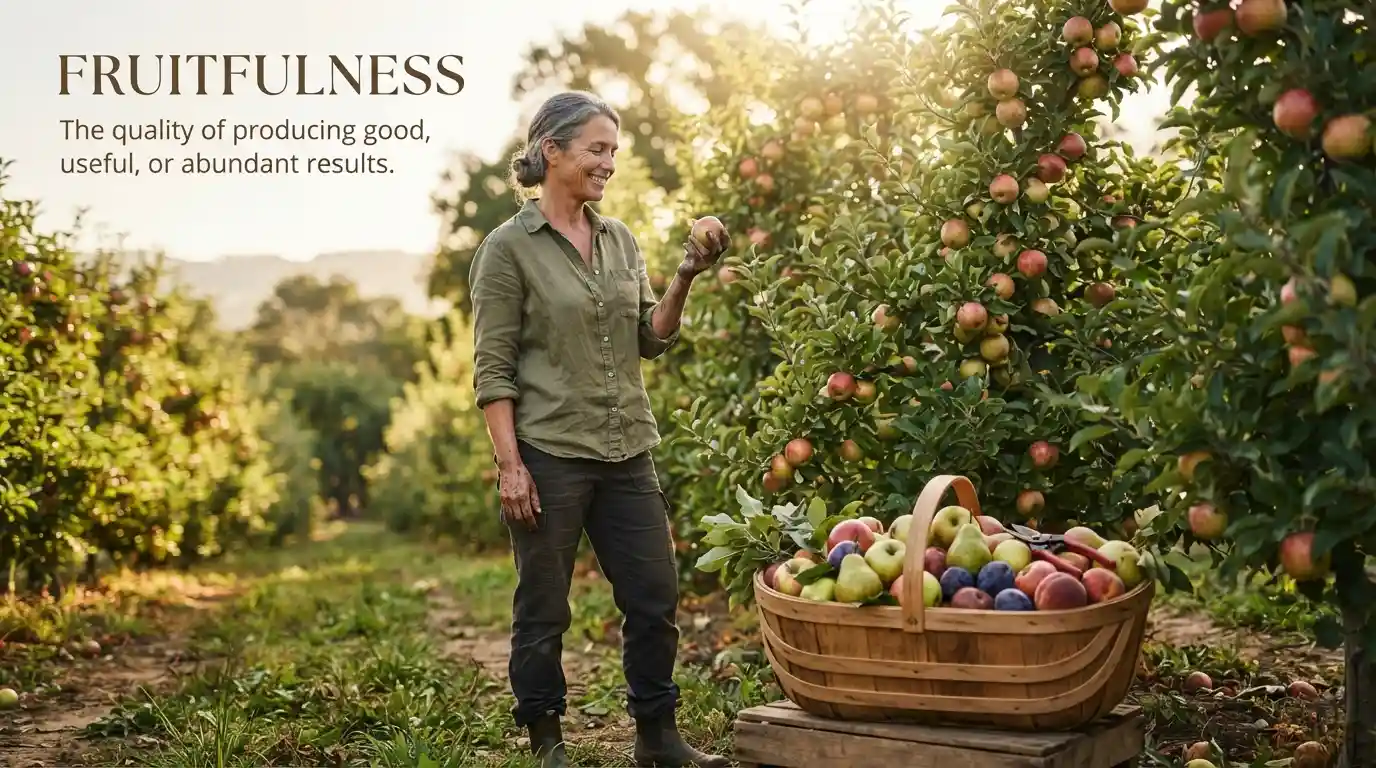
Fruitfulness often becomes important when your hard work finally produces something valuable. A student studies for months, a writer publishes useful content, and effort begins to show real results.
Learning a synonym for fruitfulness helps you describe success with greater precision. Instead of repeating one word, you can choose a synonym that better matches growth, productivity, or positive results.
The word fruitfulness commonly appears when people discuss productive work, successful efforts, rich ideas, or the ability to produce good results. It has a positive and encouraging feeling.
For students, bloggers, content writers, and daily English users, knowing each synonym for fruitfulness can improve writing, speaking, essays, and professional communication.
What Does “Fruitfulness” Really Mean?
Fruitfulness is a noun.
In simple English, fruitfulness means the quality or ability to produce useful, successful, or valuable results.
The word can describe literal production. For example, fertile land may have fruitfulness because it produces many crops.
More commonly, however, people use it figuratively. They may talk about the fruitfulness of a discussion, project, partnership, idea, or period of work.
Native speakers often understand fruitfulness as more than simply “being busy.” It suggests that something produces worthwhile outcomes.
Common contexts
Fruitfulness can appear in discussions about:
- Agriculture and land
- Work and productivity
- Creative ideas
- Research and learning
- Business projects
- Partnerships and cooperation
- Personal growth
- Efforts that lead to valuable results
Simple definition
Fruitfulness is the ability or quality of producing many useful, valuable, or successful results.
Connotative Meaning
Connotation (the feeling, association, or emotional meaning that a word carries beyond its basic definition) can affect how people understand a word.
Positive tone: Fruitfulness usually has a positive tone. It suggests growth, value, success, and productive results.
Negative tone: The word itself does not normally carry a negative meaning. However, context can describe fruitfulness as excessive or unwanted in rare situations.
Neutral tone: In agriculture, science, or formal analysis, fruitfulness can sound more neutral and descriptive.
Etymology of “Fruitfulness”
The word fruitfulness comes from fruitful, which developed from fruit. The word fruit entered English through Old French and ultimately comes from the Latin word fructus.
The Latin word fructus referred to enjoyment, produce, yield, or the result of something.
Old English (450–1100)
The modern word fruitfulness did not exist in its current form during Old English. English speakers used other words to describe fertility, crops, growth, and abundance.
Middle English (1100–1500)
After the Norman Conquest, the word fruit entered English through Old French. It gradually developed both literal and figurative meanings.
Modern English (1500–Present)
The adjective fruitful became widely used to describe something that produced useful results. Fruitfulness developed as the noun form describing that productive quality.
Pronunciation (US & UK – IPA)
- US: /ˈfruːtfəlnəs/
- UK: /ˈfruːtfəlnəs/
Syllables
fruit-ful-ness
Affixation Pattern
Root: fruit
Prefix: None
Suffix: -ful + -ness
The suffix -ful helps create the adjective fruitful. The suffix -ness then changes it into the noun fruitfulness.
Synonyms List:
The following words offer useful alternatives. However, not every synonym fits every sentence.
Some focus on producing results. Others emphasize quantity, growth, success, fertility, or creative output.
Productivity (Noun) — US /prəˌdʌkˈtɪvəti/ | UK /prəˌdʌkˈtɪvəti/
Meaning: The ability to produce a large amount of useful work or results.
Tone & Register: Neutral, professional, academic
Examples
The new schedule improved the team’s productivity.
Small changes can increase productivity at work.

Fertility (Noun) — US /fərˈtɪləti/ | UK /fəˈtɪləti/
Meaning: The natural ability to produce crops, offspring, or growth.
Tone & Register: Scientific, agricultural, formal
Examples
The soil has excellent fertility.
Farmers protect fertility through careful land management.
Abundance (Noun) — US /əˈbʌndəns/ | UK /əˈbʌndəns/
Meaning: A large quantity or plentiful supply of something valuable.
Tone & Register: Neutral, literary, descriptive
Examples
The garden produced an abundance of vegetables.
The workshop offered an abundance of useful ideas.
Plentifulness (Noun) — US /ˈplentifəlnəs/ | UK /ˈplentifəlnəs/
Meaning: The state of existing or being available in large amounts.
Tone & Register: Formal, descriptive
Examples
The region is known for the plentifulness of its natural resources.
Spring brings a sense of plentifulness to the countryside.
Productiveness (Noun) — US /prəˈdʌktɪvnəs/ | UK /prəˈdʌktɪvnəs/
Meaning: The quality of producing useful or successful results.
Tone & Register: Formal, academic
Examples
The productiveness of the meeting surprised everyone.
Good planning can improve the productiveness of a team.
Prolificacy (Noun) — US /proʊlɪˈfɪkəsi/ | UK /prəˈlɪfɪkəsi/
Meaning: The ability to produce many works, ideas, or results.
Tone & Register: Formal, academic
Examples
The author’s prolificacy impressed young writers.
Her prolificacy produced several strong research papers.
Prolificness (Noun) — US /prəˈlɪfɪknəs/ | UK /prəˈlɪfɪknəs/
Meaning: The state of producing many things or results.
Tone & Register: Formal
Examples
The artist’s prolificness shaped her career.
The team’s prolificness created a steady flow of ideas.
Richness (Noun) — US /ˈrɪtʃnəs/ | UK /ˈrɪtʃnəs/
Meaning: A quality of being full of valuable, interesting, or plentiful elements.
Tone & Register: Neutral, descriptive
Examples
The discussion had a richness that everyone appreciated.
The novel gained power from the richness of its detail.
Bounty (Noun) — US /ˈbaʊnti/ | UK /ˈbaʊnti/
Meaning: A generous amount of something useful or valuable.
Tone & Register: Literary, descriptive
Examples
The farmers celebrated the season’s bounty.
The project brought a bounty of fresh opportunities.
Yield (Noun) — US /jiːld/ | UK /jiːld/
Meaning: The amount produced by land, work, or an investment.
Tone & Register: Professional, agricultural, financial
Examples
The farm increased its wheat yield this year.
Better research methods can improve the yield of useful data.
Output (Noun) — US /ˈaʊtpʊt/ | UK /ˈaʊtpʊt/
Meaning: The amount of work, goods, or results produced.
Tone & Register: Professional, technical
Examples
The factory increased its daily output.
The writer maintained a steady output of articles.
Production (Noun) — US /prəˈdʌkʃən/ | UK /prəˈdʌkʃən/
Meaning: The process or amount of creating or producing something.
Tone & Register: Neutral, professional
Examples
The company expanded production last month.
Content production requires planning and consistency.
Generation (Noun) — US /ˌdʒenəˈreɪʃən/ | UK /ˌdʒenəˈreɪʃən/
Meaning: The process of creating or producing something.
Tone & Register: Formal, technical, academic
Examples
The campaign focused on lead generation.
Brainstorming supports the generation of new ideas.
Growth (Noun) — US /ɡroʊθ/ | UK /ɡrəʊθ/
Meaning: An increase in size, value, ability, or development.
Tone & Register: Neutral, professional
Examples
The business showed steady growth this year.
Daily practice supports vocabulary growth.
Development (Noun) — US /dɪˈveləpmənt/ | UK /dɪˈveləpmənt/
Meaning: The process of improving, expanding, or becoming more advanced.
Tone & Register: Neutral, academic, professional
Examples
The project supported the development of new skills.
Regular feedback encourages professional development.
Progress (Noun) — US /ˈprɑːɡres/ | UK /ˈprəʊɡres/
Meaning: Forward movement toward improvement or a successful result.
Tone & Register: Neutral, professional
Examples
The team made excellent progress this week.
Practice creates progress over time.
Success (Noun) — US /səkˈses/ | UK /səkˈses/
Meaning: The achievement of a desired result or goal.
Tone & Register: Neutral, positive
Examples
The campaign became a major success.
Her success came from patience and consistent effort.
Effectiveness (Noun) — US /ɪˈfektɪvnəs/ | UK /ɪˈfektɪvnəs/
Meaning: The ability to achieve the intended result.
Tone & Register: Professional, academic
Examples
The survey measured the effectiveness of the program.
Clear communication improves team effectiveness.
Efficiency (Noun) — US /ɪˈfɪʃənsi/ | UK /ɪˈfɪʃənsi/
Meaning: The ability to achieve results with little wasted time or effort.
Tone & Register: Professional, technical
Examples
The new system improved efficiency.
Automation can increase workplace efficiency.
Prosperity (Noun) — US /prɑːˈsperəti/ | UK /prɒˈsperəti/
Meaning: A state of success, wealth, or thriving development.
Tone & Register: Formal, positive
Examples
The city experienced years of prosperity.
Education can support long-term prosperity.
Flourishing (Noun) — US /ˈflɜːrɪʃɪŋ/ | UK /ˈflʌrɪʃɪŋ/
Meaning: A period or state of growing, developing, and succeeding strongly.
Tone & Register: Positive, descriptive
Examples
The community is enjoying a period of flourishing.
Her creative flourishing began after she changed careers.
Thriving (Noun/Adjective) — US /ˈθraɪvɪŋ/ | UK /ˈθraɪvɪŋ/
Meaning: Strong growth and successful development.
Tone & Register: Positive, conversational
Examples
The small business is thriving.
The garden is thriving after the spring rain.

Fecundity (Noun) — US /fɪˈkʌndəti/ | UK /fɪˈkʌndəti/
Meaning: The ability to produce many offspring, ideas, or creative works.
Tone & Register: Formal, literary, academic
Examples
The writer’s imagination showed remarkable fecundity.
The research demonstrated the fecundity of the approach.
Fecundness (Noun) — US /fɪˈkʌndnəs/ | UK /fɪˈkʌndnəs/
Meaning: The quality of being highly capable of producing results or new ideas.
Tone & Register: Formal, literary
Examples
The period was marked by intellectual fecundity.
Her artistic fecundity impressed the gallery.
Creativeness (Noun) — US /kriˈeɪtɪvnəs/ | UK /kriˈeɪtɪvnəs/
Meaning: The ability to produce original and useful ideas.
Tone & Register: Neutral, educational
Examples
The task encouraged creativity among students.
Travel often increases creative thinking and creativity.
Creativity (Noun) — US /ˌkriːeɪˈtɪvəti/ | UK /ˌkriːeɪˈtɪvəti/
Meaning: The ability to create original ideas or valuable new work.
Tone & Register: Neutral, positive
Examples
Creativity helped the team solve the problem.
The campaign depended on strong creativity.
Inventiveness (Noun) — US /ɪnˈventɪvnəs/ | UK /ɪnˈventɪvnəs/
Meaning: The ability to produce clever and original ideas or solutions.
Tone & Register: Positive, professional
Examples
Her inventiveness solved several design problems.
The competition rewarded technical inventiveness.
Resourcefulness (Noun) — US /rɪˈsɔːrsfəlnəs/ | UK /rɪˈsɔːsfəlnəs/
Meaning: The ability to find useful solutions and make effective use of available resources.
Tone & Register: Positive, professional
Examples
His resourcefulness helped the team meet the deadline.
Resourcefulness becomes valuable during unexpected problems.
Resultfulness (Noun) — US /rɪˈzʌltfəlnəs/ | UK /rɪˈzʌltfəlnəs/
Meaning: The quality of producing meaningful or useful results.
Tone & Register: Rare, formal
Examples
The strategy’s resultfulness became clear over time.
Teachers discussed the resultfulness of the new method.
Yieldingness (Noun) — US /ˈjiːldɪŋnəs/ | UK /ˈjiːldɪŋnəs/
Meaning: The capacity to produce or provide a result.
Tone & Register: Rare, formal
Examples
The soil’s yieldingness improved after careful treatment.
Researchers measured the yieldingness of different materials.
Productivity — /ˌprɒdʌkˈtɪvəti/ (UK), /ˌproʊdʌkˈtɪvəti/ (US)
Meaning: The ability to produce useful results, goods, ideas, or a significant amount of work.
Tone & Register: Neutral to formal; common in business, academic, agricultural, and professional contexts.
Examples:
The productivity of the farm increased after better irrigation methods were introduced.
Creative freedom can improve productivity in the workplace.
Productiveness — /prəˈdʌktɪvnəs/ (UK), /prəˈdʌktɪvnəs/ (US)
Meaning: The quality of producing useful results, growth, or a large amount of output.
Tone & Register: Formal and professional; often used in academic or technical writing.
Examples:
The productiveness of the soil supports a variety of crops.
The manager praised the productivity of the research team.
Fecundity — /fəˈkʌndəti/ (UK), /fəˈkʌndəti/ (US)
Meaning: The ability to produce abundantly, especially offspring, plants, ideas, or creative work.
Tone & Register: Formal and literary; common in academic, biological, and intellectual contexts.
Examples:
The fecundity of the fertile land allows farmers to grow several crops.
The writer’s fecundity produced many influential ideas.
Fertility — /fəˈtɪləti/ (UK), /fərˈtɪləti/ (US)
Meaning: The ability of land, plants, animals, or people to produce abundantly.
Tone & Register: Neutral to formal; widely used in agriculture, biology, and general English.
Examples:
Farmers work carefully to maintain the fertility of the soil.
The fertility of the valley supports a thriving agricultural community.
Abundance — /əˈbʌndəns/ (UK), /əˈbʌndəns/ (US)
Meaning: A large or plentiful amount of something, especially useful resources or natural products.
Tone & Register: Neutral; very common and versatile in everyday and formal English.
Examples:
The abundance of rainfall helped the crops grow quickly.
The region is known for its abundance of natural resources.
Copiousness — /ˈkəʊpiəsnəs/ (UK), /ˈkoʊpiəsnəs/ (US)
Meaning: The quality of being abundant, plentiful, or available in large quantities.
Tone & Register: Formal and descriptive; more common in literary or academic writing.
Examples:
The copiousness of the harvest exceeded the farmers’ expectations.
The copiousness of rainfall created ideal conditions for plant growth.
Luxuriance — /lʌɡˈʒʊəriəns/ (UK), /lʌɡˈʒʊriəns/ (US)
Meaning: Rich and abundant growth, especially of plants or vegetation.
Tone & Register: Literary and descriptive; often used for nature and landscapes.
Examples:
The luxuriance of the garden reflects the region’s fertile climate.
Visitors admired the luxuriance of the tropical vegetation.
Plentifulness — /ˈplentɪfəlnəs/ (UK), /ˈplentɪfəlnəs/ (US)
Meaning: The state of being available or produced in large amounts.
Tone & Register: Neutral to formal; descriptive and straightforward.
Examples:
The plentifulness of fresh produce benefits the local community.
The plentifulness of water supports farming throughout the region.
Richness — /ˈrɪtʃnəs/ (UK), /ˈrɪtʃnəs/ (US)
Meaning: The quality of being abundant, fertile, productive, or full of valuable resources.
Tone & Register: Neutral and highly versatile; useful in everyday, academic, and descriptive English.
Examples:
The richness of the soil allows farmers to grow healthy crops.
The richness of her imagination makes her stories engaging.
Bounty — /ˈbaʊnti/ (UK), /ˈbaʊnti/ (US)
Meaning: A generous or abundant supply of something valuable, especially food or natural produce.
Tone & Register: Neutral to literary; often positive and associated with nature or harvests.
Examples:
The farmers celebrated the bounty of the autumn harvest.
The river provides a natural bounty for nearby communities.
Profusion — /prəˈfjuːʒən/ (UK), /prəˈfjuːʒən/ (US)
Meaning: A large or abundant amount of something, especially flowers, plants, ideas, or resources.
Tone & Register: Formal and literary; often creates a vivid sense of abundance.
Examples:
The garden contains a profusion of colorful flowers.
The discussion generated a profusion of creative ideas.
Plenitude — /ˈplenɪtjuːd/ (UK), /ˈplenɪtuːd/ (US)
Meaning: A state of abundance, fullness, or having more than enough of something.
Tone & Register: Formal and literary; less common in everyday conversation.
Examples:
The fertile valley provides a plenitude of fresh produce.
The project created a plenitude of opportunities for young people.
Prosperity — /prɒˈsperəti/ (UK), /prɑːˈsperəti/ (US)
Meaning: A state of success, growth, and material well-being resulting from productive activity.
Tone & Register: Neutral to formal; common in economic, social, and professional contexts.
Examples:
The productivity of the region contributed to its prosperity.
Farmers enjoyed greater prosperity after several successful harvests.
Success — /səkˈses/ (UK), /səkˈses/ (US)
Meaning: The achievement of a desired or valuable result.
Tone & Register: Neutral; extremely common and useful in everyday and formal English.
Examples:
The success of the project demonstrated the fruitfulness of the new approach.
Her research achieved considerable success within the academic community.
Effectiveness — /ɪˈfektɪvnəs/ (UK), /ɪˈfektɪvnəs/ (US)
Meaning: The ability to produce the intended or desired result.
Tone & Register: Neutral to formal; especially common in professional, academic, and technical contexts.
Examples:
The effectiveness of the new method improved agricultural production.
Researchers tested the effectiveness of the strategy over several months.
Efficacy — /ˈefɪkəsi/ (UK), /ˈefɪkəsi/ (US)
Meaning: The ability of something to produce a successful or intended result.
Tone & Register: Formal; especially common in medical, scientific, and academic writing.
Examples:
The study examined the efficacy of the new treatment.
Researchers confirmed the efficacy of the farming technique.
Efficiency — /ɪˈfɪʃənsi/ (UK), /ɪˈfɪʃənsi/ (US)
Meaning: The ability to produce a desired result with effective use of time, energy, or resources.
Tone & Register: Neutral to formal; widely used in business, technology, and professional English.
Examples:
The new system improved the efficiency of agricultural production.
Better planning increased the team’s efficiency and output.
Exuberance — /ɪɡˈzjuːbərəns/ (UK), /ɪɡˈzuːbərəns/ (US)
Meaning: A quality of abundant growth, energy, or lively expression.
Tone & Register: Positive and literary; often used for nature, personality, or creative expression.
Examples:
The exuberance of the vegetation transformed the dry landscape.
Her exuberance brought fresh energy to the creative project.
Fructiferousness — /ˌfrʌktɪˈfɪərəsnəs/ (UK), /ˌfrʌktəˈfɪrəsnəs/ (US)
Meaning: The quality of producing fruit, useful results, or valuable outcomes.
Tone & Register: Very formal and uncommon; mainly suitable for advanced or specialized writing.
Examples:
The fructiferousness of the land impressed the agricultural researchers.
The study demonstrated the fructiferousness of the new approach.
Potency — /ˈpəʊtənsi/ (UK), /ˈpoʊtənsi/ (US)
Meaning: The power or capacity to produce a strong, effective, or significant result.
Tone & Register: Formal; common in scientific, medical, and professional contexts.
Examples:
The potency of the new method increased agricultural output.
The research revealed the potency of the strategy in improving productivity.

Synonyms by Tone
Tone matters because each word highlights a different part of the meaning.
Positive
Abundance, bounty, prosperity, flourishing, thriving, creativity, inventiveness, and resourcefulness create an encouraging and optimistic feeling.
Use them when you want to emphasize growth, success, richness, or positive development.
Neutral
Productivity, output, production, yield, growth, development, progress, effectiveness, and efficiency work well in everyday, academic, and professional contexts.
These words focus more on measurable results.
Formal
Fertility, productiveness, prolificacy, fecundity, fecundness, and generation often sound more academic, literary, scientific, or specialized.
Choose them when your context requires greater precision.
Playful or Informal
No perfect playful synonym for fruitfulness exists. In casual English, native speakers usually choose simpler expressions such as being productive, doing well, or getting great results.
Fruitfulness vs Close Alternatives
| Word | Main Meaning | Best Context |
|---|---|---|
| Fruitfulness | Ability to produce valuable results | General, literary, formal |
| Productivity | Amount of useful work or output | Work and business |
| Fertility | Ability to produce natural growth | Agriculture and biology |
| Fecundity | Strong ability to produce ideas or offspring | Academic and literary |
| Abundance | A large amount of something | Resources and results |
Fruitfulness is broad and often sounds slightly formal.
Productivity focuses on work and measurable output.
Fertility usually relates to land, living things, or biological reproduction.
How “Fruitfulness” Changes by Context
Daily conversation
In everyday conversation, fruitfulness may sound formal.
People often say productivity, success, growth, or good results instead.
For example: “The meeting was productive” sounds more natural than “The meeting showed fruitfulness.”
Writing or blogging
Fruitfulness works well in reflective or descriptive writing.
A blogger might describe the fruitfulness of a strategy, creative process, or long-term effort.
Professional or academic tone
Academic writing may use productivity, effectiveness, output, yield, or fecundity, depending on the subject.
These words can offer more precise meaning.
Creative or informal use
Creative writers may use fruitfulness, richness, bounty, or abundance to create a stronger image.
These choices can make writing feel warmer and more expressive.
Common Mistakes Learners Make
Using fruitfulness for every kind of success
Not every successful result represents fruitfulness.
A single successful event is usually better described as success or achievement.
Confusing productivity with efficiency
Productivity focuses on how much useful work you produce.
Efficiency focuses on how well you use time, effort, or resources.
Using fertility for business success
Fertility normally relates to land, biology, or reproduction.
For a successful company, growth, productivity, or prosperity is usually more natural.
Choosing rare words unnecessarily
Words such as fecundity and prolificacy are accurate in certain contexts.
However, they may sound unnatural in casual conversation.
Register Notes
In formal writing, fruitfulness can sound thoughtful and expressive.
In everyday speech, native speakers often prefer productive, successful, useful, or effective.
For related vocabulary, you may also explore an internal article about synonyms for productive.
Real-Life Examples Using “Fruitfulness”
Workplace
A manager reviews the fruitfulness of a new strategy after several months.
The discussion focuses on useful outcomes rather than activity alone.
Social situations
Two friends discuss the fruitfulness of joining a language group.
They notice better confidence and stronger communication skills.
Media and creative work
A writer describes a highly productive year as a period of creative fruitfulness.
The phrase suggests both quantity and valuable quality.
Writing and storytelling
An author may describe a peaceful period as one of intellectual fruitfulness.
The expression gives the sentence a reflective and literary tone.
Practice Quiz:
Workplace and Professional Usage
1. A manager wants to measure how much useful work the team completes. Which word fits best?
A. Fertility
B. Productivity
C. Bounty
D. Fecundity
2. A company achieves the same results while wasting less time and money. What improved?
A. Efficiency
B. Abundance
C. Richness
D. Fecundness
3. A marketing campaign successfully achieves its intended goal. Which word fits best?
A. Yield
B. Effectiveness
C. Fertility
D. Plentifulness
Growth and Development
4. A town experiences strong economic success and improving living conditions. Which word fits best?
A. Prosperity
B. Output
C. Generation
D. Yieldingness
5. A student’s skills improve steadily through daily practice. Which word best describes this change?
A. Bounty
B. Progress
C. Fecundity
D. Production
6. A garden produces far more vegetables than the family expected. Which word fits best?
A. Abundance
B. Efficiency
C. Effectiveness
D. Inventiveness
Creative and Academic Usage
7. A novelist produces many books and original ideas throughout her career. Which word fits best?
A. Fecundity
B. Fertility
C. Yieldingness
D. Efficiency
8. An engineer creates a clever solution using limited materials. Which quality does this show?
A. Resourcefulness
B. Plentifulness
C. Output
D. Prosperity
9. A classroom activity encourages students to produce original ideas. Which word fits best?
A. Creativity
B. Yield
C. Production
D. Fertility
Everyday Meaning and Context
10. Which word is the best general alternative when you mean “the ability to produce useful results”?
A. Productiveness
B. Fertility
C. Bounty
D. Prosperity
11. A farm measures the amount of wheat produced during the season. What does it measure?
A. Yield
B. Richness
C. Inventiveness
D. Flourishing
12. A small company is growing strongly and doing very well. Which word sounds most natural?
A. Thriving
B. Yieldingness
C. Prolificacy
D. Plentifulness
Reflection Task
Write one sentence about your studies, work, garden, writing, or daily routine.
Use fruitfulness, productivity, creativity, growth, or another synonym from this article.
Answer Key
1-B | 2-A | 3-B | 4-A | 5-B | 6-A | 7-A | 8-A | 9-A | 10-A | 11-A | 12-A
FAQs
1. What is the best synonym for fruitfulness?
The best synonym for fruitfulness depends on your context. Productivity works best for work and output. Fertility suits agriculture and biology. Abundance emphasizes a large quantity. Fecundity can describe strong creative or reproductive ability. For general useful results, productiveness is often the closest alternative.
2. Is productivity the same as fruitfulness?
Productivity and fruitfulness have similar meanings, but they are not always identical. Productivity usually focuses on the amount of useful work or output produced. Fruitfulness has a broader meaning and can describe valuable results from work, creativity, discussions, relationships, or long-term efforts.
3. Can fruitfulness describe a person?
Yes. Fruitfulness can describe a person’s work, creativity, ideas, or efforts. However, native speakers may find phrases such as creative productivity, success, or prolific output more natural in everyday English. The best choice depends on whether you want a formal, literary, or conversational tone.
4. What is the difference between fruitfulness and fertility?
Fruitfulness usually refers to producing useful or valuable results in a broad sense. Fertility more specifically describes the ability of land, plants, animals, or people to produce crops or offspring. Fertility can also appear figuratively, especially when discussing ideas or creative thinking.
5. What is a formal synonym for fruitfulness?
Several formal alternatives exist, including productiveness, fecundity, prolificacy, and fertility. Fecundity often appears in academic or literary writing. Productiveness is useful when discussing successful output. Choose the word that matches your exact subject rather than using a formal word simply to sound more advanced.
6. How can I use fruitfulness in a sentence?
You can use fruitfulness to describe the positive results of an effort, process, or period. For example: “The researchers discussed the fruitfulness of the new approach.” You can also use it more creatively: “The quiet months became a period of artistic fruitfulness.”
7. Is fruitfulness commonly used in everyday English?
Fruitfulness is understandable, but it is less common in casual conversation than words such as productivity, success, growth, or good results. Native speakers often choose those simpler alternatives in everyday speech. Fruitfulness appears more naturally in formal, reflective, literary, agricultural, and religious contexts.
Conclusion
Learning a synonym for fruitfulness gives you more control over your English. You can choose productivity for work, abundance for quantity, and creativity for original ideas.
Small differences between synonyms can make your writing clearer. The right word also helps your essays, blogs, emails, and conversations sound more natural and precise.
Vocabulary growth is not about using difficult words everywhere. It is about understanding meaning, tone, and context. That skill can make your communication stronger and more confident.
Now choose three words from this article and use them in your own sentences. Practice them in emails, essays, blog posts, and daily conversations to make them part of your active vocabulary.

I’m Hezel, a passionate English language enthusiast and the creator of Synworda.com. I love exploring synonyms, vocabulary, grammar, and the many ways words can make communication clearer and more effective. Through Synworda.com, I create simple, practical, and easy-to-understand content for students, writers, professionals, and anyone who wants to improve their English. I enjoy breaking down confusing words and grammar concepts into helpful explanations with clear examples. I aim to make learning English feel less complicated and more enjoyable. I believe that understanding the right words can help everyone communicate with confidence in everyday life.