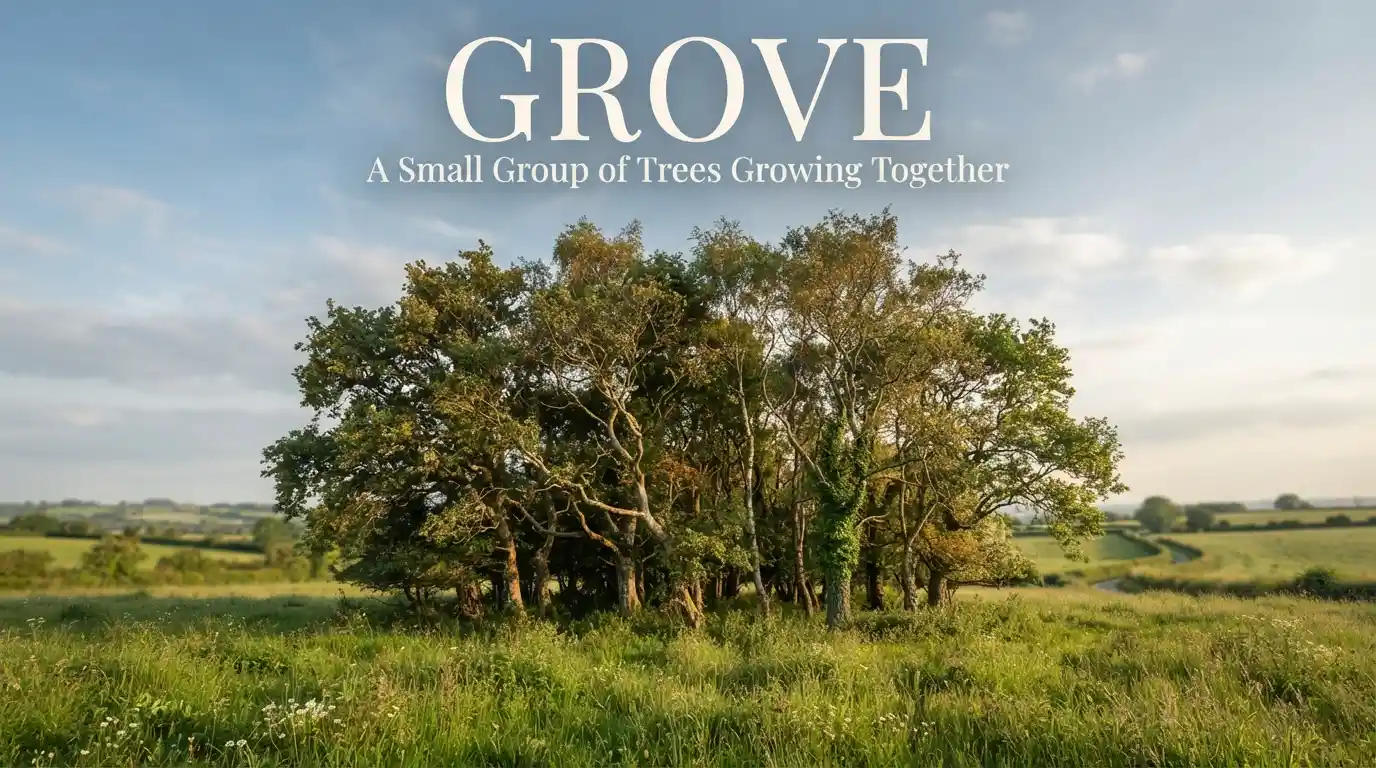
Synonym for grove can include copse, woodland, woodlot, thicket, coppice, spinney, and stand of trees. The best choice depends on the size, purpose, density, and setting of the trees.
Synonym for grove becomes useful when you describe a peaceful walk, an orchard, or a small wooded place and want more precise vocabulary.
Imagine walking past a quiet grove of olive trees at sunset. Words like copse or woodland can make that scene more vivid.
Learning a synonym for grove helps students, bloggers, writers, and daily English users describe natural places with greater variety and accuracy.
The word grove is common in nature writing and everyday descriptions. Knowing its alternatives makes your English sound richer without becoming complicated.
What Does “Grove” Really Mean?
A grove is a small group or area of trees growing close together. It can occur naturally or be planted deliberately, especially for fruit or nuts.
The word is usually a noun.
Simple Definition
Grove (noun): a small group of trees, often growing together in a particular area.
For example:
We rested beneath a shady grove.
The farmer owns an orange grove.
A grove is normally smaller than a forest. It often suggests a compact and visually distinct group of trees.
Oxford also notes that grove can describe a small area planted with particular fruit trees, such as an olive grove.
How Native Speakers Understand “Grove”
Native speakers generally picture a relatively small, pleasant, or defined area containing trees.
The word can sound slightly literary or descriptive when it refers to a natural group of trees. In agricultural contexts, however, it is completely ordinary.
Common expressions include:
- an olive grove
- an orange grove
- a coconut grove
- a pine grove
- a birch grove
- a sacred grove
- a quiet grove
- a shady grove
Connotative Meaning
Connotation (the feeling or association a word suggests beyond its basic meaning) can affect how grove feels in a sentence.
Positive tone: A grove can suggest peace, beauty, shade, nature, and relaxation.
Negative tone: The word itself is rarely negative, although a dark or isolated grove can create an eerie mood in storytelling.
Neutral tone: In farming and geographical descriptions, grove can simply identify an area containing trees.
Etymology of “Grove”
The word grove is very old in English.
Oxford traces it to Old English grāf, describing a grove, with Germanic origins.
Old English: 450–1100
The Old English form was grāf. It referred to a grove or copse.
Its exact deeper origin is uncertain. Etymological sources note that the word has no clearly established cognates across the Germanic languages.
Middle English: 1100–1500
The word developed into forms such as grove, grave, and grof.
The modern spelling gradually became established as grove.
Modern English: 1500–Present
The modern form grove retained its central meaning of a small group of trees.
It also developed strong associations with fruit cultivation, such as olive grove and orange grove.
Pronunciation
Grove
- US: /ɡroʊv/
- UK: /ɡrəʊv/
Syllables
grove
It has one syllable.
Affixation Pattern of “Grove”
Root: grove
Prefix: none
Suffix: none
Word type: Simple lexical noun
Synonyms List:
Below are useful alternatives to grove. Some are direct synonyms, while others are close contextual alternatives. The distinction matters because not every tree-related word can replace grove in every sentence.
Copse (Noun) — US / UK: /kɑːps/
Meaning: A small group or area of trees, usually smaller than a large woodland.
Tone/Register: Neutral, literary, descriptive
Examples:
We followed the narrow path into a quiet copse.
Birds were singing somewhere inside the copse.
Woodland (Noun) — US / UK: /ˈwʊdlənd/
Meaning: An area covered mainly by trees and usually larger or more extensive than a grove.
Tone/Register: Neutral, descriptive
Examples:
The children explored the nearby woodland.
A narrow trail led through the woodland.
Wood (Noun) — US / UK: /wʊd/
Meaning: A wooded area that is generally larger than a grove but smaller or less extensive than a forest.
Tone/Register: Neutral, everyday
Examples:
We walked through the wood after lunch.
The old wood was full of birds.
Woodlot (Noun) — US / UK: /ˈwʊdlɑːt/
Meaning: A small area of woodland, often managed for timber or other practical purposes.
Tone/Register: Neutral, technical
Examples:
The family manages a small woodlot behind the house.
Several trees were planted in the woodlot last spring.
Thicket (Noun) — US / UK: /ˈθɪkɪt/
Meaning: A dense area of bushes, shrubs, or closely growing trees.
Tone/Register: Neutral, descriptive
Examples:
A rabbit disappeared into the thicket.
The trail became difficult near the thicket.
Coppice (Noun) — US / UK: /ˈkɑːpɪs/; UK /ˈkɒpɪs/
Meaning: A small area of trees that are regularly cut and allowed to regrow.
Tone/Register: Formal, ecological, forestry
Examples:
The path passes beside an old coppice.
The woodland was once managed as a coppice.
Spinney (Noun) — US / UK: /ˈspɪni/
Meaning: A small area of trees, especially a small wood.
Tone/Register: British, literary, descriptive
Examples:
A fox disappeared into the spinney.
The old spinney bordered the farmer’s field.
Stand of Trees (Noun Phrase) — US / UK: /stænd əv triːz/
Meaning: A group of trees growing together in a particular area.
Tone/Register: Neutral, technical
Examples:
A stand of pine trees covered the hillside.
The researchers measured the stand of trees carefully.
Clump of Trees (Noun Phrase) — US / UK: /klʌmp əv triːz/
Meaning: A closely grouped collection of trees.
Tone/Register: Neutral, everyday
Examples:
A clump of trees provided shade near the road.
We stopped beside the clump of trees.
Cluster of Trees (Noun Phrase) — US / UK: /ˈklʌstər əv triːz/
Meaning: A group of trees growing relatively close together.
Tone/Register: Neutral, descriptive
Examples:
A cluster of trees stood at the edge of the field.
The birds gathered in a cluster of trees.
Small Woodland (Noun Phrase) — US / UK: /smɔːl ˈwʊdlənd/
Meaning: A relatively small wooded area containing several trees.
Tone/Register: Neutral
Examples:
The village has a small woodland nearby.
We found a small woodland behind the school.
Wooded Area (Noun Phrase) — US / UK: /ˈwʊdɪd ˈeriə/
Meaning: A piece of land containing many trees.
Tone/Register: Neutral, formal
Examples:
The hiking route crosses a wooded area.
The house overlooks a wooded area.
Orchard (Noun) — US / UK: /ˈɔːrtʃərd/
Meaning: An area where fruit trees are deliberately planted and cultivated.
Tone/Register: Neutral, agricultural
Examples:
The family owns an apple orchard.
We picked fresh fruit from the orchard.
Usage note: Orchard is not a perfect synonym for every grove. It is more specific because it normally involves cultivated fruit trees.
Fruit Grove (Noun Phrase) — US / UK: /fruːt ɡroʊv/; /fruːt ɡrəʊv/
Meaning: A group of fruit-producing trees planted or growing together.
Tone/Register: Neutral, agricultural
Examples:
The farm has a large fruit grove.
Workers inspected the fruit grove before harvest.
Olive Grove (Noun Phrase) — US / UK: /ˈɑːləv ɡroʊv/; /ˈɒlɪv ɡrəʊv/
Meaning: A cultivated area containing olive trees.
Tone/Register: Neutral, agricultural
Examples:
The village is surrounded by an olive grove.
They walked quietly between the olive trees.
Orange Grove (Noun Phrase) — US / UK: /ˈɔːrɪndʒ ɡroʊv/; /ˈɒrɪndʒ ɡrəʊv/
Meaning: An area where orange trees are grown.
Tone/Register: Neutral, agricultural
Examples:
The orange grove smelled fresh after the rain.
The workers entered the orange grove early.
Pine Grove (Noun Phrase) — US / UK: /paɪn ɡroʊv/; /paɪn ɡrəʊv/
Meaning: A small group or area of pine trees.
Tone/Register: Neutral, descriptive
Examples:
We camped near a peaceful pine grove.
The trail continued through the pine grove.
Sacred Grove (Noun Phrase) — US / UK: /ˈseɪkrɪd ɡroʊv/
Meaning: A group of trees regarded as spiritually or culturally important.
Tone/Register: Formal, cultural
Examples:
The community protects its sacred grove.
Visitors are asked to respect the sacred grove.
Tree Stand (Noun) — US / UK: /triː stænd/
Meaning: A group of trees occupying a particular area, especially in forestry.
Tone/Register: Technical, professional
Examples:
The survey recorded the age of each tree stand.
The forest contains several mature tree stands.
Tree Cluster (Noun) — US / UK: /triː ˈklʌstər/
Meaning: A group of trees growing close together.
Tone/Register: Neutral, descriptive
Examples:
A tree cluster blocked the view of the road.
We noticed a small tree cluster on the hill.
Small Wood (Noun Phrase) — US / UK: /smɔːl wʊd/
Meaning: A limited area of trees that forms a small wooded space.
Tone/Register: Neutral, British-friendly
Examples:
The children played near the small wood.
A small wood separated the two fields.
Bosquet (Noun) — US / UK: /bɒˈskeɪ/
Meaning: A formal group of trees, especially one arranged as part of a designed garden or park.
Tone/Register: Formal, literary, horticultural
Examples:
The palace garden contains a carefully planned bosquet.
Visitors admired the geometric arrangement of the bosquet.
Grovelet (Noun) — US / UK: /ˈɡroʊvlət/; /ˈɡrəʊvlət/
Meaning: A very small grove or little group of trees.
Tone/Register: Rare, literary
Examples:
A tiny grovelet stood beside the stream.
The grovelet offered a quiet place to rest.
Copsewood (Noun) — US / UK: /ˈkɑːpswʊd/; /ˈkɒpswʊd/
Meaning: A small wooded area or collection of trees.
Tone/Register: Literary, descriptive
Examples:
A narrow trail disappeared into the copsewood.
The copsewood provided shelter from the wind.
Tree Grove (Noun Phrase) — US / UK: /triː ɡroʊv/; /triː ɡrəʊv/
Meaning: A defined group of trees growing together.
Tone/Register: Neutral, descriptive
Examples:
A tree grove surrounded the old farmhouse.
We rested beside the tree grove.
Tree Patch (Noun Phrase) — US / UK: /triː pætʃ/
Meaning: A relatively small area containing a group of trees.
Tone/Register: Informal, neutral
Examples:
A tree patch offered shade beside the road.
The birds gathered around the tree patch.
Forest Patch (Noun Phrase) — US / UK: /ˈfɔːrɪst pætʃ/; /ˈfɒrɪst pætʃ/
Meaning: A limited section of forest separated from or distinct from a larger landscape.
Tone/Register: Academic, ecological
Examples:
The animals depend on the remaining forest patch.
Researchers mapped each forest patch.
Woodland Patch (Noun Phrase) — US / UK: /ˈwʊdlənd pætʃ/
Meaning: A small section of land covered with trees.
Tone/Register: Neutral, ecological
Examples:
A woodland patch lies behind the village.
The woodland patch attracts many birds.
Tree Cover (Noun) — US / UK: /triː ˈkʌvər/
Meaning: The amount or area of land covered by trees.
Tone/Register: Technical, environmental
Examples:
The region has extensive tree cover.
New planting increased the area’s tree cover.
Tree Growth (Noun) — US / UK: /triː ɡroʊθ/; /triː ɡrəʊθ/
Meaning: Trees growing collectively in a particular location.
Tone/Register: Neutral, ecological
Examples:
The hillside has healthy tree growth.
Natural tree growth has returned to the area.
Tree Population (Noun) — US / UK: /triː ˌpɑːpjəˈleɪʃən/
Meaning: The trees collectively growing within a particular area.
Tone/Register: Academic, scientific
Examples:
The researchers studied the local tree population.
The tree population has increased over time.
Tree Community (Noun) — US / UK: /triː kəˈmjuːnəti/
Meaning: A group of trees living together within an ecological environment.
Tone/Register: Academic, ecological
Examples:
The tree community supports several bird species.
Scientists examined the structure of the tree community.
Tree Assemblage (Noun) — US / UK: /triː əˈsemblɪdʒ/
Meaning: A collection of tree species occurring together in one area.
Tone/Register: Academic, scientific
Examples:
The study identified a diverse tree assemblage.
The tree assemblage changed after the disturbance.
Woody Vegetation (Noun Phrase) — US / UK: /ˈwʊdi ˌvedʒəˈteɪʃən/
Meaning: Plants with woody stems, including trees and shrubs, growing in an area.
Tone/Register: Scientific, academic
Examples:
The hillside supports dense woody vegetation.
Woody vegetation provides shelter for wildlife.
Woody Growth (Noun Phrase) — US / UK: /ˈwʊdi ɡroʊθ/
Meaning: Trees and shrubs growing densely or naturally in a particular location.
Tone/Register: Technical, descriptive
Examples:
Woody growth has spread along the stream.
The gardener cleared some woody growth.
Tree Belt (Noun) — US / UK: /triː belt/
Meaning: A strip or band of trees planted or growing together.
Tone/Register: Environmental, neutral
Examples:
A tree belt protects the fields from strong winds.
The village is bordered by a tree belt.
Shelterbelt (Noun) — US / UK: /ˈʃeltərbelt/
Meaning: A line or group of trees planted to protect land from wind.
Tone/Register: Agricultural, technical
Examples:
The farm has a shelterbelt along its northern edge.
The shelterbelt reduces wind damage to crops.
Windbreak (Noun) — US / UK: /ˈwɪndbreɪk/
Meaning: A row or group of trees planted to reduce the force of wind.
Tone/Register: Agricultural, environmental
Examples:
The farmers planted a windbreak around the fields.
The windbreak protects the young trees.
Tree Line (Noun) — US / UK: /triː laɪn/
Meaning: A boundary or line formed by trees growing together.
Tone/Register: Neutral, geographical
Examples:
We walked along the tree line.
The cabin stood just beyond the tree line.
Tree Beltway (Noun Phrase) — US / UK: /triː beltweɪ/
Meaning: A surrounding belt or ring of trees.
Tone/Register: Descriptive, specialized
Examples:
A tree beltway surrounds the property.
The tree beltway creates a natural boundary.
Grove Area (Noun Phrase) — US / UK: /ɡroʊv ˈeriə/; /ɡrəʊv ˈeəriə/
Meaning: A particular section of land occupied by a group of trees.
Tone/Register: Neutral
Examples:
The grove area is popular with visitors.
Signs mark the protected grove area.
Tree Reserve (Noun Phrase) — US / UK: /triː rɪˈzɜːrv/
Meaning: An area deliberately protected or maintained for trees.
Tone/Register: Environmental, formal
Examples:
The town created a tree reserve.
The tree reserve protects several native species.
Woodland Reserve (Noun Phrase) — US / UK: /ˈwʊdlənd rɪˈzɜːrv/
Meaning: A protected area containing woodland.
Tone/Register: Formal, environmental
Examples:
The woodland reserve attracts nature lovers.
Several rare birds live in the woodland reserve.
Forest Clearing (Noun Phrase) — US / UK: /ˈfɔːrɪst ˈklɪərɪŋ/
Meaning: An open area surrounded by trees within a forest.
Tone/Register: Neutral, descriptive
Examples:
We stopped for lunch in a forest clearing.
Sunlight filled the forest clearing.
Woodland Clearing (Noun Phrase) — US / UK: /ˈwʊdlənd ˈklɪərɪŋ/
Meaning: An open space within a wooded area.
Tone/Register: Neutral, descriptive
Examples:
The deer stood in a woodland clearing.
A small stream crossed the woodland clearing.
Tree Island (Noun Phrase) — US / UK: /triː ˈaɪlənd/
Meaning: A distinct group of trees surrounded by open land or a different type of vegetation.
Tone/Register: Ecological, descriptive
Examples:
A tree island stood in the middle of the grassland.
The birds used the tree island for shelter.
Vegetation Island (Noun Phrase) — US / UK: /ˌvedʒəˈteɪʃən ˈaɪlənd/
Meaning: A distinct patch of vegetation separated from surrounding plant communities.
Tone/Register: Academic, ecological
Examples:
The vegetation island supports unusual plant species.
Researchers recorded insects around the vegetation island.
Tree Enclave (Noun Phrase) — US / UK: /triː ˈenkleɪv/
Meaning: A small, distinct group of trees surrounded by a different landscape.
Tone/Register: Literary, descriptive
Examples:
A tree enclave remained untouched beside the highway.
The tree enclave created a peaceful green space.
Woodland Enclave (Noun Phrase) — US / UK: /ˈwʊdlənd ˈenkleɪv/
Meaning: A distinct small area of woodland surrounded by other land uses.
Tone/Register: Formal, descriptive
Examples:
A woodland enclave survives near the city.
The woodland enclave provides habitat for wildlife.
Tree Sanctuary (Noun Phrase) — US / UK: /triː ˈsæŋktʃuəri/
Meaning: A protected place where trees are preserved.
Tone/Register: Environmental, formal
Examples:
The community created a tree sanctuary.
The tree sanctuary protects old native trees.
Arboreal Area (Noun Phrase) — US / UK: /ɑːrˈbɔːriəl ˈeriə/
Meaning: An area characterized by trees or tree-based vegetation.
Tone/Register: Formal, scientific
Examples:
The species prefers an arboreal area.
The park contains several arboreal areas.
Arboretum (Noun) — US / UK: /ˌɑːrbəˈriːtəm/
Meaning: A place where many kinds of trees and woody plants are grown for study, conservation, or display.
Tone/Register: Formal, botanical
Examples:
The students visited the local arboretum.
The arboretum contains hundreds of tree species.
Tree Garden (Noun Phrase) — US / UK: /triː ˈɡɑːrdən/
Meaning: A landscaped or cultivated area designed around trees.
Tone/Register: Neutral, descriptive
Examples:
The hotel has a peaceful tree garden.
Visitors walked through the tree garden in the morning.
Tree Plantation (Noun Phrase) — US / UK: /triː plænˈteɪʃən/
Meaning: An area where trees are deliberately planted and managed.
Tone/Register: Agricultural, environmental
Examples:
The region contains a large tree plantation.
The tree plantation supplies timber for local industries.
Important: Grovelet is uncommon in modern everyday English. It is better suited to creative or literary writing than ordinary conversation.
Synonyms for Grove by Tone
Positive
These choices can create peaceful or pleasant imagery:
- grove
- woodland
- copse
- small wood
- pine grove
- olive grove
- fruit grove
They work well in travel writing, nature descriptions, stories, and reflective passages.
Neutral
These words are useful when you simply want to describe trees accurately:
- wood
- woodland
- woodlot
- stand of trees
- cluster of trees
- clump of trees
- wooded area
- tree stand
- tree cluster
Negative or Dense
Some alternatives can suggest difficulty, darkness, or heavy vegetation:
- thicket
- dense woodland
- thick growth
These words are useful when the trees or vegetation make movement difficult.
Playful or Informal
English does not have many genuinely playful direct synonyms for grove. Instead, casual speakers often use simple phrases such as group of trees or little wood.
Why Tone Matters
Choosing a synonym is not only about replacing one word with another.
A grove sounds peaceful. A thicket can sound dense and difficult to enter. A woodlot sounds practical. An orchard clearly suggests cultivated fruit trees.
The right word helps readers understand both the place and the feeling behind it.
“Grove” vs Close Alternatives
Grove vs Copse
A grove is a small group of trees and can have a pleasant or cultivated feeling.
A copse specifically suggests a small area of trees or woodland. It often sounds more British or literary.
Use grove for general nature descriptions. Use copse when you want to emphasize a small wooded patch.
Grove vs Woodland
A grove is generally smaller and more compact.
Woodland can cover a much larger area.
For example, a quiet grove beside the lake suggests a small cluster. A large woodland surrounding the village suggests a wider wooded landscape.
Grove vs Orchard
An orchard is specifically associated with cultivated fruit trees.
A grove can contain fruit trees, but it can also contain trees that are grown naturally or for other purposes.
So olive grove and olive orchard can overlap, but grove is often the more natural expression for olives.
How “Grove” Changes by Context
Daily Conversation
In everyday English, grove is easy to understand, especially when discussing parks, farms, gardens, travel, or nature.
For simple conversation, you can say:
There is a small grove behind the house.
If the exact type is unimportant, a group of trees is also natural.
Writing or Blogging
Grove is particularly useful in descriptive writing.
A travel blogger might write:
We walked through a peaceful olive grove before reaching the village.
Here, grove creates a stronger visual image than simply saying trees.
Professional or Academic Tone
Technical writing may prefer terms such as stand, woodlot, wooded area, or tree cluster.
Forestry researchers often need terminology that describes tree distribution and management more precisely.
Creative or Informal Use
In storytelling, grove can create atmosphere.
A writer might describe a moonlit grove as peaceful, mysterious, magical, or even frightening.
The surrounding adjectives often determine the emotional effect.
Common Mistakes Learners Make
Mistake 1: Using “grove” for one tree
A grove refers to a group of trees, not a single tree.
Incorrect:
There is a beautiful grove beside my house.
This sentence is fine only if several trees are meant. If there is just one tree, use tree.
Mistake 2: Treating “grove” and “forest” as identical
A forest is generally much more extensive.
A grove is usually a smaller collection of trees.
Mistake 3: Using “orchard” for every grove
An orchard normally contains cultivated fruit trees.
A grove may contain fruit trees, but it does not have to.
Mistake 4: Using “thicket” for a peaceful open grove
A thicket usually suggests dense vegetation.
If sunlight can easily pass between widely spaced trees, grove may be a better choice.
Mistake 5: Overusing “grove” in descriptive writing
Repeating the same word can make writing feel flat.
Try grove, copse, woodland, or stand of trees when the context supports them.
Register Notes
Grove is neutral enough for everyday English but can have a literary or descriptive quality.
Copse and spinney can sound more literary or British.
Woodlot and tree stand are more technical.
Orchard is practical and agricultural.
Bosquet is formal and specialized.
A good writer does not simply search for the longest synonym list. The goal is to choose the word that communicates the exact idea.
Real-Life Mini Scenarios
Workplace
A landscape designer may describe a tree stand when discussing planting plans.
A report might mention a wooded area near a proposed building site.
Social Situations
Someone describing a weekend walk might say:
We had lunch beside a quiet grove.
The word makes the setting easy to visualize.
Media and Pop Culture
Films and novels often use words such as grove, woodland, and thicket to establish mood.
A peaceful grove can suggest safety. A dark thicket can suggest mystery.
Writing and Storytelling
A storyteller might choose grove for a calm scene and thicket for a scene where a character struggles to move through dense vegetation.
This is an important lesson in vocabulary: synonyms can change the atmosphere of a sentence.
How to Choose the Best Synonym for Grove
Choose grove when you mean a small group of trees with a natural, peaceful, or descriptive feeling.
For a small wooded patch, copse is a more specific choice.
A broader tree-covered area is better described as woodland.
When the vegetation is dense and difficult to move through, thicket fits well.
Orchard is the better choice when cultivated fruit trees are the main focus.
For managed trees that are repeatedly cut and allowed to regrow, coppice is appropriate.
A small managed woodland area can be called a woodlot.
In forestry or technical contexts, stand of trees provides greater precision.
Spinney works well when a British or literary flavor suits the writing.
For a formal, deliberately designed garden setting, bosquet is the more specialized term.
The best synonym is therefore determined by size, density, purpose, setting, and tone.
Interactive Practice Quiz
Choose the word that fits each situation best.
1. A farmer grows oranges in a dedicated area of trees. What word fits best?
A. Thicket
B. Orchard
C. Woodlot
D. Spinney
2. A small group of trees stands peacefully beside a lake. Which word sounds most natural?
A. Grove
B. Forest
C. Jungle
D. Timber
3. The trees are extremely dense and difficult to walk through. Which word fits best?
A. Orchard
B. Grove
C. Thicket
D. Woodlot
4. A forestry report describes a group of trees occupying one defined section.
A. Tree stand
B. Grovelet
C. Orchard
D. Spinney
5. Which word usually suggests a small wooded patch?
A. Copse
B. Desert
C. Meadow
D. Field
6. Which term is strongly associated with cultivated fruit trees?
A. Thicket
B. Orchard
C. Coppice
D. Woodland
7. Which word is more technical and can describe a small managed woodland?
A. Woodlot
B. Grove
C. Spinney
D. Bosquet
8. Which word can sound distinctly British or literary?
A. Spinney
B. Orchard
C. Tree stand
D. Woodlot
9. Which word describes trees that are regularly cut and allowed to regrow?
A. Copse
B. Coppice
C. Grove
D. Cluster
10. Which phrase simply describes trees grouped?
A. Tree cluster
B. Fruit orchard
C. Sacred grove
D. Coppice
11. You are describing a formal group of trees in a designed European garden. Which word may fit?
A. Thicket
B. Bosquet
C. Woodlot
D. Orchard
12. You want a general, everyday word for an area covered with trees.
A. Woodland
B. Bosquet
C. Grovelet
D. Coppice
Reflection Task
Write one sentence using grove, copse, woodland, thicket, or orchard. Then explain why your chosen word fits the situation.
Answer Key: 1-B | 2-A | 3-C | 4-A | 5-A | 6-B | 7-A | 8-A | 9-B | 10-A | 11-B | 12-A
FAQs
1. What is the closest synonym for grove in everyday English?
Copse is one of the closest single-word alternatives to grove when you mean a small group or area of trees. However, woodland, small wood, and stand of trees can also work depending on the context. If the trees are cultivated for fruit, orchard may be more precise.
2. Is “woodland” the same as “grove”?
Not exactly. A grove normally refers to a relatively small group of trees, while woodland can describe a much larger tree-covered area. They overlap in meaning, but woodland generally suggests a broader scale. Choose grove when the trees form a smaller, more distinct group.
3. What is a synonym for grove when talking about fruit trees?
Orchard is often the best alternative when you mean cultivated fruit trees. You can also use specific expressions such as olive grove, orange grove, or fruit grove. The choice depends on whether you want to emphasize the trees themselves or their agricultural purpose.
4. What is the difference between a grove and a thicket?
A grove is a small group of trees and often suggests an open or pleasant wooded space. A thicket is much denser and can contain shrubs, bushes, and tangled vegetation. Therefore, thicket is better when the vegetation is thick and difficult to pass through.
5. Is “copse” a good synonym for grove?
Yes. Copse is a strong synonym when you mean a small area or group of trees. It can sound slightly more literary or British than grove. It is especially useful in descriptive writing where you want to avoid repeating the word grove.
6. What is a professional synonym for grove?
In professional or forestry contexts, stand of trees, tree stand, or woodlot may be more appropriate. These terms can describe tree groups based on management, location, or composition. They are more precise than grove when technical details about trees are important.
7. Can “forest” replace “grove”?
Usually, no. A forest normally refers to a much larger area dominated by trees. A grove is smaller and more localized. Replacing grove with forest can therefore change the meaning and make the setting sound much larger than intended.
8. Why should English learners study synonyms for grove?
Learning alternatives helps learners describe natural places more precisely and avoid repetition. It also improves descriptive writing, storytelling, essays, blogging, and everyday communication. Understanding the differences between words such as grove, copse, woodland, and thicket makes vocabulary more flexible.
Conclusion
Learning a synonym for grove is useful because each alternative gives a slightly different picture. Precise vocabulary makes descriptions clearer, richer, and easier to remember.
Words like copse, woodland, orchard, thicket, and woodlot help writers match vocabulary to size, purpose, and atmosphere. That makes communication more natural.
Students can use these words in essays, while bloggers and content writers can create stronger nature descriptions. Daily speakers can also avoid unnecessary repetition.
Practice by using a few of these words in emails, essays, stories, and daily conversations. Small vocabulary choices can make your English more confident and expressive.
External Sources
For readers who want to verify definitions, pronunciation, and word history, the Oxford Advanced Learner’s Dictionary provides authoritative information on grove, including its meanings and origin.
Oxford Advanced Learner’s Dictionary — Grove

I’m Hezel, a passionate English language enthusiast and the creator of Synworda.com. I love exploring synonyms, vocabulary, grammar, and the many ways words can make communication clearer and more effective. Through Synworda.com, I create simple, practical, and easy-to-understand content for students, writers, professionals, and anyone who wants to improve their English. I enjoy breaking down confusing words and grammar concepts into helpful explanations with clear examples. I aim to make learning English feel less complicated and more enjoyable. I believe that understanding the right words can help everyone communicate with confidence in everyday life.