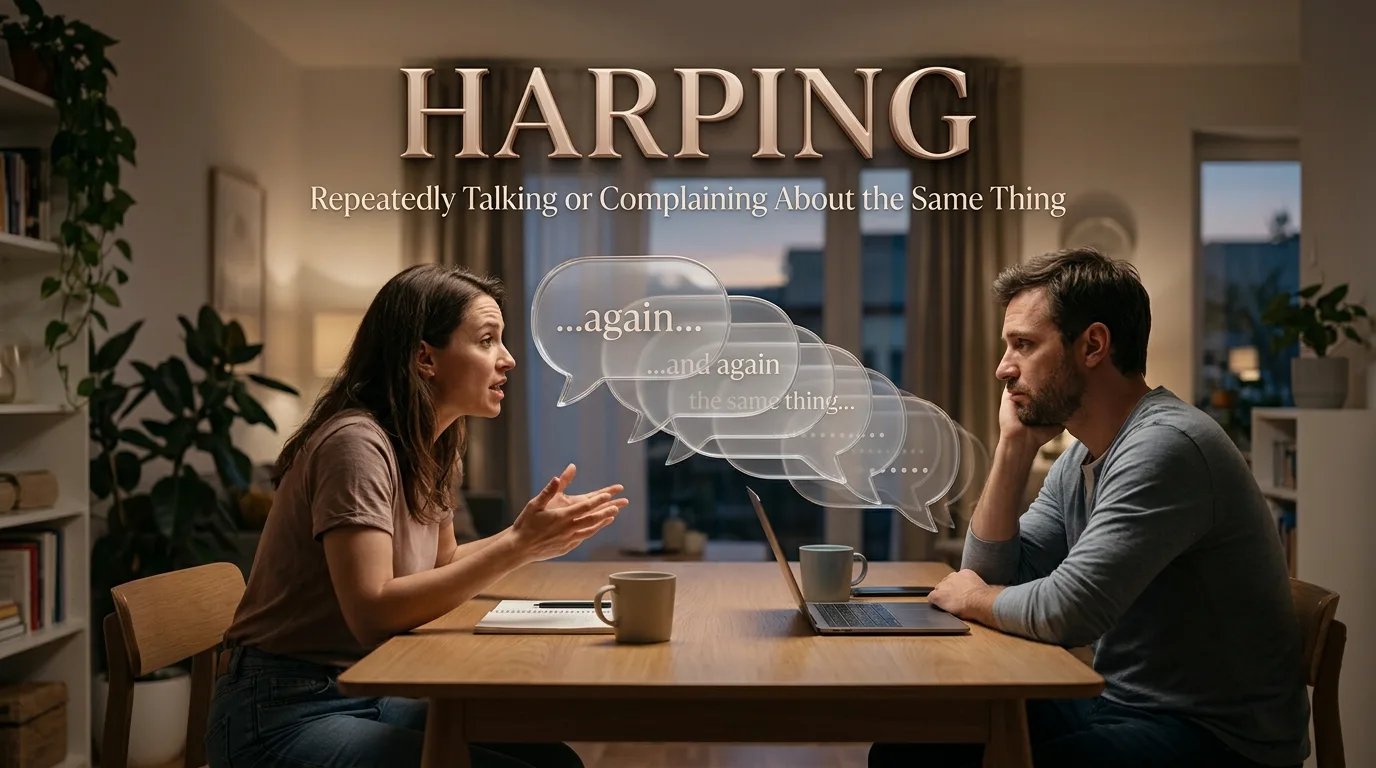
Synonym for harping includes words and phrases such as dwelling on, nagging, repeating, belaboring, and going on about something. “Harping” means repeatedly talking about the same issue, often annoyingly or critically.
Synonym for harping can be useful when someone keeps returning to the same complaint. Imagine a friend mentioning one small mistake during every conversation. That is classic harping.
The word is common in everyday English because people often describe repeated complaints or criticism. A well-chosen alternative can make your meaning more precise.
For students, bloggers, content writers, and daily English users, learning a synonym for harping helps create clearer and more varied sentences.
When you understand these alternatives, you can show whether someone is complaining, repeating a point, stressing an issue, or simply refusing to move on.
What Does “Harping” Really Mean?
Harping means repeatedly talking about, criticizing, or focusing on the same subject, especially when the repetition becomes irritating.
The word is most commonly used in the expression “harping on” or “harping on about.”
For example:
She keeps harping on about the same mistake.
This means she repeatedly talks about the mistake, even though it has already been discussed.
Part of Speech
Harping is primarily the present participle or gerund form of the verb “harp.”
The verb harp means to keep talking or thinking about the same subject repeatedly.
Emotional Tone
“Harping” usually carries a negative tone.
It can suggest irritation, criticism, persistence, or unnecessary repetition. Native speakers often use it when they feel that someone should stop returning to an old topic.
Compare:
- “He mentioned the problem again.” — neutral.
- “He kept harping on the problem.” — negative and critical.
The second sentence suggests that the repeated discussion has become annoying.
Connotative Meaning
Connotation (the emotional or implied feeling associated with a word) is important when using “harping.”
Positive Tone
“Harping” is rarely positive. It normally describes unwanted repetition.
A neutral alternative such as reiterating can sometimes communicate repetition without sounding critical.
Negative Tone
The strongest use of “harping” is negative.
It can suggest that someone is:
- Complaining repeatedly
- Criticizing continuously
- Focusing too much on one issue
- Refusing to let a subject go
- Annoying others through repetition
Neutral Tone
The word itself is not usually neutral. However, alternatives such as repeating, reiterating, or restating can express repeated communication without the same negative judgment.
Etymology of “Harping”
The word harping comes from the verb harp, which is connected to the noun harp, the musical instrument.
The English word harp comes from Old English hearpe, meaning the stringed musical instrument. Related forms appear in other Germanic languages.
The figurative meaning developed from the idea of repeatedly playing the same instrument or returning again and again to a particular musical pattern.
Over time, to harp on something developed the figurative sense of repeatedly talking about the same subject.
Old English: 450–1100
Old English used forms related to hearpe for the harp as a musical instrument.
The original meaning was literal rather than figurative.
Middle English: 1100–1500
During Middle English, forms such as harpe became established as English spelling and pronunciation changed.
The word continued to refer primarily to the musical instrument.
Modern English: 1500–Present
In Modern English, harp developed a figurative use.
The expression “to harp on” came to describe persistent repetition, especially repeated complaints or criticism.
Today, harping is most often encountered in the phrase “harping on about something.”
Pronunciation
US: /ˈhɑːr.pɪŋ/
UK: /ˈhɑː.pɪŋ/
Syllables
harp-ing
Affixation Pattern of “Harping”
Root
harp
Prefix
None
Suffix
-ing
The -ing suffix changes the verb harp into its present participle or gerund form, harping.
Synonyms List:
The best alternative depends on what the speaker is actually doing. Someone may be complaining, repeating information, emphasizing a point, or refusing to stop discussing an issue.
Below are useful alternatives that native speakers can use naturally.
Dwelling On (Phrasal Verb) — US /ˈdwɛlɪŋ ɑːn/ | UK /ˈdwelɪŋ ɒn/
Meaning: Focusing on a subject, problem, or past event for too long.
Tone/Register: Neutral to negative; common.
Example:
She keeps dwelling on her old mistakes.
Try not to dwell on what happened yesterday.
Nagging (Verb/Adjective) — US /ˈnæɡɪŋ/ | UK /ˈnæɡɪŋ/
Meaning: Repeatedly complaining, reminding, or criticizing irritatingly.
Tone/Register: Informal; negative.
Example:
His nagging about the deadline became frustrating.
She stopped nagging him about the unfinished task.
Repeating (Verb) — US /rɪˈpiːtɪŋ/ | UK /rɪˈpiːtɪŋ/
Meaning: Saying or stating something again.
Tone/Register: Neutral; everyday and widely used.
Example:
You are repeating the same argument.
There is no need to keep repeating that point.
Reiterating (Verb) — US /riːˈɪtəreɪtɪŋ/ | UK /riːˈɪtəreɪtɪŋ/
Meaning: Expressing the same idea again, usually to make it clear or emphasize it.
Tone/Register: Formal; academic and professional.
Example:
The manager reiterated the safety rules.
She reiterated her concerns before the meeting ended.
Belaboring (Verb) — US /bɪˈleɪbərɪŋ/ | UK /bɪˈleɪbərɪŋ/
Meaning: Discussing or explaining something for much longer than necessary.
Tone/Register: Formal; negative.
Example:
There is no reason to belabor the obvious point.
The article belabors an issue that was already clear.
Going On About (Phrasal Verb) — US /ˈɡoʊɪŋ ɑːn əˈbaʊt/ | UK /ˈɡəʊɪŋ ɒn əˈbaʊt/
Meaning: Talking about the same subject for a long time, often annoyingly.
Tone/Register: Informal; conversational.
Example:
He kept going on about his new phone.
My brother can go on about football for hours.
Droning On (Phrasal Verb) — US /ˈdroʊnɪŋ ɑːn/ | UK /ˈdrəʊnɪŋ ɒn/
Meaning: Continuing to speak in a boring, repetitive way.
Tone/Register: Informal; strongly negative.
Example:
The speaker kept droning on about minor details.
I lost focus while he was droning on.
Fixating On (Phrasal Verb) — US /fɪkˈseɪtɪŋ ɑːn/ | UK /fɪkˈseɪtɪŋ ɒn/
Meaning: Giving excessive attention to one particular subject.
Tone/Register: Neutral to negative; common in modern English.
Example:
She is fixating on one small error.
Try not to fixate on things you cannot change.
Obsessing Over (Phrasal Verb) — US /əbˈsesɪŋ ˈoʊvər/ | UK /əbˈsesɪŋ ˈəʊvə/
Meaning: Thinking or talking about something excessively.
Tone/Register: Informal to neutral.
Example:
He is obsessing over one negative comment.
She spent all evening obsessing over the result.
Stressing (Verb) — US /ˈstrɛsɪŋ/ | UK /ˈstresɪŋ/
Meaning: Giving repeated or strong emphasis to a particular point.
Tone/Register: Neutral; common.
Example:
The teacher kept stressing the importance of practice.
She was stressing the same rule throughout the lesson.
Emphasizing (Verb) — US /ˈɛmfəsaɪzɪŋ/ | UK /ˈemfəsaɪzɪŋ/
Meaning: Giving special importance to an idea or point.
Tone/Register: Neutral to formal.
Example:
The coach emphasized teamwork before the match.
The report emphasizes the need for better planning.
Insisting On (Phrasal Verb) — US /ɪnˈsɪstɪŋ ɑːn/ | UK /ɪnˈsɪstɪŋ ɒn/
Meaning: Continuing to demand or state something firmly.
Tone/Register: Neutral; sometimes negative.
Example:
She kept insisting on the same explanation.
He is insisting on discussing the matter tonight.
Rehashing (Verb) — US /riːˈhæʃɪŋ/ | UK /riːˈhæʃɪŋ/
Meaning: Discussing an old topic again without adding much new information.
Tone/Register: Informal to neutral; negative.
Example:
We do not need to rehash yesterday’s argument.
The meeting spent too long rehashing old problems.
Revisiting (Verb) — US /riːˈvɪzɪtɪŋ/ | UK /riːˈvɪzɪtɪŋ/
Meaning: Returning to a previous topic for further discussion.
Tone/Register: Neutral to formal.
Example:
Let’s revisit the proposal next week.
The writer revisits the issue in the final chapter.
Restating (Verb) — US /riːˈsteɪtɪŋ/ | UK /riːˈsteɪtɪŋ/
Meaning: Expressing the same idea again, often in clearer words.
Tone/Register: Neutral to formal.
Example:
The teacher is restating the question.
I will restate the main point for clarity.
Hammering On (Phrasal Verb) — US /ˈhæmərɪŋ ɑːn/ | UK /ˈhæmərɪŋ ɒn/
Meaning: Repeatedly emphasizing or discussing the same point.
Tone/Register: Informal; negative.
Example:
The article keeps hammering on the same complaint.
He was hammering on about the delay.
Pressing (Verb) — US /ˈpresɪŋ/ | UK /ˈpresɪŋ/
Meaning: Continuing to ask for an answer or action.
Tone/Register: Neutral; context-dependent.
Example:
The reporter kept pressing the minister for an answer.
She continued pressing him about the missing files.
Complaining (Verb) — US /kəmˈpleɪnɪŋ/ | UK /kəmˈpleɪnɪŋ/
Meaning: Expressing dissatisfaction about something.
Tone/Register: Neutral to negative; everyday.
Example:
He spent the afternoon complaining about the weather.
She was complaining about the same problem again.
Criticizing (Verb) — US /ˈkrɪtəsaɪzɪŋ/ | UK /ˈkrɪtɪsaɪzɪŋ/
Meaning: Pointing out faults or weaknesses in someone or something.
Tone/Register: Neutral to negative.
Example:
She keeps criticizing his work.
Constantly criticizing others can damage relationships.
Berating (Verb) — US /bɪˈreɪtɪŋ/ | UK /bɪˈreɪtɪŋ/
Meaning: Repeatedly criticizing or scolding someone harshly.
Tone/Register: Formal; strongly negative.
Example:
The manager was berating the employee in front of everyone.
Publicly berating someone rarely solves the problem.
Chiding (Verb) — US /ˈtʃaɪdɪŋ/ | UK /ˈtʃaɪdɪŋ/
Meaning: Speaking to someone with mild criticism or disapproval.
Tone/Register: Formal or literary.
Example:
Her mother was gently chiding her for being late.
He smiled while chiding his friend for forgetting the appointment.
Reproaching (Verb) — US /rɪˈproʊtʃɪŋ/ | UK /rɪˈprəʊtʃɪŋ/
Meaning: Expressing disappointment or disapproval toward someone.
Tone/Register: Formal; serious.
Example:
She was reproaching herself for the mistake.
His expression sounded more reproaching than angry.
Upbraiding (Verb) — US /ʌpˈbreɪdɪŋ/ | UK /ʌpˈbreɪdɪŋ/
Meaning: Strongly criticizing someone for a mistake or fault.
Tone/Register: Formal; literary.
Example:
The coach was upbraiding the team after the loss.
He avoided upbraiding his colleague in public.
Carping (Verb/Adjective) — US /ˈkɑːrpɪŋ/ | UK /ˈkɑːpɪŋ/
Meaning: Making repeated, petty, or negative criticisms.
Tone/Register: Formal to literary; negative.
Example:
His carping about every small detail became tiresome.
The article is too focused on carping criticism.
Grumbling (Verb) — US /ˈɡrʌmbəlɪŋ/ | UK /ˈɡrʌmbəlɪŋ/
Meaning: Complaining quietly or with dissatisfaction.
Tone/Register: Informal; everyday.
Example:
He was grumbling about the long wait.
The passengers started grumbling after the delay.
Moaning (Verb) — US /ˈmoʊnɪŋ/ | UK /ˈməʊnɪŋ/
Meaning: Complaining repeatedly about something, especially in informal British English.
Tone/Register: Informal; particularly common in British English.
Example:
He is always moaning about his workload.
Stop moaning and help me finish this task.
Whining (Verb) — US /ˈwaɪnɪŋ/ | UK /ˈwaɪnɪŋ/
Meaning: Complaining in an irritating, weak, or high-pitched manner.
Tone/Register: Informal; strongly negative.
Example:
The child kept whining about the long journey.
Nobody wanted to listen to him whine again.
Nagging At (Phrasal Verb) — US /ˈnæɡɪŋ æt/ | UK /ˈnæɡɪŋ æt/
Meaning: Repeatedly bothering someone with criticism or reminders.
Tone/Register: Informal; negative.
Example:
She kept nagging at him about his homework.
I do not want to spend the evening nagging at anyone.
Ranting About (Phrasal Verb) — US /ˈræntɪŋ əˈbaʊt/ | UK /ˈræntɪŋ əˈbaʊt/
Meaning: Speaking at length and with strong emotion about a subject.
Tone/Register: Informal; expressive.
Example:
He was ranting about the new rules online.
She spent ten minutes ranting about the traffic.
Harping On About (Phrasal Verb) — US /ˈhɑːrpɪŋ ɑːn əˈbaʊt/ | UK /ˈhɑːpɪŋ ɒn əˈbaʊt/
Meaning: Repeatedly talking about the same issue, usually in an irritating way.
Tone/Register: Informal; negative.
Example:
He keeps harping on about his old job.
She was still harping on about the disagreement.
Reiterating (Verb) — US /riːˈɪtəreɪtɪŋ/ | UK /riːˈɪtəreɪtɪŋ/
Meaning: Saying the same thing again to reinforce or clarify a point.
Tone/Register: Formal, Professional
Example:
The manager kept reiterating the importance of punctuality.
She reiterated the instructions before the meeting ended.
Repeating Oneself (Phrase) — US /rɪˈpiːtɪŋ wʌnˈself/ | UK /rɪˈpiːtɪŋ wʌnˈself/
Meaning: Saying the same information again and again.
Tone/Register: Neutral, Conversational
Example:
I feel like I am repeating myself.
He was tired of repeating himself during the discussion.
Overemphasizing (Verb) — US /ˌoʊvərˈɛmfəsaɪzɪŋ/ | UK /ˌəʊvərˈemfəsaɪzɪŋ/
Meaning: Giving something more importance or attention than necessary.
Tone/Register: Formal, Neutral
Example:
The article may be overemphasizing one minor problem.
Try not to overemphasize a single mistake.
Overstating (Verb) — US /ˌoʊvərˈsteɪtɪŋ/ | UK /ˌəʊvəˈsteɪtɪŋ/
Meaning: Describing something as more serious or important than it really is.
Tone/Register: Formal, Neutral
Example:
The writer may be overstating the problem.
He kept overstating the risks during the discussion.
Reiterating a Point (Phrase) — US /riːˈɪtəreɪtɪŋ ə pɔɪnt/ | UK /riːˈɪtəreɪtɪŋ ə pɔɪnt/
Meaning: Repeating an idea to make sure it receives attention.
Tone/Register: Formal, Professional
Example:
The professor kept reiterating a point during the lecture.
She reiterated the point during her presentation.
Repeating a Complaint (Phrase) — US /rɪˈpiːtɪŋ ə kəmˈpleɪnt/ | UK /rɪˈpiːtɪŋ ə kəmˈpleɪnt/
Meaning: Continuing to express the same dissatisfaction.
Tone/Register: Neutral, Negative
Example:
He spent the morning repeating the same complaint.
There was little value in repeating the complaint again.
Continuing to Complain (Phrase) — US /kənˈtɪnjuɪŋ tə kəmˈpleɪn/ | UK /kənˈtɪnjuɪŋ tə kəmˈpleɪn/
Meaning: Persisting in expressing dissatisfaction about something.
Tone/Register: Neutral, Conversational
Example:
She continued to complain about the schedule.
He kept complaining even after the issue was fixed.
Persisting (Verb) — US /pərˈsɪstɪŋ/ | UK /pəˈsɪstɪŋ/
Meaning: Continuing to pursue a subject despite attempts to move on.
Tone/Register: Neutral, Formal
Example:
He persisted in discussing the same concern.
She persisted despite everyone’s attempts to change the subject.
Persisting With a Point (Phrase) — US /pərˈsɪstɪŋ wɪð ə pɔɪnt/ | UK /pəˈsɪstɪŋ wɪð ə pɔɪnt/
Meaning: Continuing to emphasize an idea after others have already heard it.
Tone/Register: Neutral, Negative
Example:
He kept persisting with the same point.
Her persistence became frustrating after several explanations.
Insisting Repeatedly (Phrase) — US /ɪnˈsɪstɪŋ rɪˈpiːtɪdli/ | UK /ɪnˈsɪstɪŋ rɪˈpiːtɪdli/
Meaning: Continuing to state or demand something again and again.
Tone/Register: Neutral, Negative
Example:
He was insisting repeatedly that nothing had changed.
She kept insisting repeatedly on the same solution.
Repeating a Theme (Phrase) — US /rɪˈpiːtɪŋ ə θiːm/ | UK /rɪˈpiːtɪŋ ə θiːm/
Meaning: Returning to the same central idea multiple times.
Tone/Register: Neutral, Academic
Example:
The essay keeps repeating the same theme.
The speaker repeatedly returned to that theme.
Returning To (Phrasal Verb) — US /rɪˈtɜːrnɪŋ tuː/ | UK /rɪˈtɜːnɪŋ tuː/
Meaning: Coming back to a subject that was already discussed.
Tone/Register: Neutral, Formal
Example:
She kept returning to the issue of funding.
The discussion repeatedly returned to the original complaint.
Revisiting the Same Issue (Phrase) — US /riːˈvɪzɪtɪŋ ðə seɪm ˈɪʃuː/ | UK /riːˈvɪzɪtɪŋ ðə seɪm ˈɪʃuː/
Meaning: Discussing an already-known problem again.
Tone/Register: Neutral, Professional
Example:
We keep revisiting the same issue.
There is little benefit in revisiting the same issue.
Circling Back (Phrasal Verb) — US /ˈsɜːrkəlɪŋ bæk/ | UK /ˈsɜːkəlɪŋ bæk/
Meaning: Returning to a previously mentioned subject.
Tone/Register: Professional, Conversational
Example:
The manager kept circling back to the deadline.
She circled back to the earlier concern.
Beating a Dead Horse (Idiom) — US /ˈbiːtɪŋ ə ded hɔːrs/ | UK /ˈbiːtɪŋ ə ded hɔːs/
Meaning: Continuing to discuss something that cannot be changed or resolved.
Tone/Register: Informal, Idiomatic
Example:
We are beating a dead horse by discussing it again.
Let’s move forward instead of beating a dead horse.
Going Round in Circles (Idiom) — US /ˈɡoʊɪŋ raʊnd ɪn ˈsɜːrkəlz/ | UK /ˈɡəʊɪŋ raʊnd ɪn ˈsɜːkəlz/
Meaning: Repeatedly discussing the same matter without making progress.
Tone/Register: Informal, Conversational
Example:
We are going round in circles with this argument.
The meeting went round in circles for an hour.
Laboring the Point (Phrase) — US /ˈleɪbərɪŋ ðə pɔɪnt/ | UK /ˈleɪbərɪŋ ðə pɔɪnt/
Meaning: Explaining or emphasizing a point for too long.
Tone/Register: Formal, Negative
Example:
There is no need to labor the point.
The speaker spent too long laboring the point.
Overexplaining (Verb) — US /ˌoʊvərɪkˈspleɪnɪŋ/ | UK /ˌəʊvərɪkˈspleɪnɪŋ/
Meaning: Giving more explanation than a situation requires.
Tone/Register: Informal, Neutral
Example:
He kept overexplaining a very simple idea.
You do not need to overexplain your decision.
Overdiscussing (Verb) — US /ˌoʊvərdɪˈskʌsɪŋ/ | UK /ˌəʊvədɪˈskʌsɪŋ/
Meaning: Discussing a subject excessively or unnecessarily.
Tone/Register: Neutral, Negative
Example:
The group spent too long overdiscussing the minor issue.
They were overdiscussing a decision that had already been made.
Overworking a Point (Phrase) — US /ˌoʊvərˈwɜːrkɪŋ ə pɔɪnt/ | UK /ˌəʊvəˈwɜːkɪŋ ə pɔɪnt/
Meaning: Giving an idea excessive attention or explanation.
Tone/Register: Neutral, Negative
Example:
The writer is overworking the same point.
Avoid overworking a simple argument.
Belaboring an Issue (Phrase) — US /bɪˈleɪbərɪŋ ən ˈɪʃuː/ | UK /bɪˈleɪbərɪŋ ən ˈɪʃuː/
Meaning: Continuing to discuss an issue long after enough has been said.
Tone/Register: Formal, Negative
Example:
The discussion was belaboring an issue everyone understood.
There was no point in belaboring the issue further.
Prolonging the Discussion (Phrase) — US /prəˈlɔːŋɪŋ ðə dɪˈskʌʃən/ | UK /prəˈlɒŋɪŋ ðə dɪˈskʌʃən/
Meaning: Making a discussion continue longer than necessary.
Tone/Register: Formal, Neutral
Example:
He kept prolonging the discussion.
There was no reason to prolong the discussion.
Protracting (Verb) — US /proʊˈtræktɪŋ/ | UK /prəˈtræktɪŋ/
Meaning: Making something continue for longer than necessary.
Tone/Register: Formal, Academic
Example:
They were protracting a discussion that needed a simple decision.
The repeated objections only protracted the meeting.
Dwelling Excessively (Phrase) — US /ˈdwɛlɪŋ ɪkˈsesɪvli/ | UK /ˈdwelɪŋ ɪkˈsesɪvli/
Meaning: Giving too much continued attention to one subject.
Tone/Register: Neutral, Negative
Example:
He is dwelling excessively on the criticism.
Dwelling excessively on the past can prevent progress.
Focusing Excessively (Phrase) — US /ˈfoʊkəsɪŋ ɪkˈsesɪvli/ | UK /ˈfəʊkəsɪŋ ɪkˈsesɪvli/
Meaning: Paying an unreasonable amount of attention to one issue.
Tone/Register: Neutral, Formal
Example:
The report is focusing excessively on one weakness.
She was focusing excessively on a minor detail.
Overdwelling (Verb) — US /ˌoʊvərˈdwɛlɪŋ/ | UK /ˌəʊvəˈdwelɪŋ/
Meaning: Spending too much time thinking or talking about a particular subject.
Tone/Register: Neutral, Negative
Example:
The writer is overdwelling on the character’s past.
Try not to dwell on a single mistake.
Reiterative (Adjective) — US /riˈɪtərətɪv/ | UK /riˈɪtərətɪv/
Meaning: Characterized by repeated statements, ideas, or expressions.
Tone/Register: Formal, Academic
Example:
The speech became overly reiterative.
Its reiterative style weakened the overall argument.
Monotonous (Adjective) — US /məˈnɑːtənəs/ | UK /məˈnɒtənəs/
Meaning: Repetitive and lacking variety, especially in speech or presentation.
Tone/Register: Neutral, Negative
Example:
His monotonous explanation lost the audience’s attention.
The repeated discussion became monotonous.
Tedious (Adjective) — US /ˈtiːdiəs/ | UK /ˈtiːdiəs/
Meaning: Boring because something continues for too long or lacks variety.
Tone/Register: Neutral, Negative
Example:
The meeting became tedious after the same topic returned repeatedly.
His explanation was becoming tedious.
Repetitious (Adjective) — US /rəˈpetɪʃəs/ | UK /rɪˈpetɪʃəs/
Meaning: Containing too much unnecessary repetition.
Tone/Register: Neutral, Formal
Example:
The article feels repetitious in the final section.
His speech became repetitious after several minutes.
Synonyms for Harping by Tone
Positive
“Harping” itself is rarely positive, but some alternatives can describe repetition without criticism.
- Emphasizing
- Reiterating
- Restating
- Revisiting
These words are useful when repeated discussion has a legitimate purpose.
Neutral
These alternatives focus more on repetition than annoyance:
- Repeating
- Pressing
- Stressing
- Revisiting
- Restating
- Emphasizing
They work well in professional and academic writing.
Negative
These words suggest irritation, criticism, or excessive repetition:
- Nagging
- Dwelling on
- Belaboring
- Carping
- Grumbling
- Whining
- Berating
- Rehashing
- Harping on
Playful or Informal
These expressions are more conversational:
- Going on about
- Droning on
- Moaning
- Ranting about
- Hammering on
Tone matters because two words can describe similar behavior while creating very different impressions.
“Harping” vs Close Alternatives
Harping vs Dwelling On
The term harping usually describes repeatedly talking about a subject.
Dwelling on can involve thinking about something too much, even without discussing it aloud.
Use harping when repeated speech is the main issue.
Use dwelling on when excessive mental or emotional focus is important.
Harping vs Reiterating
Reiterating is usually neutral or professional.
Harping is normally negative.
A manager may reiterate an important safety rule. Someone who repeatedly complains about the rule may be accused of harping on it.
Harping vs Nagging
Nagging often involves repeated reminders, complaints, or requests directed at another person.
Harping has a broader meaning and can involve repeatedly discussing a topic.
For example, a parent may nag a child to clean their room. A colleague may harp on about a mistake made weeks earlier.
How “Harping” Changes by Context
Daily Conversation
In everyday speech, harping on often describes repeated complaints.
“Stop harping on about the traffic.”
The speaker usually wants the other person to move on from the subject.
Writing or Blogging
Writers can use “harping” when describing repetitive criticism or commentary.
“The article spends too much time harping on past failures.”
For neutral writing, reiterating, restating, or revisiting may sound more professional.
Professional or Academic Tone
“Harping” can sound informal and judgmental in professional settings.
Instead, writers often choose emphasizing, reiterating, or restating.
For example:
“The report reiterates the importance of accurate data.”
This sounds more objective than:
“The report keeps harping on accurate data.”
Creative or Informal Use
In stories, dialogue, blogs, and social media, “harping” can add personality.
It can show frustration between characters or make a speaker sound impatient.
“You’re still harping on that?”
This short sentence immediately communicates irritation.
Common Mistakes Learners Make
Mistake 1: Using “Harping” for Any Repetition
Not every repeated statement is harping.
A teacher can repeat an important instruction without harping on it.
Mistake 2: Forgetting “On”
The most natural construction is usually:
harp on something
or
harp on about something
For example:
She keeps harping on the same issue.
He keeps harping on about his old problems.
Mistake 3: Using It in Positive Situations
“Harping” usually carries a negative implication.
If someone repeats useful information clearly, reiterating or emphasizing is often better.
Mistake 4: Confusing Harping With Ranting
A person can rant about many different things.
Harping specifically highlights repeated attention to the same subject.
Register Notes
“Harping” is common in conversational English and informal writing.
It is less suitable when you want an objective academic tone.
In formal writing, alternatives such as reiterating, emphasizing, restating, revisiting, or repeating may be more appropriate.
For learners building vocabulary, it is useful to understand both the meaning and the emotional effect of the word.
For additional vocabulary research, consider linking to an external dictionary source such as Cambridge Dictionary or Merriam-Webster.
Real-Life Mini Scenarios
Workplace
A team member repeatedly complains about a project decision during every meeting.
A colleague might say:
“We have discussed this already. There’s no need to keep harping on it.”
Social Situation
A friend keeps bringing up an embarrassing mistake from last year.
You might say:
“Please stop harping on that old mistake.”
Media and Pop Culture
A commentator repeatedly criticizes the same celebrity or public event.
A writer could describe this as:
“The commentator keeps harping on the controversy.”
Writing and Storytelling
A character refuses to let go of an old disagreement.
The narrator might write:
“He spent the evening harping on the argument they had years ago.”
How to Choose the Right Synonym
Dwelling on works best when someone focuses excessively on a past issue.
Use nagging for repeated reminders, complaints, or criticism directed at another person.
Reiterating fits situations where repetition is deliberate and professional.
When something is explained or discussed for too long, belaboring is a stronger choice.
Rehashing describes discussing an old issue again without adding much new information.
For petty and persistent criticism, carping is more precise.
Grumbling suits quiet, unhappy, or low-level complaints.
When a complaint sounds irritating, weak, or overly emotional, whining may fit better.
Droning on is appropriate when repetitive speech becomes tedious.
If repetition is useful and purposeful, emphasizing is a more positive choice.
Restating works when an idea is expressed again to improve clarity.
For intentionally bringing an old topic back into discussion, revisiting is appropriate.
Interactive Practice Quiz
Choose the best answer for each situation.
1. Your friend keeps complaining about the same restaurant experience from last month. Which word fits best?
A. Reiterating
B. Harping
C. Restating
D. Emphasizing
2. A teacher repeats an important exam instruction clearly. Which word sounds most appropriate?
A. Nagging
B. Whining
C. Reiterating
D. Carping
3. Someone keeps focusing emotionally on an old mistake. Which expression fits best?
A. Dwelling on
B. Restating
C. Pressing
D. Revisiting
4. A parent repeatedly reminds a teenager to clean their room. Which word is most natural?
A. Nagging
B. Reiterating
C. Revisiting
D. Emphasizing
5. A speaker talks for too long about minor details. Which expression fits best?
A. Belaboring
B. Restating
C. Revisiting
D. Pressing
6. Someone complains quietly about a long queue. Which word fits best?
A. Grumbling
B. Reiterating
C. Emphasizing
D. Restating
7. A professional report repeats its main recommendation for clarity. Which word is best?
A. Whining
B. Reiterating
C. Harping
D. Moaning
8. Someone gives a long, emotional complaint about new rules. Which expression works best?
A. Ranting about
B. Restating
C. Reiterating
D. Revisiting
9. A writer discusses an old issue again and adds new information. Which word is appropriate?
A. Revisiting
B. Nagging
C. Whining
D. Droning on
10. A speaker continues talking in a boring and repetitive way. Which phrase fits best?
A. Droning on
B. Emphasizing
C. Reiterating
D. Restating
11. Someone makes repeated petty criticisms about every small detail. Which word fits best?
A. Carping
B. Revisiting
C. Restating
D. Pressing
12. A journalist repeatedly asks for an answer during an interview. Which phrase fits best?
A. Pressing for an answer
B. Dwelling on
C. Grumbling
D. Rehashing
Reflection Task
Choose one synonym from this article and write your own sentence about a real-life situation. Then ask yourself whether the word sounds neutral, positive, or negative.
Answer Key: 1-B | 2-C | 3-A | 4-A | 5-A | 6-A | 7-B | 8-A | 9-A | 10-A | 11-A | 12-A
FAQs
1. What is the closest synonym for harping in everyday English?
The closest everyday alternatives are dwelling on, going on about, repeating, and nagging, depending on the context. “Harping” usually suggests that someone repeatedly discusses the same subject irritatingly. “Going on about” is especially natural in casual conversation, while “dwelling on” focuses more on excessive attention to an issue.
2. Is harping on someone the same as nagging them?
Not exactly. Nagging usually involves repeatedly reminding, criticizing, or asking another person to do something. Harping on is broader and means repeatedly discussing a particular subject. A person can harp on a mistake, complaint, or opinion without directly asking another person to change their behavior.
3. Is “harping on” negative or neutral?
“Harping on” is generally negative. It suggests that someone has talked about a subject too many times or refuses to let it go. If you want a neutral expression, use repeating, reiterating, restating, or emphasizing. These words do not automatically suggest that the repetition is annoying.
4. What does “stop harping on about it” mean?
“Stop harping on about it” means stop repeatedly talking about the same issue. It is usually said when the speaker feels that a complaint, mistake, disagreement, or problem has already received enough attention. The expression is conversational and can sound impatient or annoyed.
5. What is a formal synonym for harping?
Reiterating, emphasizing, restating, and sometimes belaboring can work in formal contexts. The best choice depends on the intended meaning. “Reiterating” is neutral, while “belaboring” suggests that something has been discussed for unnecessarily long. Formal writing should avoid “harping” when an objective tone is required.
6. Can harping be used in academic writing?
Yes, but it is usually better suited to analytical or critical writing than neutral academic explanation. It carries a negative judgment about excessive repetition. For objective academic prose, words such as reiterating, emphasizing, restating, or revisiting are often more appropriate.
7. What is the difference between harping and rehashing?
Harping emphasizes persistent and often irritating discussion of a subject. Rehashing means discussing an old topic again, especially without adding anything substantially new. A person can rehash an old argument without sounding as personally critical as someone who keeps harping on it.
8. What is the best synonym for harping in professional communication?
For professional communication, reiterating or emphasizing is usually safer because both can sound objective. If you are describing unnecessary repetition, belaboring or revisiting may work depending on the context. Avoid “harping” when you need a neutral and diplomatic tone.
Conclusion
Learning a synonym for harping helps you describe repeated speech with greater accuracy. Words like nagging, dwelling, and reiterating each carry a different shade.
Good vocabulary is not about using difficult words. It is about choosing the word that best matches your meaning, tone, and audience.
These alternatives can strengthen essays, blogs, emails, conversations, and everyday communication. They also help you express criticism without sounding repetitive.
Start practicing by using one new synonym in an email, essay, or daily conversation. Small vocabulary choices can make your English clearer, richer, and more natural.

I’m Hezel, a passionate English language enthusiast and the creator of Synworda.com. I love exploring synonyms, vocabulary, grammar, and the many ways words can make communication clearer and more effective. Through Synworda.com, I create simple, practical, and easy-to-understand content for students, writers, professionals, and anyone who wants to improve their English. I enjoy breaking down confusing words and grammar concepts into helpful explanations with clear examples. I aim to make learning English feel less complicated and more enjoyable. I believe that understanding the right words can help everyone communicate with confidence in everyday life.