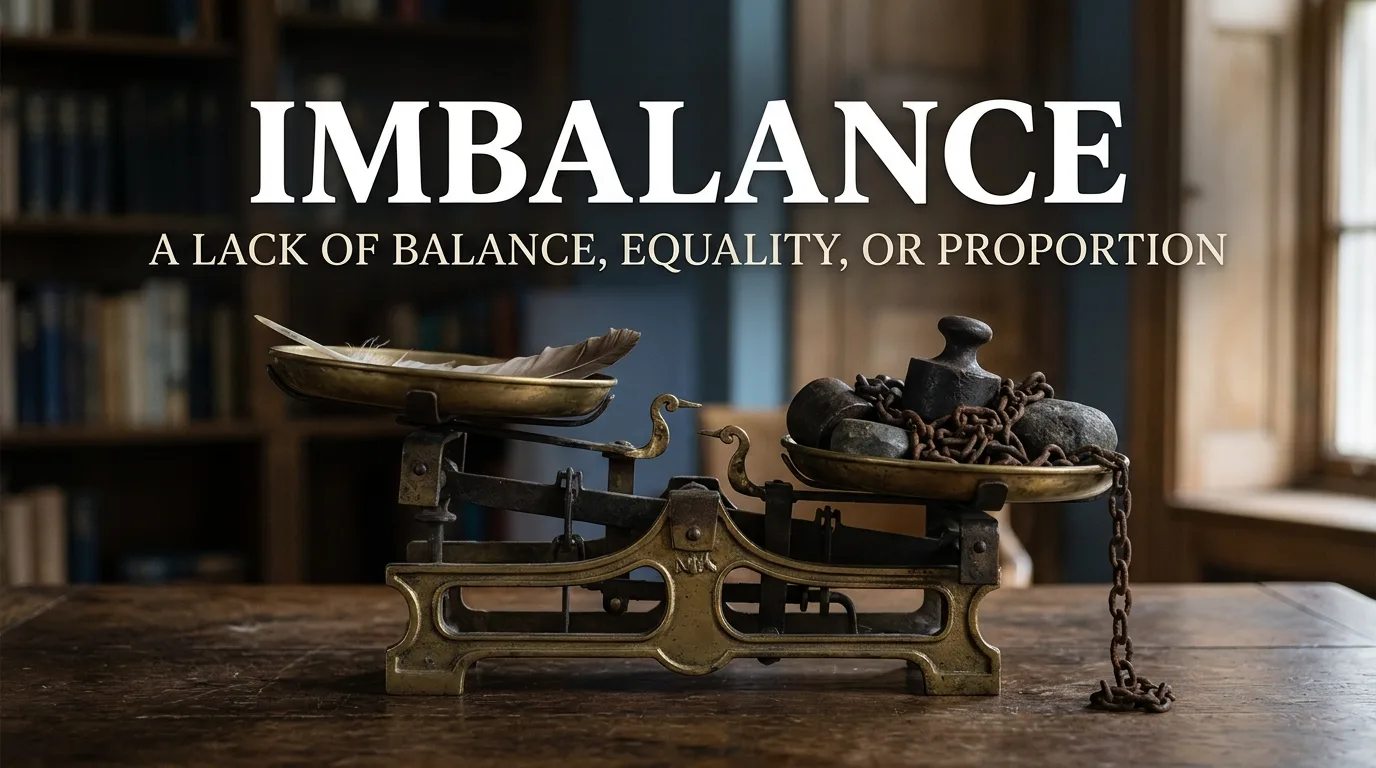
A synonym for imbalance is a word or phrase that describes a lack of balance, equality, proportion, or stability. Common alternatives include disparity, inequality, unevenness, disproportion, disequilibrium, and imbalance of power. The best choice depends on the situation and the type of imbalance you want to describe.
Imagine a team where one person completes nearly every task while others contribute very little. You might describe this situation as an imbalance of responsibilities. Choosing a precise synonym helps explain the problem clearly.
The word imbalance appears in everyday conversations, health discussions, business reports, and academic writing. Understanding its alternatives helps you describe unequal situations without repeating the same expression.
If you are a student, blogger, content writer, or everyday English learner, learning synonyms can strengthen your vocabulary. You can express ideas more naturally and choose words that suit different audiences.
This guide explores useful alternatives, pronunciation, meanings, real-life examples, and common mistakes. You will also find a practice quiz to help you use each word confidently.
What Does “Imbalance” Really Mean?
Imbalance means a condition in which two or more things are not equal, properly proportioned, or stable. One side may have too much, too little, or greater influence than the other.
For example, an imbalance between work and personal life can leave someone feeling exhausted. Similarly, an imbalance in a budget may occur when spending exceeds available income.
Part of Speech
- Noun: Imbalance describes a condition of unequal distribution or a lack of stability.
- Plural noun: Imbalances refers to multiple situations involving a lack of balance.
Simple definition: Imbalance is a situation in which things are not balanced, equal, or properly distributed.
How Native Speakers Understand the Word
Native English speakers use imbalance when something is uneven, disproportionate, unstable, or unfairly distributed. The word does not always suggest a serious problem. Its meaning depends on the surrounding context.
For example, an imbalance in a financial account may be a technical issue. An imbalance of power between two people may suggest unfairness or control.
Connotative Meaning of Imbalance
(Connotation means the feelings, associations, or attitudes a word suggests beyond its basic definition.)
- Positive tone: Imbalance rarely has a positive connotation by itself, although recognizing an imbalance can lead to improvement.
- Negative tone: It often suggests unfairness, instability, inequality, or a problem that needs attention.
- Neutral tone: In mathematics, science, accounting, and technical discussions, it can simply describe a measurable difference.
Etymology of Imbalance
The word imbalance combines the prefix im- with balance. The prefix conveys the idea of negation, while balance refers to a state of equilibrium or proportion.
The word balance entered English through Old French balance, ultimately from Latin bilanx, meaning “having two scales” or “two-pan balance.” The prefix im- developed from forms associated with Latin in-.
Historical Development
- Old English (450–1100): The modern word imbalance was not established in Old English. Related ideas were expressed through words and phrases describing weight, equality, and steadiness.
- Middle English (1100–1500): The influence of French helped establish balance in English. Its uses expanded around weighing, comparing, and maintaining proportion.
- Modern English (1500–present): The vocabulary of balance expanded into figurative and technical contexts. Imbalance became useful for describing unequal conditions in health, economics, relationships, and systems.
Pronunciation of Imbalance
- US: /ɪmˈbæl.əns/
- UK: /ɪmˈbæl.əns/
Syllables: im-bal-ance
Affixation Pattern of Imbalance
- Root/base: balance
- Prefix: im- (expressing negation)
- Suffix: None added to the complete word in its standard formation
The word combines a negative prefix with balance to express the absence of proper balance.
Synonyms List:
Asymmetry (Noun) — US: /eɪˈsɪm.ə.tri/ / UK: /eɪˈsɪm.ə.tri/
Meaning: A lack of equality or equivalence between two halves or parts.
Tone/Register: Formal, Technical, Design
Examples: The architect noticed a clear asymmetry in the building design.
Her face showed a subtle asymmetry when she smiled.
Disparity (Noun) — US: /dɪˈspær.ə.ti/ / UK: /dɪˈspær.ət.i/
Meaning: A noticeable and often unfair difference between two or more things.
Tone/Register: Formal, Academic, Economic
Examples: There is a growing disparity between urban and rural incomes.
The report highlighted the disparity in healthcare access.
Inequality (Noun) — US: /ˌɪn.ɪˈkwɑː.lə.ti/ / UK: /ˌɪn.ɪˈkwɒl.ə.ti/
Meaning: The unfair situation where some people have more rights or money than others.
Tone/Register: Formal, Political, Social Science
Examples: The government wants to reduce income inequality this year.
Gender inequality remains a major topic in corporate offices.
Instability (Noun) — US: /ˌɪn.stəˈbɪl.ə.ti/ / UK: /ˌɪn.stəˈbɪl.ə.ti/
Meaning: A tendency to change unexpectedly or collapse easily.
Tone/Register: Neutral, Economic, Psychology
Examples: Political instability damaged the local economy.
Emotional instability can make daily tasks difficult.
Disproportion (Noun) — US: /ˌdɪs.prəˈpɔːr.ʃən/ / UK: /ˌdɪs.prəˈpɔː.ʃən/
Meaning: A lack of proper ratio between related things.
Tone/Register: Formal, Academic
Examples: The punishment showed a clear disproportion to the crime.
A high proportion of funding went to one department.
Bias (Noun) — US: /ˈbaɪ.əs/ / UK: /ˈbaɪ.əs/
Meaning: An inclination or preference that interferes with impartial judgment.
Tone/Register: Neutral, Professional, Academic
Examples: The hiring process showed a clear bias toward local candidates.
Journalists must work hard to keep personal bias out of news stories.
Unevenness (Noun) — US: /ʌnˈiː.vən.nəs/ / UK: /ʌnˈiː.vən.nəs/
Meaning: The quality of not being level, smooth, or equal.
Tone/Register: Informal, Descriptive
Examples: The unevenness of the mountain path made walking slow.
There is an obvious unevenness in the team’s performance.
Irregularity (Noun) — US: /ɪˌreɡ.jəˈlær.ə.ti/ / UK: /ɪˈreɡ.jəˈlær.ə.ti/
Meaning: A state of not following a standard, smooth, or regular pattern.
Tone/Register: Formal, Medical, Administrative
Examples: The auditor found an irregularity in the financial books.
An irregularity in his heartbeat sent him to the clinic.
Unsteadiness (Noun) — US: /ʌnˈsted.i.nəs/ / UK: /ʌnˈsted.i.nəs/
Meaning: A temporary condition of shaking or lacking physical balance.
Tone/Register: Informal, Physical
Examples: She felt a sudden unsteadiness after standing up quickly.
The table’s unsteadiness caused the drink to spill.
Lopsidedness (Noun) — US: /ˌlɑːpˈsaɪ.dəd.nəs/ / UK: /ˌlɒpˈsaɪ.dəd.nəs/
Meaning: The condition of leaning heavily to one side.
Tone/Register: Informal, Casual
Examples: The lopsidedness of the wooden shelf made books slide off.
The final score reflected the lopsidedness of the match.
Disalignment (Noun) — US: /ˌdɪs.əˈlaɪn.mənt/ / UK: /ˌdɪs.əˈlaɪn.mənt/
Meaning: A state where things are no longer arranged in a straight line or correct position.
Tone/Register: Technical, Mechanics
Examples: A slight misalignment of the wheels wore down the tires.
The misalignment between corporate goals and team actions caused delays.
Disproportionateness (Noun) — US: /ˌdɪs.prəˈpɔːr.ʃən.ət.nəs/ / UK: /ˌdɪs.prəˈpɔː.ʃən.ət.nəs/
Meaning: The state of being far out of proportion in size or degree.
Tone/Register: Highly Formal, Legal
Examples: The lawyer argued the disproportionateness of the fine.
We were surprised by the disproportionateness of their response.
Skew (Noun) — US: /skjuː/ / UK: /skjuː/
Meaning: A slant or deviation from a symmetric distribution.
Tone/Register: Technical, Data, Statistics
Examples: There is a noticeable demographic skew in the survey data.
The chart shows a distinct rightward skew in profits.
Overbalance (Noun) — US: /ˌoʊ.vɚˈbæl.əns/ / UK: /ˌəʊ.vəˈbæl.əns/
Meaning: A loss of equilibrium caused by too much weight on one side.
Tone/Register: Physical, Technical
Examples: A sudden overbalance sent the cyclist into the grass.
The heavy cargo caused an overbalance on the boat.
Top-heaviness (Noun) — US: /tɑːpˈhev.i.nəs/ / UK: /tɒpˈhev.i.nəs/
Meaning: The state of having too much weight or authority concentrated at the top.
Tone/Register: Business, Informal
Examples: The company failed due to top-heaviness in management.
The vase fell because of its extreme top-heaviness.
Asymmetrism (Noun) — US: /eɪˈsɪm.ə.trɪ.zəm/ / UK: /eɪˈsɪm.ə.trɪ.zəm/
Meaning: The intentional practice or structural state of asymmetrical arrangement.
Tone/Register: Artistic, Structural
Examples: The modern art piece relied on striking asymmetry.
Architects used asymmetry to make the building stand out.
Favoritism (Noun) — US: /ˈfeɪ.vɚ.ə.tɪ.zəm/ / UK: /ˈfeɪ.vər.ɪ.zəm/
Meaning: Unfair support or treatment given to one person or group over another.
Tone/Register: Informal, Workplace
Examples: Employees complained about favoritism during promotion season.
Parents should avoid showing favoritism among their children.
Partiality (Noun) — US: /ˌpɑːr.ʃiˈæl.ə.ti/ / UK: /ˌpɑː.ʃiˈæl.ə.ti/
Meaning: An unfair bias toward one side in a dispute or choice.
Tone/Register: Formal, Legal
Examples: The judge was accused of partiality toward the defense team.
We expect complete freedom from partiality in news coverage.
Friction (Noun) — US: /ˈfrɪk.ʃən/ / UK: /ˈfrɪk.ʃən/
Meaning: Discord or instability caused by conflicting forces or viewpoints.
Tone/Register: Metaphorical, Workplace
Examples: The structural imbalance created friction between teams.
Personality clashes caused friction in the department.
Wobble (Noun) — US: /ˈwɑː.bəl/ / UK: /ˈwɒb.əl/
Meaning: An unsteady movement or brief period of instability.
Tone/Register: Informal, Conversational
Examples: The economy experienced a short wobble early this quarter.
I felt a slight wobble in the steering wheel.
Unequalness (Noun) — US: /ʌnˈiː.kwəl.nəs/ / UK: /ʌnˈiː.kwəl.nəs/
Meaning: The state or condition of not being equal in quantity, size, or value.
Tone/Register: Neutral, Descriptive
Examples: The unequalness of the playing field gave one team a clear advantage.
Researchers measured the unequalness in wealth distribution across regions.
Imparity (Noun) — US: /ɪmˈpær.ə.ti/ / UK: /ɪmˈpær.ɪ.ti/
Meaning: An instance of inequality, disparity, or lack of parity.
Tone/Register: Formal, Technical
Examples: Economic analysts noted a severe disparity between trade imports and exports.
The contract was rejected due to a fundamental disparity in obligations.
Asymmetry (Noun) — US: /ˌeɪ.sɪˈmiː.tri.ə/ / UK: /ˌæ.sɪˈmɛ.tri.ə/
Meaning: A structural or anatomical condition marked by a lack of symmetry.
Tone/Register: Technical, Scientific, Medical
Examples: The doctor measured the cranial asymmetria during the infant’s checkup.
Botanists observed subtle asymmetria in the leaves of the modified plant.
Non-uniformity (Noun) — US: /ˌnɑːn.juː.nəˈfɔːr.mə.ti/ / UK: /ˌnɒn.juː.nɪˈfɔː.mɪ.ti/
Meaning: The quality of varying in texture, structure, or distribution across a system.
Tone/Register: Academic, Industrial
Examples: The non-uniformity of the wall coating caused dark spots after drying.
Quality control reported non-uniformity across the manufactured batch.
Variance (Noun) — US: /ˈver.i.əns/ / UK: /ˈveə.ri.əns/
Meaning: The state of being different, divergent, or inconsistent from an established balance.
Tone/Register: Business, Statistics, Legal
Examples: There was a significant variance between the estimated budget and actual costs.
The flight path showed a slight variance from the original course.
Dissonance (Noun) — US: /ˈdɪs.ə.nəns/ / UK: /ˈdɪs.ə.nəns/
Meaning: A lack of agreement or harmony between elements in a system.
Tone/Register: Formal, Psychological, Musical
Examples: Cognitive dissonance occurs when actions contradict deeply held beliefs.
A dissonance between sales goals and inventory created office tension.
Tilt (Noun) — US: /tɪlt/ / UK: /tɪlt/
Meaning: A pronounced slant, bias, or shift in direction away from equilibrium.
Tone/Register: Informal, Political, Casual
Examples: The media coverage showed a clear tilt toward the incumbent candidate.
A sudden tilt in market demand forced factories to adjust production.
Deviation (Noun) — US: /ˌdiː.viˈeɪ.ʃən/ / UK: /ˌdiː.viˈeɪ.ʃən/
Meaning: A departure from an accepted standard, balance, or expected norm.
Tone/Register: Technical, Scientific, Administrative
Examples: Any deviation from the safety protocol will result in a suspension.
The graph illustrates a sharp deviation from baseline temperatures.
Asymmetrization (Noun) — US: /eɪˌsɪm.ə.trəˈzeɪ.ʃən/ / UK: /eɪˌsɪm.ə.traɪˈzeɪ.ʃən/
Meaning: The act or process of causing a system or object to lose symmetry.
Tone/Register: Highly Technical, Scientific
Examples: The rapid growth caused an asymmetrization of the cellular structure.
Engineers studied the deliberate asymmetrization of the aircraft wing.
Incommensurability (Noun) — US: /ɪn.kəˌmen.ʃɚ.əˈbɪl.ə.ti/ / UK: /ɪn.kəˌmen.ʃər.əˈbɪl.ə.ti/
Meaning: The state of having no common basis or measure for comparison.
Tone/Register: Academic, Philosophical
Examples: The incommensurability of the two value systems made negotiation impossible.
Scholars debated the incommensurability of ancient and modern metrics.
Incongruity (Noun) — US: /ˌɪn.kəŋˈɡruː.ə.ti/ / UK: /ˌɪn.kəŋˈɡruː.ə.ti/
Meaning: The state of being out of place or incompatible with surrounding elements.
Tone/Register: Formal, Literary
Examples: The incongruity between his casual clothes and formal title amused everyone.
Critics pointed out the incongruity of the modern scene in the historical film.
Skewness (Noun) — US: /ˈskjuː.nəs/ / UK: /ˈskjuː.nəs/
Meaning: The degree to which a statistical distribution deviates from a balanced bell curve.
Tone/Register: Technical, Data Science
Examples: The data set exhibits positive skewness due to high outlier salaries.
Researchers adjusted their formulas to account for the skewness of results.
Incoherence (Noun) — US: /ˌɪn.koʊˈhɪr.əns/ / UK: /ˌɪn.kəʊˈhɪə.rəns/
Meaning: A lack of logical connection or structural integration among parts.
Tone/Register: Neutral, Academic
Examples: The policy suffered from an internal incoherence that confused managers.
An incoherence in strategy led to wasted departmental resources.
Divergence (Noun) — US: /daɪˈvɝː.dʒəns/ / UK: /daɪˈvɜː.dʒəns/
Meaning: A drawing apart or growing difference between two elements.
Tone/Register: Formal, Financial, Scientific
Examples: A widening divergence in opinion stalled the committee’s final vote.
Economic indicators showed a divergence between consumer spending and savings.
Disproportionately (Noun) — US: /ˌdɪs.prəˈpɔːr.ʃən.ət.li/ / UK: /ˌdɪs.prəˈpɔː.ʃən.ət.li/
Meaning: The condition or occurrence of being out of proper proportion or scale.
Tone/Register: Formal, Analytical
Examples: The report highlighted the disproportionately high rate of taxes paid by small shops.
A disproportionately large amount of time was spent on administrative tasks.
Irregularness (Noun) — US: /ɪˈreɡ.jə.lɚ.nəs/ / UK: /ɪˈreɡ.jə.lə.nəs/
Meaning: The state of lacking symmetry, uniform shape, or consistent timing.
Tone/Register: Informal, Descriptive
Examples: The irregularity of the stone steps made climbing awkward.
She noticed an irregularity in the rhythmic ticking of the clock.
Heterogeneity (Noun) — US: /ˌhet.ə.roʊ.dʒəˈneɪ.ə.ti/ / UK: /ˌhet.ər.əʊ.dʒəˈneɪ.ə.ti/
Meaning: A state composed of parts that are unequal or dissimilar to one another.
Tone/Register: Academic, Scientific
Examples: The heterogeneity of the test group yielded varied medical results.
Urban planners embraced the cultural heterogeneity of the neighborhood.
Preponderance (Noun) — US: /prɪˈpɑːn.dɚ.əns/ / UK: /prɪˈpɒn.dər.əns/
Meaning: Superiority in weight, power, numbers, or importance on one side.
Tone/Register: Formal, Legal
Examples: The legal verdict relied on the preponderance of evidence presented.
A preponderance of tech companies dominates the local market.
Slant (Noun) — US: /slænt/ / UK: /slɑːnt/
Meaning: A leaning, bias, or asymmetrical perspective applied to information.
Tone/Register: Informal, Media
Examples: The article carried an obvious editorial slant toward the candidate.
His story presented a distinct slant that favored management.
Unsymmetry (Noun) — US: /ʌnˈsɪm.ə.tri/ / UK: /ʌnˈsɪm.ə.tri/
Meaning: The absence or opposite of symmetrical arrangement.
Tone/Register: Technical, Design
Examples: The graphic designer used unsymmetry to create a sense of movement.
Engineers noted the unsymmetry in load distribution across the beam.
Offset (Noun) — US: /ˈɑːf.set/ / UK: /ˈɒf.set/
Meaning: A displacement or dynamic imbalance between opposing forces or parts.
Tone/Register: Neutral, Technical, Financial
Examples: The structural offset caused the door frame to stick.
A tax offset was applied to correct the financial imbalance.
Inequality-gap (Noun) — US: /ˌɪn.ɪˈkwɑː.lə.ti ɡæp/ / UK: /ˌɪn.ɪˈkwɒl.ə.ti ɡæp/
Meaning: The measurable distance or margin created by an unequal distribution.
Tone/Register: Socioeconomic, Policy
Examples: Economists warned that the inequality gap was expanding rapidly.
New policies aim to close the digital inequality gap in schools.
Unlevelness (Noun) — US: /ʌnˈlev.əl.nəs/ / UK: /ʌnˈlev.əl.nəs/
Meaning: The physical or structural quality of not being flat, even, or horizontal.
Tone/Register: Informal, Physical
Examples: The unlevelness of the floor made the wardrobe lean forward.
Carpenters corrected the unlevelness of the foundation beams.
Disconnectedness (Noun) — US: /ˌdɪs.kəˈnek.tɪd.nəs/ / UK: /ˌdɪs.kəˈnek.tɪd.nəs/
Meaning: A state of lacking coherence, unity, or structural balance between parts.
Tone/Register: Neutral, Psychological
Examples: Employees complained about a feeling of disconnectedness from leadership.
The essay suffered from a disconnectedness between major ideas.
Misalignment (Noun) — US: /ˌmɪs.əˈlaɪn.mənt/ / UK: /ˌmɪs.əˈlaɪn.mənt/
Meaning: An incorrect positioning or lack of agreement between parts or goals.
Tone/Register: Professional, Technical
Examples: A structural misalignment caused severe wear on the car engine.
The strategic misalignment between marketing and sales lowered revenue.
Inequality-ratio (Noun) — US: /ˌɪn.ɪˈkwɑː.lə.ti ˈreɪ.ʃi.oʊ/ / UK: /ˌɪn.ɪˈkwɒl.ə.ti ˈreɪ.ʃi.əʊ/
Meaning: A statistical comparison expressing the scale of imbalance between values.
Tone/Register: Analytical, Financial
Examples: Analysts monitored the inequality ratio between top earners and staff.
The inequality ratio in housing distribution raised policy concerns.
Asymmetricalness (Noun) — US: /ˌeɪ.sɪˈmet.rɪ.kəl.nəs/ / UK: /ˌeɪ.sɪˈmet.rɪ.kəl.nəs/
Meaning: The quality or attribute of lacking symmetrical proportions.
Tone/Register: Formal, Artistic
Examples: The asymmetricalness of the sculpture was its main attraction.
Designers highlighted the asymmetricalness of the modern layout.
Predominance (Noun) — US: /prɪˈdɑː.mə.nəns/ / UK: /prɪˈdɒm.ɪ.nəns/
Meaning: The state of holding greater power, weight, or influence than others.
Tone/Register: Formal, Sociological
Examples: The predominance of one commercial brand stifled market competition.
Cultural predominance altered regional communication styles over time.
Non-equilibrium (Noun) — US: /nɑːn ˌiː.kwəˈlɪb.ri.əm/ / UK: /nɒn ˌiː.kwɪˈlɪb.ri.əm/
Meaning: A state in which opposing forces or influences are not balanced.
Tone/Register: Scientific, Physics, Chemistry
Examples: Thermodynamic systems in non-equilibrium exchange energy rapidly.
The market entered a brief non-equilibrium following the announcement.
Overweighting (Noun) — US: /ˌoʊ.vɚˈweɪ.tɪŋ/ / UK: /ˌəʊ.vəˈweɪ.tɪŋ/
Meaning: The act or result of giving excessive weight or importance to one factor.
Tone/Register: Financial, Investment
Examples: The portfolio showed an overweighting in high-risk tech stocks.
Critics warned against the overweighting of short-term metrics in planning.
Synonyms for Imbalance by Tone
The tone of a synonym affects how readers interpret your message. A technical word may suit a research paper, while a familiar alternative can make everyday conversation easier.
Positive or Solution-Focused Alternatives
These words are not inherently positive synonyms, but they can help describe an imbalance in a constructive context.
- Disparity: Useful when identifying a difference that needs to be reduced.
- Inconsistency: Helpful when discussing opportunities to improve performance.
- Mismatch: Appropriate when explaining a problem that can be corrected.
Neutral Alternatives
Use these terms when you want to describe a condition without immediately judging it.
- Unevenness
- Discrepancy
- Asymmetry
- Instability
- Disequilibrium
- Skew
Negative Alternatives
These words often highlight unfairness, poor organization, or conflict.
- Inequality
- Inequity
- Maldistribution
- Disharmony
- Disunity
- Lopsidedness
Informal or Conversational Alternatives
These options are useful when explaining an uneven situation in everyday English.
- Mismatch
- Lopsidedness
- Unevenness
- Unsteadiness
Choose the word that matches your intended meaning. For example, inequity emphasizes unfairness, while asymmetry can describe a simple difference in shape or structure without implying injustice.
“Imbalance” vs. Close Alternatives
Several synonyms appear similar, but each emphasizes a different aspect of an uneven situation. Understanding these differences helps you select a word that communicates your meaning accurately.
| Word | Main difference | Best context |
|---|---|---|
| Imbalance | General lack of balance or proportion | Workload, health, finances, relationships |
| Disparity | Noticeable difference between groups or results | Income, education, opportunities |
| Inequality | Lack of equality, often involving rights or resources | Social issues, wages, access |
| Disequilibrium | A system is outside its equilibrium | Economics, science, physical systems |
| Discrepancy | Two figures or accounts do not agree | Reports, records, measurements |
Which Word Should You Choose?
Use imbalance when you need a broad term for a lack of balance. It works across many everyday and professional contexts.
Choose disparity when comparing groups, outcomes, or resources. For example, a disparity in salaries highlights a difference between employees or departments.
Choose inequality when the difference concerns equal treatment, opportunities, rights, or resources. Choose discrepancy when two records contain conflicting information.
How “Imbalance” Changes by Context
The same word can describe different problems depending on the subject. Selecting a context-appropriate synonym makes your writing more precise.
Daily Conversation
In everyday speech, people often use imbalance to describe an uneven workload, a relationship that lacks mutual effort, or a schedule that leaves little time for rest.
For example, “There is an imbalance between my work and personal life” sounds natural. You could also say, “My schedule feels uneven.”
Writing and Blogging
Bloggers can use disparity, unevenness, mismatch, or inequality to avoid repetition. The right word also helps readers understand the exact issue.
For example, an article about education might discuss disparities in school funding. A lifestyle article might explore an imbalance between work and leisure.
Professional and Academic Writing
Formal writing often benefits from specific vocabulary. Disproportionality may suit policy research, disequilibrium may suit economics, and discrepancy may suit financial reporting.
Always match the word to the evidence. A numerical difference does not automatically prove unfair treatment.
Creative and Informal Writing
Creative writers can use disharmony, lopsidedness, or mismatch to describe relationships, visual compositions, and conflicting emotions.
For example, “A quiet unease grew from the disharmony between their promises and actions” creates a more expressive effect than simply repeating imbalance.
Common Mistakes Learners Make
1. Treating Every Difference as Inequality
A difference is not always an injustice. Two departments may have different budgets because their responsibilities differ.
Use disparity for a noticeable difference. Reserve inequality or inequity for contexts where unequal treatment or opportunity is relevant.
2. Confusing Discrepancy With Imbalance
A discrepancy means two records or values do not match. An imbalance describes a lack of balance or proportion.
For example, a discrepancy in an invoice involves conflicting figures. An imbalance in a budget may involve spending that exceeds available income.
3. Using Technical Words in Casual Conversations
Words such as disequilibrium and disproportionality can sound unnecessarily technical in everyday speech.
Instead of saying, “There is disequilibrium in our household chores,” try, “Our household chores are unevenly shared.”
4. Overusing One Synonym
Repeating disparity in every paragraph can make an article sound mechanical. However, replacing every instance of imbalance with a different word can also weaken clarity.
Use synonyms only when their meanings fit. Sometimes repeating the original word is the clearest option.
Register Notes: Formal vs. Informal
- Formal: Disparity, inequity, disproportionality, disequilibrium.
- Neutral: Imbalance, unevenness, discrepancy, inconsistency.
- Conversational: Mismatch, lopsidedness, unsteadiness.
In spoken English, shorter and familiar words often sound more natural. In academic writing, precise terminology helps readers identify the specific issue under discussion.
For further vocabulary practice, explore related English lessons on synonyms for inequality and discrepancy.
Real-Life Examples Using Imbalance
Real situations make the meaning easier to remember. Consider how the same general idea appears in different areas of life.
Workplace
A manager notices that one employee handles most urgent tasks. The manager identifies a workload imbalance and redistributes responsibilities.
Social Situations
One friend always plans outings and pays for shared activities. The friendship may have an imbalance of effort, especially if the other person rarely contributes.
Media and Public Discussion
A news report examines the disparity between urban and rural access to healthcare. The word disparity highlights a difference between two populations.
Writing and Storytelling
A novelist creates disharmony between a character’s public image and private actions. This contrast adds tension and encourages readers to question the character’s motives.
Interactive Practice Quiz:
Test your understanding with these 12 real-life questions. Select the word that best fits each situation before checking the answer key.
1. A report compares the average salaries of two departments. Which word best describes the difference?
A. Disparity
B. Disharmony
C. Unsteadiness
2. Two invoices show different totals for the same purchase. What is the issue?
A. Inequality
B. Discrepancy
C. Lopsidedness
3. A study examines unfair access to educational opportunities. Which word fits best?
A. Inequity
B. Asymmetry
C. Unsteadiness
4. A machine shakes because its rotating parts are not balanced. Which term is most suitable?
A. Disunity
B. Discrepancy
C. Unbalance
5. A market moves away from a stable economic state. Which technical term fits?
A. Disequilibrium
B. Disharmony
C. Mismatch
6. One employee does almost all the work on a group project. What would you call the situation?
A. Workload imbalance
B. Numerical discrepancy
C. Visual asymmetry
7. A graphic designer deliberately places elements unevenly on a page. Which term may describe this layout?
A. Inequity
B. Asymmetry
C. Maldistribution
8. Different levels of healthcare staffing are spread poorly across regions. Which word is most precise?
A. Maldistribution
B. Incongruity
C. Disunity
9. A team’s results vary greatly from one match to another. Which word describes this lack of consistency?
A. Inconsistency
B. Inequality
C. Disproportion
10. A team loses cooperation because members cannot agree. Which term best fits?
A. Disunity
B. Discrepancy
C. Disequilibrium
11. A competition ends with one side winning by a huge margin. Which informal noun describes the result?
A. Lopsidedness
B. Inequity
C. Discrepancy
12. A policy produces effects far greater than expected compared with another group. Which formal term might researchers examine?
A. Unsteadiness
B. Disproportionality
C. Disunity
Reflection Task
Write two sentences about a situation in your life, studies, or work where something feels unbalanced. Use imbalance in the first sentence and a suitable synonym in the second.
For example, you might describe an uneven workload as an imbalance and then explain the disparity in responsibilities.
Answer key: 1-A, 2-B, 3-A, 4-C, 5-A, 6-A, 7-B, 8-A, 9-A, 10-A, 11-A, 12-B.
Conclusion
Learning a synonym for imbalance helps you express differences with greater accuracy. Words such as disparity, inequality, and unevenness add clarity to everyday conversations and professional writing.
A stronger vocabulary also improves blogging, essays, emails, and storytelling. Choosing the right alternative helps readers understand whether you mean unfairness, instability, or a simple difference.
You do not need to memorize every synonym at once. Start with a few useful words and practice them in sentences that reflect situations you encounter every day.
Keep building your English skills by using these alternatives in your next email, essay, or conversation. Small steps toward better word choice can make your communication clearer and more confident.
External Source
For reliable definitions and examples, consult the Cambridge Dictionary entry for imbalance.
FAQs
1. What is the best synonym for imbalance in academic writing?
Disparity, inequality, disequilibrium, and disproportionality can work well in academic writing, depending on the subject. Use disparity when comparing groups or outcomes, and inequality when discussing unequal opportunities or resources. In economics and science, disequilibrium may be more precise. Always choose a term that accurately reflects your evidence and argument.
2. What is another word for imbalance in a relationship?
Unevenness, disparity, or imbalance of effort can describe a relationship in which one person contributes more time, care, or emotional support than the other. You might say, “There is an imbalance of effort in our relationship.” If you want to emphasize a lack of agreement rather than unequal contributions, disharmony may be more suitable.
3. What is the difference between imbalance and disproportion?
Imbalance is a broad term for a lack of balance or stability. Disproportion specifically emphasizes an unsuitable relationship between amounts, sizes, importance, or effects. For example, an imbalance in a work schedule may involve too many hours and too little rest. A disproportion between effort and reward highlights that the reward does not match the effort.
4. What is a formal synonym for imbalance of power?
Power disparity and power asymmetry are formal terms for differences in authority, influence, or control. The first highlights gaps between people or groups, while the second focuses on unequal positions, resources, or abilities. Both expressions appear in discussions of workplace relationships, politics, negotiations, and social institutions.
5. Which synonym for imbalance is best for business reports?
The best choice depends on the business problem. Use discrepancy for conflicting financial figures, disparity for differences in performance or pay, and mismatch for incompatible supply and demand. Use disequilibrium when discussing economic conditions outside a stable state. Precise wording makes a report easier to understand and prevents readers from confusing different types of problems.
6. Can imbalance have a neutral meaning in science?
Yes. In science, imbalance can describe a measurable difference between quantities or processes without automatically suggesting unfairness. Researchers may discuss a chemical imbalance, an energy imbalance, or an imbalance between opposing forces. The exact meaning depends on the field and the evidence. A neutral scientific description should not imply a diagnosis or a harmful condition without sufficient support.
7. How can I avoid repeating the word imbalance in an essay?
First, identify what kind of imbalance you are describing. Then choose a suitable alternative, such as unevenness, disparity, inequality, or discrepancy. Avoid replacing the word simply for variety. For example, use discrepancy for conflicting figures but inequality for unequal opportunities. Clear meaning matters more than using a different word in every sentence.

I’m Hezel, a passionate English language enthusiast and the creator of Synworda.com. I love exploring synonyms, vocabulary, grammar, and the many ways words can make communication clearer and more effective. Through Synworda.com, I create simple, practical, and easy-to-understand content for students, writers, professionals, and anyone who wants to improve their English. I enjoy breaking down confusing words and grammar concepts into helpful explanations with clear examples. I aim to make learning English feel less complicated and more enjoyable. I believe that understanding the right words can help everyone communicate with confidence in everyday life.