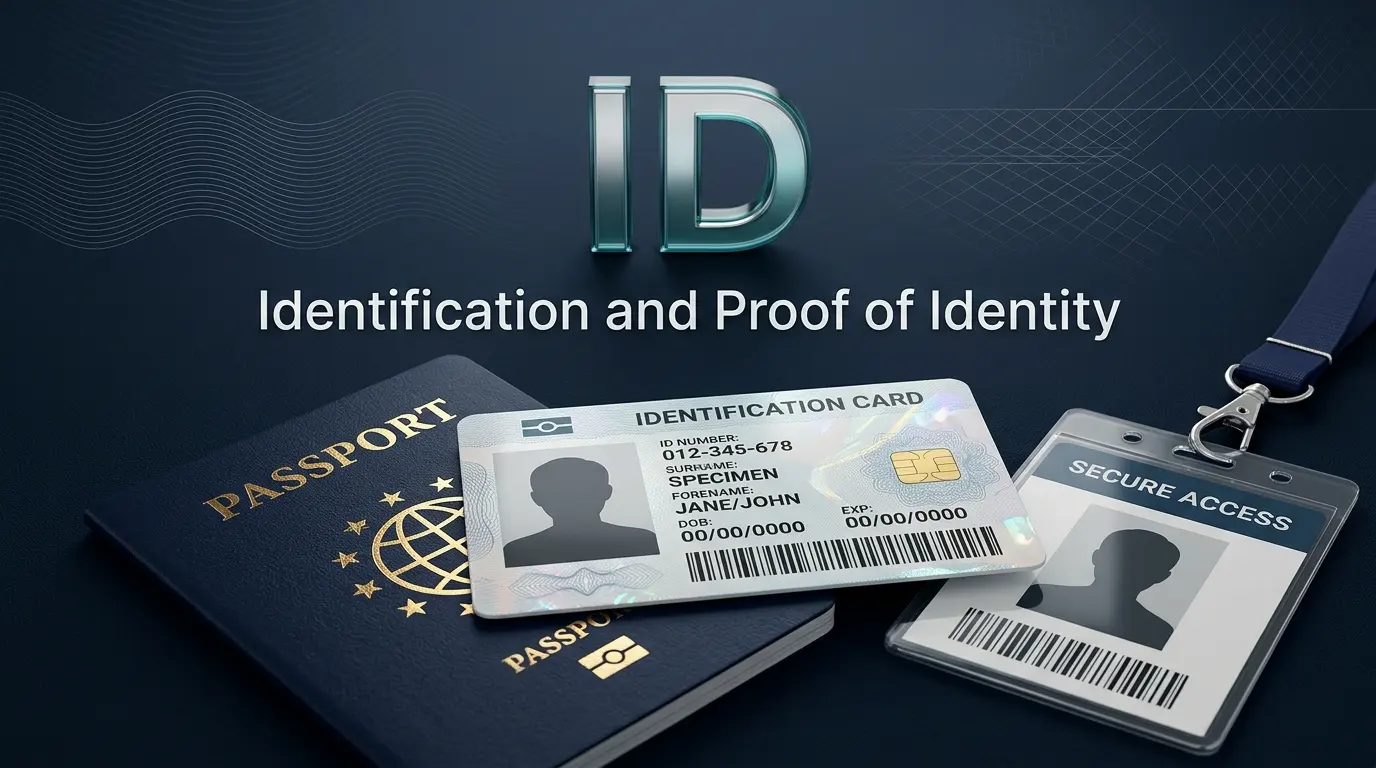
A synonym for ID depends on what “ID” means in your sentence. If it means identification, alternatives include identity document, identification card, and proof of identity. If it means identifying someone or something, alternatives include recognize, identify, label, and classify. The best choice depends on context.
Imagine filling out a form at a bank or checking in at a hotel. Someone asks you to show your ID. You might hear “identification” or “identity document” in a more formal conversation.
Learning a synonym for ID helps you express ideas more clearly. Students can improve essays, bloggers can avoid repetitive wording, and content writers can make their explanations easier to understand.
The abbreviation “ID” is common in daily English. It can refer to an identity document, identification, or a unique identifier in technology. Understanding its meaning helps you choose accurate alternatives.
When you search for a synonym for ID, remember that context matters. A driver’s license may serve as an ID, while a username or code may identify a digital account. These meanings need different words.
What Does “ID” Really Mean?
“ID” is a common abbreviation for identification. It usually refers to an official document or card that proves who someone is. It can also mean a code, number, or label used to recognize a person, object, or account.
For example, a passport can serve as an ID when you travel. A student number can identify you in a university database.
Part of Speech
- Noun: “Please show your ID at the entrance.”
- Verb: “The security officer will ID every visitor.” This informal verb means to check or establish someone’s identity.
- Abbreviation: ID is the shortened form of identification in everyday English.
Emotional Tone and Connotation
Connotation (the feeling or association a word creates beyond its literal meaning) helps explain how a word sounds in different situations.
- Positive tone: Words such as credential can suggest qualification, achievement, or professional standing.
- Negative tone: Terms such as surveillance identifier may sound intrusive when used in discussions about privacy.
- Neutral tone: Identification, identity document, and identifier are generally factual and straightforward.
The word “ID” itself is usually neutral. Its emotional effect depends on the situation. Showing ID at an airport is routine, while being repeatedly asked for identification can feel uncomfortable.
Etymology: Where Does “ID” Come From?
The abbreviation ID comes from identification. The shortened form “I.D.” is recorded from around 1955. The noun identification entered English in the 1640s through French, related to the verb identify.
A Brief History
- Old English (450–1100): The modern abbreviation ID was not used. English speakers relied on other words and descriptions to establish who someone was.
- Middle English (1100–1500): English vocabulary continued to develop through contact with French and Latin. The modern word identification had not yet appeared in its current form.
- Modern English (1500–present): Identification developed into a term for establishing identity. Later, ID became a convenient abbreviation, especially for cards and documents.
The psychological term id has a different origin. It comes from Latin id, meaning “it,” and became established in English psychoanalytic terminology in the 1920s. This meaning refers to an instinct-driven part of the mind, not an identity document.
Pronunciation (US and UK – IPA)
- US: /ˌaɪˈdiː/
- UK: /ˌaɪˈdiː/
Syllables
ID: I-D (two spoken letter names).
Affixation Pattern
- Root: The abbreviation comes from identification.
- Prefix: None.
- Suffix: None in the abbreviation ID.
- Word formation: Initial-letter abbreviation or shortening.
Synonyms List:
Unconscious Mind (Noun) — US: /ˌʌnˈkɑːn.ʃəs maɪnd/ | UK: /ˌʌnˈkɒn.ʃəs maɪnd/
Meaning: The part of the mental apparatus containing hidden thoughts, memories, and instinctual desires.
Tone/Register: Academic / Formal
Examples:
Her sudden outburst revealed deep feelings hidden within her unconscious mind.
Psychologists study dreams to understand the contents of the unconscious mind.
Instinctual Drive (Noun) — US: /ɪnˈstɪŋk.tʃu.əl draɪv/ | UK: /ɪnˈstɪŋk.tʃu.əl draɪv/
Meaning: An inborn biological impulse that motivates an organism toward specific actions.
Tone/Register: Scientific / Technical
Examples:
Survival depends on an instinctual drive to seek food and shelter.
The novel portrays a hero torn between social duty and instinctual drive.
Primal Urge (Noun) — US: /ˈpraɪ.məl ɝːdʒ/ | UK: /ˈpraɪ.məl ɜːdʒ/
Meaning: An ancient, fundamental desire for survival, dominance, or pleasure.
Tone/Register: Literary / Expressive
Examples:
Fear triggered a primal urge to run away from danger.
The artist painted with a primal urge that ignored traditional rules.
Animal Instinct (Noun) — US: /ˈæn.ə.məl ˈɪn.stɪŋkt/ | UK: /ˈæn.ɪ.məl ˈɪn.stɪŋkt/
Meaning: Raw physical intuition guided by basic survival mechanisms rather than reason.
Tone/Register: Informal / Conversational
Examples:
When the alarm sounded, his animal instinct took over immediately.
She trusted her animal instinct during the dangerous mountain hike.
Raw Impulse (Noun) — US: /rɑː ˈɪm.pʌls/ | UK: /rɔː ˈɪm.pʌls/
Meaning: A sudden, unthinking reaction or desire driven entirely by feeling.
Tone/Register: General / Casual
Examples:
Buying the expensive car was a moment of pure raw impulse.
He held back his raw impulse to shout during the argument.
Inner Self (Noun) — US: /ˈɪn.ɚ self/ | UK: /ˈɪn.ə self/
Meaning: A person’s true, private emotional nature hidden beneath public behavior.
Tone/Register: Personal / Reflective
Examples:
Journaling helped her connect with her genuine inner self.
His public persona was confident, but his inner self felt uncertain.
Subconscious (Noun) — US: /ˌsʌbˈkɑːn.ʃəs/ | UK: /ˌsʌbˈkɒn.ʃəs/
Meaning: The mental boundary layer operating just beneath active conscious awareness.
Tone/Register: Popular Psychology / General
Examples:
Certain odors trigger vivid memories stored in your subconscious.
His subconscious held onto fears from early childhood experiences.
Psyche (Noun) — US: /ˈsaɪ.ki/ | UK: /ˈsaɪ.ki/
Meaning: The totality of the human mind, including conscious and unconscious elements.
Tone/Register: Formal / Clinical
Examples:
Trauma leaves lasting marks on the human psyche.
The film explores the darker corners of the protagonist’s psyche.
Pleasure Principle (Noun) — US: /ˈpleʒ.ɚ ˌprɪn.sə.pəl/ | UK: /ˈpleʒ.ə ˌprɪn.sə.pəl/
Meaning: The instinctual seeking of gratification and immediate avoidance of pain.
Tone/Register: Academic / Psychoanalytic
Examples:
Infants operate purely on the pleasure principle without impulse control.
Maturity means moving past the pleasure principle toward reality.
Shadow Self (Noun) — US: /ˈʃæd.oʊ self/ | UK: /ˈʃæd.əʊ self/
Meaning: The repressed, unacknowledged, or darker aspects of one’s personality.
Tone/Register: Jungian / Literary
Examples:
Facing your shadow self requires intense honesty and courage.
The villain represents the shadow self of the main hero.
Baser Nature (Noun) — US: /ˈbeɪ.sɚ ˈneɪ.tʃɚ/ | UK: /ˈbeɪ.sə ˈneɪ.tʃə/
Meaning: The selfish or unsophisticated aspect of human character.
Tone/Register: Formal / Literary
Examples:
He fought against his baser nature to make the ethical choice.
Literature often contrasts high ideals with human baser nature.
Gut Feeling (Noun) — US: /ɡʌt ˈfiː.lɪŋ/ | UK: /ɡʌt ˈfiː.lɪŋ/
Meaning: An immediate intuitive reaction originating without conscious reasoning.
Tone/Register: Informal / Daily English
Examples:
My gut feeling told me to walk away from the business deal.
She made the choice based on a quick gut feeling.
Early Mind (Noun) — US: /ˈprɪm.ə.t̬ɪv maɪnd/ | UK: /ˈprɪm.ɪ.tɪv maɪnd/
Meaning: Evolutionary older brain functions responsible for immediate emotional responses.
Tone/Register: Educational / Scientific
Examples:
The early mind reacts quickly when a threat is detected.
Stress triggers the early mind into fight-or-flight mode.
Wild Impulse (Noun) — US: /waɪld ˈɪm.pʌls/ | UK: /waɪld ˈɪm.pʌls/
Meaning: An unpredictable or uninhibited surge of spontaneous motivation.
Tone/Register: Expressive / Narrative
Examples:
On a wild impulse, they booked plane tickets to Rome.
She checked her wild impulse to quit her job on the spot.
Primary Process (Noun) — US: /ˈpraɪ.mer.i ˈprɑː.ses/ | UK: /ˈpraɪ.mər.i ˈprəʊ.ses/
Meaning: Unconscious mental activity characterized by immediate pleasure-seeking.
Tone/Register: Specialized Psychoanalytic
Examples:
Dreams provide a clear window into primary process thinking.
Primary process thought ignores logic, time, and external reality.
Primary Process Thought (Noun) — US: /ˈpraɪ.mer.i ˈprɑː.ses θɑːt/ | UK: /ˈpraɪ.mər.i ˈprəʊ.ses θɔːt/
Meaning: The early, illogical mode of thinking characteristic of the unconscious mind.
Tone/Register: Academic / Clinical
Examples:
Dreams often display primary process thought through strange and illogical symbols.
Children rely heavily on primary process thought before developing formal reasoning.
Unfiltered Desire (Noun) — US: /ʌnˈfɪl.tɚd dɪˈzaɪɚ/ | UK: /ʌnˈfɪl.təd dɪˈzaɪə/
Meaning: A raw, direct longing that operates without social restraint or hesitation.
Tone/Register: Literary / Expressive
Examples:
His action was driven purely by unfiltered desire for victory.
She expressed her emotions with unfiltered desire during the performance.
Visceral Drive (Noun) — US: /ˈvɪs.ɚ.əl draɪv/ | UK: /ˈvɪs.ər.əl draɪv/
Meaning: An intense, deeply felt internal impulse originating from physical or emotional necessity.
Tone/Register: Formal / Descriptive
Examples:
A visceral drive to survive pushed the trapped hiker forward.
The novel captures the character’s visceral drive for justice.
Unconscious Impulse (Noun) — US: /ʌnˈkɑːn.ʃəs ˈɪm.pʌls/ | UK: /ʌnˈkɒn.ʃəs ˈɪm.pʌls/
Meaning: An involuntary mental urge that occurs without deliberate intent or awareness.
Tone/Register: Scientific / Educational
Examples:
Habitual actions often stem from a deeply rooted unconscious impulse.
She recognized an unconscious impulse to double-check the lock.
Early Instinct (Noun) — US: /ˈprɪm.ə.t̬ɪv ˈɪn.stɪŋkt/ | UK: /ˈprɪm.ɪ.tɪv ˈɪn.stɪŋkt/
Meaning: An evolutionary basic behavioral urge focused on survival, hunger, or self-defense.
Tone/Register: General / Scientific
Examples:
The loud noise awakened an early instinct to protect her family.
Animals rely on early instincts to navigate harsh winter environments.
Innate Need (Noun) — US: /ɪˈneɪt niːd/ | UK: /ɪˈneɪt niːd/
Meaning: An inborn biological or psychological requirement present from birth.
Tone/Register: Academic / General
Examples:
Human beings possess an innate need for social connection and belonging.
Curiosity is an innate need that drives learning across all ages.
Biological Imperative (Noun) — US: /ˌbaɪ.əˈlɑː.dʒɪ.kəl ɪmˈper.ə.t̬ɪv/ | UK: /ˌbaɪ.əˈlɒdʒ.ɪ.kəl ɪmˈper.ə.tɪv/
Meaning: A fundamental survival requirement dictated by evolutionary biology.
Tone/Register: Formal / Technical
Examples:
Reproduction represents a core biological imperative for every species.
Seeking shelter during storms fulfills an urgent biological imperative.
Internal Compulsion (Noun) — US: /ɪnˈtɝː.nəl kəmˈpʌl.ʃən/ | UK: /ɪnˈtɜː.nəl kəmˈpʌl.ʃən/
Meaning: An irresistible psychological urge forcing an individual toward a specific behavior.
Tone/Register: Clinical / Formal
Examples:
He felt an internal compulsion to clean his desk before starting work.
An internal compulsion drove the writer to finish the manuscript overnight.
Unconditioned Reflex (Noun) — US: /ˌʌn.kənˈdɪʃ.ənd ˈriː.fleks/ | UK: /ˌʌn.kənˈdɪʃ.ənd ˈriː.fleks/
Meaning: An automatic, unlearned response to a specific sensory stimulus.
Tone/Register: Scientific / Psychological
Examples:
Blinking when a flash occurs is a typical unconditioned reflex.
The test measures the patient’s unconditioned reflex to sudden contact.
Unrepressed Drive (Noun) — US: /ˌʌn.rɪˈprest draɪv/ | UK: /ˌʌn.rɪˈprest draɪv/
Meaning: An active psychological force that has not been held back by conscious control.
Tone/Register: Psychoanalytic / Academic
Examples:
His continuous restlessness pointed to an unrepressed drive for adventure.
The artwork shows the power of an unrepressed drive unleashed on canvas.
Natural Inclination (Noun) — US: /ˈnætʃ.ɚ.əl ˌɪn.kləˈneɪ.ʃən/ | UK: /ˈnætʃ.ər.əl ˌɪn.klɪˈneɪ.ʃən/
Meaning: An inherent preference or tendency to act or think in a certain way.
Tone/Register: Conversational / General
Examples:
Her natural inclination was to comfort anyone who seemed upset.
He followed his natural inclination toward mathematics from an early age.
Untamed Instinct (Noun) — US: /ʌnˈteɪmd ˈɪn.stɪŋkt/ | UK: /ʌnˈteɪmd ˈɪn.stɪŋkt/
Meaning: A wild, uncultivated inner impulse that ignores societal boundaries.
Tone/Register: Literary / Creative
Examples:
The runner drew strength from an untamed instinct during the final stretch.
Wilderness living calls upon an untamed instinct long hidden in modern life.
Subconscious Reflex (Noun) — US: /ˌsʌbˈkɑːn.ʃəs ˈriː.fleks/ | UK: /ˌsʌbˈkɒn.ʃəs ˈriː.fleks/
Meaning: An immediate physical or mental reaction occurring below active awareness.
Tone/Register: Popular Science / General
Examples:
Ducking under the low branch was a swift subconscious reflex.
His friendly smile acted as a subconscious reflex when meeting new clients.
Innate Impulse (Noun) — US: /ɪˈneɪt ˈɪm.pʌls/ | UK: /ɪˈneɪt ˈɪm.pʌls/
Meaning: A natural, unlearned internal trigger prompting immediate action.
Tone/Register: Formal / Educational
Examples:
She resisted the innate impulse to glance at her ringing phone.
Children act on innate impulse until they learn self-regulation.
Raw Passion (Noun) — US: /rɑː ˈpæʃ.ən/ | UK: /rɔː ˈpæʃ.ən/
Meaning: Intense, unrefined emotional energy focused on a subject or desire.
Tone/Register: Expressive / Informal
Examples:
The musician played with a raw passion that moved the entire audience.
Their debate displayed the raw passion both sides held for the project.
Instinctive Craving (Noun) — US: /ɪnˈstɪŋk.tɪv ˈkreɪ.vɪŋ/ | UK: /ɪnˈstɪŋk.tɪv ˈkreɪ.vɪŋ/
Meaning: A deep, natural urge for physical or emotional gratification.
Tone/Register: General / Casual
Examples:
Cold weather often brings an instinctive craving for warm food.
The solitary traveler felt an instinctive craving for quiet surroundings.
Elemental Drive (Noun) — US: /ˌel.əˈmen.t̬əl draɪv/ | UK: /ˌel.ɪˈmen.təl draɪv/
Meaning: A fundamental, basic force that powers human behavior at the simplest level.
Tone/Register: Literary / Philosophical
Examples:
Self-preservation remains the most elemental drive in living beings.
The poem explores the elemental drive toward creation and growth.
Instinctive Compulsion (Noun) — US: /ɪnˈstɪŋk.tɪv kəmˈpʌl.ʃən/ | UK: /ɪnˈstɪŋk.tɪv kəmˈpʌl.ʃən/
Meaning: An automatic, powerful internal force commanding immediate attention.
Tone/Register: Academic / Clinical
Examples:
An instinctive compulsion made him check the safety harness twice.
Migrating birds follow an instinctive compulsion across long distances.
Native Instinct (Noun) — US: /ˈneɪ.t̬ɪv ˈɪn.stɪŋkt/ | UK: /ˈneɪ.tɪv ˈɪn.stɪŋkt/
Meaning: An inborn ability or internal compass natural to a specific person or species.
Tone/Register: General / Formal
Examples:
Her native instinct for leadership showed during the crisis.
He relied on his native instinct when navigating the unfamiliar terrain.
Instinctive Urge (Noun) — US: /ɪnˈstɪŋk.tɪv ɝːdʒ/ | UK: /ɪnˈstɪŋk.tɪv ɜːdʒ/
Meaning: A spontaneous inner push toward a specific physical or mental action.
Tone/Register: Conversational / General
Examples:
He fought the instinctive urge to pull his hand back from the heat.
An instinctive urge prompted her to double-check the lock on the door.
Automatic Impulse (Noun) — US: /ˌɑː.t̬əˈmæt̬.ɪk ˈɪm.pʌls/ | UK: /ˌɔː.təˈmæt.ɪk ˈɪm.pʌls/
Meaning: A rapid, subconscious movement or decision made without premeditation.
Tone/Register: Technical / Scientific
Examples:
Swatting the flying insect was an automatic impulse.
An automatic impulse kept the driver alert during the foggy morning ride.
Primal Drive (Noun) — US: /ˈpraɪ.məl draɪv/ | UK: /ˈpraɪ.məl draɪv/
Meaning: An ancient biological motivation centered on survival, safety, or appetite.
Tone/Register: Educational / Expressive
Examples:
The documentary examined the primal drive behind animal territorial behavior.
Hunger is a primal drive that overrides secondary worries quickly.
Unconscious Desire (Noun) — US: /ʌnˈkɑːn.ʃəs dɪˈzaɪɚ/ | UK: /ʌnˈkɒn.ʃəs dɪˈzaɪə/
Meaning: A hidden yearning that influences behavior without conscious realization.
Tone/Register: Psychoanalytic / Academic
Examples:
Analysis revealed an unconscious desire for independence from his family business.
Her career choices reflected an unconscious desire to seek approval.
Wild Urge (Noun) — US: /waɪld ɝːdʒ/ | UK: /waɪld ɜːdʒ/
Meaning: A sudden, unrestrained longing to break routine or act spontaneously.
Tone/Register: Informal / Narrative
Examples:
A wild urge to take a road trip hit him on Friday evening.
She suppressed a wild urge to laugh aloud in the quiet hall.
Early Drive (Noun) — US: /ˈprɪm.ə.t̬ɪv draɪv/ | UK: /ˈprɪm.ɪ.tɪv draɪv/
Meaning: A basic psychological force inherited from early evolutionary development.
Tone/Register: Scientific / Historical
Examples:
The fight-or-flight response is governed by an early drive.
Early human survival depended heavily on this early drive.
Unfiltered Impulse (Noun) — US: /ʌnˈfɪl.tɚd ˈɪm.pʌls/ | UK: /ʌnˈfɪl.təd ˈɪm.pʌls/
Meaning: A sudden urge expressed immediately without social editing or hesitation.
Tone/Register: Expressive / Casual
Examples:
Blurted out in frustration, his words came from an unfiltered impulse.
She bought the painting on an unfiltered impulse during her vacation.
Basic Instinct (Noun) — US: /ˈbeɪ.sɪk ˈɪn.stɪŋkt/ | UK: /ˈbeɪ.sɪk ˈɪn.stɪŋkt/
Meaning: A fundamental, widespread inner drive common to human nature.
Tone/Register: Daily English / Popular Culture
Examples:
Protecting one’s offspring is a basic instinct across nature.
His basic instinct warned him that the situation was unsafe.
Internal Motivation (Noun) — US: /ɪnˈtɝː.nəl ˌmoʊ.t̬əˈveɪ.ʃən/ | UK: /ɪnˈtɜː.nəl ˌməʊ.tɪˈveɪ.ʃən/
Meaning: A personal drive arising from internal satisfaction rather than external rewards.
Tone/Register: Professional / Educational
Examples:
High internal motivation drives her to practice the piano daily.
Students show better persistence when guided by internal motivation.
Raw Appetite (Noun) — US: /rɑː ˈæp.ə.taɪt/ | UK: /rɔː ˈæp.ɪ.taɪt/
Meaning: An unrefined, direct hunger or desire for physical or material fulfillment.
Tone/Register: Informal / Descriptive
Examples:
The long mountain hike created a raw appetite for a hot meal.
The investor showed a raw appetite for high-risk opportunities.
Instinctive Reflex (Noun) — US: /ɪnˈstɪŋk.tɪv ˈriː.fleks/ | UK: /ɪnˈstɪŋk.tɪv ˈriː.fleks/
Meaning: An unlearned physical reaction performed instantly in response to stimuli.
Tone/Register: Scientific / General
Examples:
Catching the falling glass was an instinctive reflex.
Her hand moved back from the stove by instinctive reflex.
Subconscious Drive (Noun) — US: /ˌsʌbˈkɑːn.ʃəs draɪv/ | UK: /ˌsʌbˈkɒn.ʃəs draɪv/
Meaning: An underlying psychological force steering choices without direct awareness.
Tone/Register: General Psychology / Writing
Examples:
A subconscious drive for perfection caused him to redo the report.
Her subconscious drive toward art was obvious from childhood sketches.
Fundamental Urge (Noun) — US: /ˌfʌn.dəˈmen.t̬əl ɝːdʒ/ | UK: /ˌfʌn.dəˈmen.təl ɜːdʒ/
Meaning: A foundational emotional or physical need central to human behavior.
Tone/Register: Academic / Philosophical
Examples:
Seeking safety is a fundamental urge present in every living creature.
The author writes about the fundamental urge to communicate.
Visceral Impulse (Noun) — US: /ˈvɪs.ɚ.əl ˈɪm.pʌls/ | UK: /ˈvɪs.ər.əl ˈɪm.pʌls/
Meaning: An immediate, bodily feeling that demands quick physical or verbal response.
Tone/Register: Literary / Descriptive
Examples:
He stepped back from the ledge on a visceral impulse.
A visceral impulse made her gasp when the news broke.
Primary Instinct (Noun) — US: /ˈpraɪ.mer.i ˈɪn.stɪŋkt/ | UK: /ˈpraɪ.mər.i ˈɪn.stɪŋkt/
Meaning: The most important biological or psychological urge guiding basic choices.
Tone/Register: Scientific / Academic
Examples:
Finding clean water remains a primary instinct in wilderness survival.
Self-defense acts as a primary instinct when threatened directly.
Innate Drive (Noun) — US: /ɪˈneɪt draɪv/ | UK: /ɪˈneɪt draɪv/
Meaning: An inherited psychological push toward growth, survival, or action.
Tone/Register: Educational / Professional
Examples:
Her innate drive for excellence earned her top recognition.
Humans possess an innate drive to explore unknown places.
Instinctive Need (Noun) — US: /ɪnˈstɪŋk.tɪv niːd/ | UK: /ɪnˈstɪŋk.tɪv niːd/
Meaning: An unlearned psychological or biological necessity driving human action.
Tone/Register: General / Educational
Examples:
Safety is an instinctive need during times of unexpected change.
The animal responded to an instinctive need to find a safe resting spot.
Unconscious Motivation (Noun) — US: /ʌnˈkɑːn.ʃəs ˌmoʊ.t̬əˈveɪ.ʃən/ | UK: /ʌnˈkɒn.ʃəs ˌməʊ.tɪˈveɪ.ʃən/
Meaning: An unseen inner reason or force behind a person’s behavior.
Tone/Register: Clinical / Psychoanalytic
Examples:
Therapy helps individuals understand their unconscious motivation.
Unconscious motivation often explains unexpected personal habits.
Untamed Impulse (Noun) — US: /ʌnˈteɪmd ˈɪm.pʌls/ | UK: /ʌnˈteɪmd ˈɪm.pʌls/
Meaning: A wild, unguided urge that operates outside deliberate mental control.
Tone/Register: Expressive / Narrative
Examples:
The protagonist acted on an untamed impulse to escape the town.
He managed his anger before it turned into an untamed impulse.
Primal Instinct (Noun) — US: /ˈpraɪ.məl ˈɪn.stɪŋkt/ | UK: /ˈpraɪ.məl ˈɪn.stɪŋkt/
Meaning: An ancient biological response linked directly to core self-preservation.
Tone/Register: General / Descriptive
Examples:
When the fire alarm rang, primal instinct directed everyone to the exit.
The movie shows characters relying on primal instinct in deep waters.
Visceral Craving (Noun) — US: /ˈvɪs.ɚ.əl ˈkreɪ.vɪŋ/ | UK: /ˈvɪs.ər.əl ˈkreɪ.vɪŋ/
Meaning: A deep, physical sensation of intense desire for something vital or comforting.
Tone/Register: Expressive / Literary
Examples:
After the grueling workout, he felt a visceral craving for rest.
The homesick traveler had a visceral craving for familiar surroundings.
Synonyms for ID by Tone
Not every alternative fits every situation. Choose words based on the setting, the purpose of the document, and the level of formality.
Positive or Professional
These words can sound official, reliable, or qualification-focused:
- Credential — highlights authority, qualification, or permission.
- Passport — suggests an official travel document.
- Identification card — clear and suitable for formal situations.
- Security pass — emphasizes authorized access.
Neutral
These alternatives communicate identity without adding much emotional meaning:
- Identification
- Identity document
- Identity card
- Photo ID
- Proof of identity
- Identification number
- ID number
- Identifier
- Unique code
- Reference number
Negative or Sensitive Contexts
These expressions can feel intrusive when the discussion concerns privacy or monitoring:
- Tracking identifier — a code used to follow activity or records.
- Surveillance identifier — an identifier used in monitoring contexts.
- Personal identifier — information that can distinguish an individual and may raise privacy concerns.
These terms are not inherently negative. Their tone depends on how and why the information is collected.
Playful or Informal
- ID — the most common casual alternative to identification.
- ID card — a short, familiar expression.
- Badge — convenient in workplace or event conversations, although it may refer to a particular type of identification item.
Why Tone Matters
A phrase that sounds natural in conversation may be too casual for a legal document. Similarly, a technical term can confuse readers who simply need to know which card to bring.
Use everyday wording for everyday situations. Choose precise, formal terminology for official documents and professional writing.
“ID” vs. Close Alternatives
| Word or phrase | Main difference | Best use |
|---|---|---|
| ID | Short, general term for identification or an identity document | Everyday conversation |
| Identification | Emphasizes the process or evidence of establishing identity | Formal instructions and applications |
| Identity document | Specifically refers to a document proving identity | Travel and administration |
| Identifier | Refers to a label, number, or code that distinguishes something | Databases and technology |
For example, “Bring your ID” is natural in conversation. “Submit an identity document” is more formal. “Enter your identifier” is appropriate when a computer system requests a code.
The expressions are related, but they are not always interchangeable.
English meaning – Cambridge Dictionary
+2
How “ID” Changes by Context
Daily Conversation
People often say “ID” because it is short and immediately understood. At a reception desk, you might hear, “Could I see your ID?”
You can replace it with “identification” when you want a slightly more formal tone. For example, “Please bring identification to your appointment.”
Writing and Blogging
Writers should explain abbreviations when readers may not know them. On first use, write “identification (ID)” and use “ID” afterward.
For an article about travel, passport or identity document may be more precise. For a technology article, identifier or ID number may better match the subject.
Professional and Academic Writing
Formal writing benefits from precise terms. Use proof of identity when describing a verification requirement. Use identification number when discussing a numbered record.
Avoid replacing every instance of “ID” with the same alternative. Repetition can make writing sound unnatural, but inaccurate synonyms can confuse the reader.
Creative and Informal Use
In dialogue, characters can naturally say “Show me your ID” or “I forgot my badge.” These expressions sound more conversational than “Please present your identification document.”
In a story, choose the term that matches the character and setting. A security guard, a university student, and a software developer may use different words for different purposes.
Common Mistakes Learners Make
1. Treating Every Alternative as Identical
A passport is a specific document, while identification is a broader concept. An identifier may be a code rather than a physical object.
Better approach: Identify what the word refers to before choosing a replacement.
2. Using “Credential” for Every ID
Credentials can establish identity, but they can also demonstrate qualifications or permissions. A teaching certificate is a credential, yet it is not necessarily an identity card.
Better approach: Use credential when authority, qualification, or access is relevant.
3. Confusing an ID Number With a Reference Number
An ID number identifies a person, account, or record. A reference number often helps locate a particular request or transaction.
Better approach: Follow the terminology used by the relevant organization or system.
4. Making Formal Writing Sound Unnecessarily Complicated
“Please present your identification document” is appropriate in some official contexts. In everyday conversation, “Please show your ID” is usually clearer.
Better approach: Match the wording to the audience and situation.
5. Confusing “ID” With the Psychological Term “Id”
Capitalization and context matter. “Please show your ID” refers to identification. “The id seeks immediate satisfaction” refers to a concept in psychoanalysis.
Better approach: Check the sentence’s subject and meaning before selecting a synonym.
Register Notes
- Formal: Proof of identity, identity document, identification papers.
- Informal: ID, ID card, photo ID.
- Technical: Identifier, unique code, identification number.
- Professional: Credential, security pass, employee badge.
For related vocabulary, you can also explore articles about synonyms for identity, verification, and credential.
Real-Life Examples Using ID
Workplace
A new employee arrives at the office. The receptionist asks to see an ID card before issuing a security pass. Each item has a distinct purpose: one establishes identity, while the other permits access.
Social Situations
A guest arrives at a private event. The organizer checks the guest list and requests photo ID. In casual conversation, both people are likely to use the shorter expression “ID.”
Media and Pop Culture
A crime drama may show a detective examining identification papers. A modern technology series might instead discuss a digital identifier linked to a user profile.
Writing and Storytelling
A blogger writing about international travel might use passport when discussing border checks. An article about account security might use unique identifier instead. Both choices are more precise than repeating “ID” in every sentence.
Interactive Practice Quiz
Choose the best answer for each situation. The questions test meaning, tone, and context.
1. A hotel receptionist asks you to prove who you are. Which term is the most natural?
A. Unique code
B. ID
C. Reference number
2. Which phrase specifically describes an official document proving identity?
A. Identity document
B. Access card
C. Tracking identifier
3. A database distinguishes each customer from every other customer. What does it use?
A. Passport
B. Membership card
C. Identifier
4. Which term is most appropriate for a document that permits international travel?
A. Passport
B. Employee badge
C. Reference number
5. A visitor needs permission to enter a restricted office. Which item is most relevant?
A. Proof of identity
B. Security pass
C. Student ID
6. Which phrase is best for a formal request to establish who an applicant is?
A. Proof of identity
B. Badge
C. Unique code
7. A university student wants to borrow a library book using a campus card. Which term fits?
A. Student ID
B. Surveillance identifier
C. Reference number
8. A customer needs a code to locate a submitted support request. Which term fits best?
A. Identity card
B. Reference number
C. Passport
9. Which term can refer to proof of professional qualifications or permission?
A. Credential
B. Photo ID
C. Identity papers
10. A form asks for a number assigned to identify a particular record. What should you enter?
A. Identification number
B. Security pass
C. Identity document
Answer Key: 1-B, 2-A, 3-C, 4-A, 5-B, 6-A, 7-A, 8-B, 9-A, 10-A
Reflection Task
Write two short sentences using different alternatives for “ID.” Use one term in a daily conversation and another in a formal or technical context. Explain why each term fits.
Conclusion
Choosing the right synonym for ID makes your English more precise and natural. Words such as identification, identity document, and identifier each serve a different purpose.
For students, bloggers, and content writers, learning these alternatives helps reduce repetition. It also improves clarity in essays, articles, emails, and everyday conversations.
Remember that context matters more than the number of synonyms you know. A passport, a security pass, and a digital identifier are related, but they are not interchangeable.
Keep practicing by using these words in your own sentences. Try them in an email, a short paragraph, or a daily conversation to build confidence and strengthen your vocabulary.
FAQs
1. What is the best synonym for ID in formal writing?
The best formal alternative is usually identification, identity document, or proof of identity. Choose identification when discussing the process of confirming someone’s identity. Use identity document for an official document and proof of identity when emphasizing evidence. The most accurate choice depends on the sentence and the document’s purpose.
2. Is an ID the same as an identity document?
Not always. An ID is a broad, everyday term that often refers to an identity document, such as a passport or identity card. However, ID can also refer to a number or code that identifies a record or account. An identity document specifically means a document used to establish a person’s identity.
3. What is another word for ID number?
Common alternatives include identification number, identifier, and, in certain situations, reference number. An identification number identifies a person or record. An identifier can be a number, name, or code. A reference number usually helps locate a particular application, transaction, or request. Use the term that matches the system’s purpose.
4. What is the difference between ID and verification?
ID usually refers to identification or the document used to establish identity. Verification is the process of checking whether information is genuine or correct. For example, a passport can be used as ID, while checking the passport’s details is part of identity verification. The terms are related, but they describe different things.
5. What is a synonym for ID in computer programming?
In programming, identifier is often the most suitable alternative. It refers to a name used to distinguish a variable, function, object, or other element. Depending on the system, ID number, unique identifier, or key may also fit. However, a key can have a specific technical role, so these terms should not be treated as identical.
6. What does ID mean in psychology?
In psychology, particularly Freudian psychoanalysis, the id is the instinct-driven part of the mind associated with basic desires and immediate gratification. It differs from “ID,” the common abbreviation for identification. The intended meaning becomes clear from context: identity documents belong to everyday administration, while the id belongs to psychological theory.
7. Can I use passport as a synonym for ID?
Yes, when the ID in question is an identity document, and the passport is accepted for that purpose. However, a passport is more specific than ID. A student card, national identity card, or driver’s license may also serve as identification in suitable circumstances. Always consider the requirements of the organization requesting the document.
External Source
For reliable definitions, pronunciation, and examples, consult the Cambridge Dictionary entry for ID. It explains the difference between the identification abbreviation and the psychological term.

I’m Hezel, a passionate English language enthusiast and the creator of Synworda.com. I love exploring synonyms, vocabulary, grammar, and the many ways words can make communication clearer and more effective. Through Synworda.com, I create simple, practical, and easy-to-understand content for students, writers, professionals, and anyone who wants to improve their English. I enjoy breaking down confusing words and grammar concepts into helpful explanations with clear examples. I aim to make learning English feel less complicated and more enjoyable. I believe that understanding the right words can help everyone communicate with confidence in everyday life.